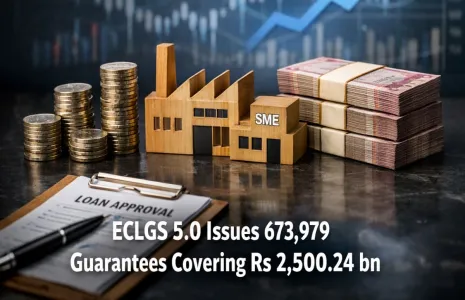
Banks Sanction Rs 600 bn Under ECLGS 5.0 as MSME Demand Surges
ECONOMY & POLICY

Banks Sanction Rs 600 bn Under ECLGS 5.0 as MSME Demand Surges

Banks have sanctioned more than Rs 600 billion (Rs 600 bn) under the Emergency Credit Line Guarantee Scheme 5.0 during the April–June quarter of FY27 as lenders stepped up support for sectors affected by disruptions linked to the West Asia conflict. Launched in May, the scheme targets stressed sectors including micro, small and medium enterprises, exporters, logistics, manufacturing and aviation. The bulk of guarantees has flowed to MSMEs.

Punjab National Bank emerged as the largest lender in the quarter, disbursing an exact Rs 123.45 billion (Rs 123.45 bn), and said it had been eligible to disburse up to Rs 300 billion and received about 20,000 applications. Canara Bank reported sanctions of roughly Rs 70 bn and indicated scope to disburse up to Rs 200 bn under the programme. The State Bank of India and Bank of Baroda had not disclosed figures but management commentary pointed to healthy demand.

Among private lenders, HDFC Bank sanctioned about Rs 140 bn and Axis Bank disbursed around Rs 100 bn during the quarter, while Kotak Mahindra Bank sanctioned about Rs 30 bn. ICICI Bank and Yes Bank did not disclose their ECLGS 5.0 figures. Bank commentary suggested that public sector banks led the initial rollout, with private lenders also registering strong traction as existing borrowers tapped the government?backed credit line.

Mid-sized lenders also reported healthy uptake: Indian Bank sanctioned about Rs 50 bn, Central Bank of India around Rs 45 bn and Indian Overseas Bank about Rs 26 bn. Among smaller private banks, Federal Bank sanctioned roughly Rs 20 bn, RBL Bank disbursed about Rs 2 bn and Karur Vysya Bank sanctioned close to Rs 750 million (Rs 750 mn). Demand for the scheme appears sustained as lenders process applications and support recovery in affected sectors.

Banks have sanctioned more than Rs 600 billion (Rs 600 bn) under the Emergency Credit Line Guarantee Scheme 5.0 during the April–June quarter of FY27 as lenders stepped up support for sectors affected by disruptions linked to the West Asia conflict. Launched in May, the scheme targets stressed sectors including micro, small and medium enterprises, exporters, logistics, manufacturing and aviation. The bulk of guarantees has flowed to MSMEs. Punjab National Bank emerged as the largest lender in the quarter, disbursing an exact Rs 123.45 billion (Rs 123.45 bn), and said it had been eligible to disburse up to Rs 300 billion and received about 20,000 applications. Canara Bank reported sanctions of roughly Rs 70 bn and indicated scope to disburse up to Rs 200 bn under the programme. The State Bank of India and Bank of Baroda had not disclosed figures but management commentary pointed to healthy demand. Among private lenders, HDFC Bank sanctioned about Rs 140 bn and Axis Bank disbursed around Rs 100 bn during the quarter, while Kotak Mahindra Bank sanctioned about Rs 30 bn. ICICI Bank and Yes Bank did not disclose their ECLGS 5.0 figures. Bank commentary suggested that public sector banks led the initial rollout, with private lenders also registering strong traction as existing borrowers tapped the government?backed credit line. Mid-sized lenders also reported healthy uptake: Indian Bank sanctioned about Rs 50 bn, Central Bank of India around Rs 45 bn and Indian Overseas Bank about Rs 26 bn. Among smaller private banks, Federal Bank sanctioned roughly Rs 20 bn, RBL Bank disbursed about Rs 2 bn and Karur Vysya Bank sanctioned close to Rs 750 million (Rs 750 mn). Demand for the scheme appears sustained as lenders process applications and support recovery in affected sectors.

Related Stories

Gold Stories

Next Story
Real Estate

A Concrete Statement in Jubilee Hills

The Jubilee Hills residence is an exploration of structure as architecture, where mathematical precision, exposed concrete, and engineering discipline come together to create a bold and enduring built form.Constructed with Blushfarbe, HAACE’s bespoke concrete finish, the project demanded exceptional control, as every visible structural element was also required to perform as the final architectural surface. Deep reinforced concrete roof frames extend into the vertical façade, while precision-cast fluted surfaces, rhythmic vertical fins, circular columns, and a cantilevered staircase create ..

Next Story
Infrastructure Energy

Hindustan Zinc raises renewable power share to 22 per cent

Hindustan Zinc has increased the share of renewable energy in its overall power consumption to 22 per cent, up from around 18 per cent in FY26, as it advances towards sourcing 70 per cent of its power requirements from renewable sources by FY28.During FY26, the company generated 892 million units of green power, up from 632 million units in FY25. It has also expanded its round-the-clock renewable power arrangement with Serentica Renewables from 450 MW to 530 MW to support the transition.Hindustan Zinc is strengthening its renewable energy portfolio through solar, wind and energy storage soluti..

Next Story
Resources

Crompton unveils new brand identity and super-premium platform

Crompton Greaves Consumer Electricals Ltd. has unveiled a new master brand identity as part of its Crompton 2.0 transformation, alongside the launch of its super-premium brand Crompton Rhion and the strengthening of its Energion platform.The refreshed identity introduces Cephyr, a new emblem inspired by sapphire and Zephyrus, the Greek wind, representing Crompton’s evolution towards a design-led, consumer-centric brand. The new brand promise, ‘Amazing, Every Day’, is supported by a new sonic identity that will be rolled out across advertising, digital platforms, products and retail envir..

Advertisement

Subscribe to Our Newsletter

Get daily newsletters around different themes from Construction world.

STAY CONNECTED

Advertisement