Chandigarh Proposes Uniform FAR of 2 for Industrial Buildings
ECONOMY & POLICY

Chandigarh Proposes Uniform FAR of 2 for Industrial Buildings

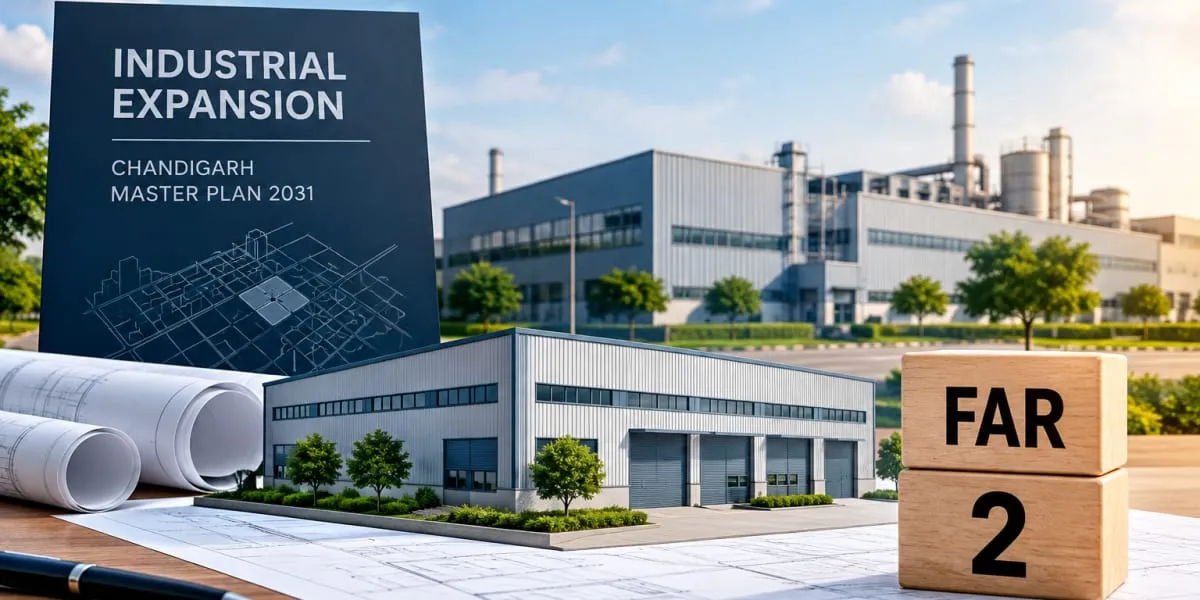
Industrial establishments in Chandigarh’s Phase 3 could receive greater construction space for expansion and modernisation under a proposal to fix the floor area ratio (FAR) for industrial buildings at 2, regardless of plot size. The proposal was discussed by the Chandigarh Heritage Committee and covers buildings governed by both architectural controls and zoning parameters.

The proposed change forms part of amendments being considered to the Chandigarh Master Plan 2031. If approved, it would replace the existing plot-size-linked approach with a uniform FAR of 2, allowing industrial units to make better use of their premises while remaining subject to applicable planning and architectural restrictions.

The proposal was discussed at a meeting chaired by chief secretary H Rajesh Prasad. Finance secretary-cum-secretary, urban planning, Diprava Lakra presented details of the proposed changes and their implications for different parts of the city.

The administration also examined the wider impact of the amendments on Phase 3, which includes Sectors 48 to 56, Sector 61 and Sector 63. Officials have been considering ways to simplify planning provisions, reduce procedural difficulties and provide greater clarity to property owners and other stakeholders as industrial and commercial requirements change.

No amendments have been proposed for Phase 1, covering Sectors 1 to 30. In Phase 2, covering Sector 31 to 47-B, stilt parking would be permitted only in government flats yet to be constructed. The restrictions are intended to protect Chandigarh’s heritage character and original planning principles while allowing development-related regulations to become more responsive.

The committee also reviewed existing planning provisions and suggestions from stakeholders, focusing on public convenience, ease of doing business and planned growth. The chief secretary said the planning framework needed to evolve while preserving the city’s architectural and heritage identity, and that development and conservation should complement each other. The amendments have undergone public consultation and Screening Committee scrutiny. Committee approval would allow them to be placed before the UT administrator for consideration by the competent authority.

Industrial establishments in Chandigarh’s Phase 3 could receive greater construction space for expansion and modernisation under a proposal to fix the floor area ratio (FAR) for industrial buildings at 2, regardless of plot size. The proposal was discussed by the Chandigarh Heritage Committee and covers buildings governed by both architectural controls and zoning parameters. The proposed change forms part of amendments being considered to the Chandigarh Master Plan 2031. If approved, it would replace the existing plot-size-linked approach with a uniform FAR of 2, allowing industrial units to make better use of their premises while remaining subject to applicable planning and architectural restrictions. The proposal was discussed at a meeting chaired by chief secretary H Rajesh Prasad. Finance secretary-cum-secretary, urban planning, Diprava Lakra presented details of the proposed changes and their implications for different parts of the city. The administration also examined the wider impact of the amendments on Phase 3, which includes Sectors 48 to 56, Sector 61 and Sector 63. Officials have been considering ways to simplify planning provisions, reduce procedural difficulties and provide greater clarity to property owners and other stakeholders as industrial and commercial requirements change. No amendments have been proposed for Phase 1, covering Sectors 1 to 30. In Phase 2, covering Sector 31 to 47-B, stilt parking would be permitted only in government flats yet to be constructed. The restrictions are intended to protect Chandigarh’s heritage character and original planning principles while allowing development-related regulations to become more responsive. The committee also reviewed existing planning provisions and suggestions from stakeholders, focusing on public convenience, ease of doing business and planned growth. The chief secretary said the planning framework needed to evolve while preserving the city’s architectural and heritage identity, and that development and conservation should complement each other. The amendments have undergone public consultation and Screening Committee scrutiny. Committee approval would allow them to be placed before the UT administrator for consideration by the competent authority.

Related Stories

Gold Stories

Next Story
Building Material

From Rough to Refined: How Modern Plastering Is Changing Wall Finishes

When Rohan first walked into his newly constructed home, he imagined what it would become—a warm living room, a bright bedroom, and walls smooth enough to complement his carefully chosen interiors.But there was one problem.The walls didn't look anything like the finished home he had imagined.They were uneven in places, rough to the touch, and covered with visible patches and minor surface imperfections. Rohan initially thought paint would fix everything.His contractor had a different answer.“Before the paint, we need to get the plastering right.”That conversation made Rohan realise somet..

Next Story
Infrastructure Urban

Embraer to Acquire 51 Per Cent Stake in Mahindra Aerospace Arm

Brazilian aerospace major Embraer will acquire a 51 per cent equity stake in Novavayu Aerospace, a step-down subsidiary of Mahindra and Mahindra, under an Investment Agreement notified by the automobile company in an exchange filing. The transaction will give Embraer control of the aerospace business. Following completion of the acquisition, Novavayu Aerospace will cease to be a wholly owned subsidiary and become an associate of Mahindra Defence Systems, which is a step-down wholly owned subsidiary of Mahindra and Mahindra. The agreement is expected to be completed on or before December 1. Mah..

Next Story
Infrastructure Urban

RBI Opens Special Dollar Window for Three State-Run OMCs

The Reserve Bank of India (RBI) has opened a special facility to meet the entire daily US dollar requirements of three public sector oil marketing companies (OMCs), in a move aimed at easing pressure on the Indian rupee. The facility will take effect on October 12, 2026, and remain available until further notice. Indian Oil Corporation, Hindustan Petroleum Corporation and Bharat Petroleum Corporation are eligible to use the arrangement. Under the facility, the RBI will sell US dollars to the three companies through designated banks, allowing them to meet their oil-import payments without sourc..

Advertisement

Subscribe to Our Newsletter

Get daily newsletters around different themes from Construction world.

STAY CONNECTED

Advertisement

SPECIAL OFFER
QR Code