+
CAQM Orders Stricter Particulate Emission Norms for Delhi-NCR
ECONOMY & POLICY

CAQM Orders Stricter Particulate Emission Norms for Delhi-NCR

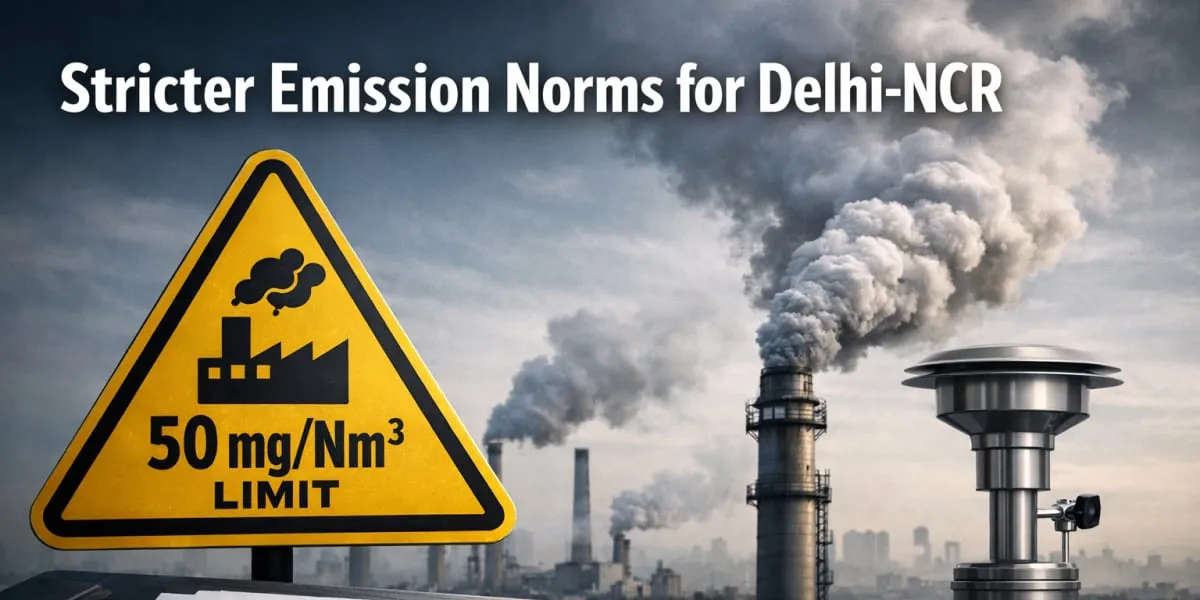
The Commission for Air Quality Management in NCR and Adjoining Areas issued Statutory Direction number 98 on Saturday proposing a uniform particulate matter emission standard of 50 milligrams per normal cubic metre (mg/Nm³) for identified industries across Delhi-NCR. The Commission referred to recommendations of the Central Pollution Control Board based on studies by the Indian Institute of Technology Kanpur and to a technical committee report and concluded that the 50 mg/Nm³ standard is technically achievable and environmentally necessary. The revision is expected to reduce industrial emissions and aid abatement of air pollution in the region.

The direction sets the limit at 50 mg/Nm³ for 17 categories of highly polluting industries identified by the Central Pollution Control Board, red category medium and large air polluting industries, food and food processing units, textile industries with boilers or thermic fluid heaters and metal industries with furnaces in Delhi-NCR. It exempts units for which a lower particulate matter emission standard is already prescribed under any applicable consent, direction or statutory provision. Compliance for large and medium industries is effective from August first, 2026 and for remaining industries from October first, 2026.

Industrial stack emissions are a significant source of elevated particulate matter in Delhi-NCR and contribute to secondary particulate formation that harms regional air quality. Since its inception the Commission has implemented measures such as mandatory transition to cleaner fuels, emission standards for biomass and other fuel based boilers and furnaces and issuance of approved fuel lists through statutory directions. The revised standard together with these measures is intended to deliver health and environmental benefits for populations near industrial sources.

The Commission has directed the respective National Capital Region state governments, the Government of National Capital Territory of Delhi, the pollution control boards of Haryana, Uttar Pradesh and Rajasthan and the Delhi Pollution Control Committee to ensure effective implementation and adherence to the prescribed timelines for compliance. They have also been instructed to undertake intensive information, education and communication activities to sensitise stakeholders and support compliance.

The Commission for Air Quality Management in NCR and Adjoining Areas issued Statutory Direction number 98 on Saturday proposing a uniform particulate matter emission standard of 50 milligrams per normal cubic metre (mg/Nm³) for identified industries across Delhi-NCR. The Commission referred to recommendations of the Central Pollution Control Board based on studies by the Indian Institute of Technology Kanpur and to a technical committee report and concluded that the 50 mg/Nm³ standard is technically achievable and environmentally necessary. The revision is expected to reduce industrial emissions and aid abatement of air pollution in the region. The direction sets the limit at 50 mg/Nm³ for 17 categories of highly polluting industries identified by the Central Pollution Control Board, red category medium and large air polluting industries, food and food processing units, textile industries with boilers or thermic fluid heaters and metal industries with furnaces in Delhi-NCR. It exempts units for which a lower particulate matter emission standard is already prescribed under any applicable consent, direction or statutory provision. Compliance for large and medium industries is effective from August first, 2026 and for remaining industries from October first, 2026. Industrial stack emissions are a significant source of elevated particulate matter in Delhi-NCR and contribute to secondary particulate formation that harms regional air quality. Since its inception the Commission has implemented measures such as mandatory transition to cleaner fuels, emission standards for biomass and other fuel based boilers and furnaces and issuance of approved fuel lists through statutory directions. The revised standard together with these measures is intended to deliver health and environmental benefits for populations near industrial sources. The Commission has directed the respective National Capital Region state governments, the Government of National Capital Territory of Delhi, the pollution control boards of Haryana, Uttar Pradesh and Rajasthan and the Delhi Pollution Control Committee to ensure effective implementation and adherence to the prescribed timelines for compliance. They have also been instructed to undertake intensive information, education and communication activities to sensitise stakeholders and support compliance.

Next Story
Equipment

Kabelschlepp India Installs Robotic VMC in Bengaluru

Kabelschlepp India, part of the Tsubaki Group, has installed a state-of-the-art Vertical Machining Center (VMC) integrated with robotic automation at its Bengaluru facility. The inauguration was held in the presence of Henning Preis, President & CEO, Kabelschlepp Group, Jörg Schulz, Vice President – Production, and Srinivas P. Kamisetty, Managing Director, Kabelschlepp India.The high-precision CNC VMC is designed for advanced milling, drilling, tapping and multi-axis machining. Equipped with a vertical spindle orientation, automatic tool changer and intelligent CNC control system, it en..

Next Story
Infrastructure Transport

Highway Delivery Reset!

Project delays and inefficiencies continue to bedevil the progress of India’s National Highways network. A multi-pronged reform agenda is needed to inject greater transparency and accountability at every stage – from planning and procurement to execution, maintenance and oversight. This article offers key recommendations and reform strategies that government stakeholders – from the Ministry of Road Transport & Highways (MoRTH) and the National Highways Authority of India (NHAI) to state agencies and oversight bodies – should pursue to put highway development on a better track.Decen..

Next Story
Infrastructure Transport

MSIDC Executes ₹37,000 Crore Road Programme

With Rs 37,000 crore worth of road projects under execution across Maharashtra, Maharashtra State Infrastructure Development Corporation (MSIDC) is driving one of the state’s largest infrastructure programmes. Dr Brijesh Dixit, Managing Director, discusses the institutional reforms, execution frameworks, financing strategies and technology adoption enabling timely, high-quality delivery, in conversation with PRATAP PADODE, Editor-in-Chief, CW.With over Rs 37,000 crore worth of road projects underway across districts – many under tight timelines – what institutional and executio..

Advertisement

Subscribe to Our Newsletter

Get daily newsletters around different themes from Construction world.

STAY CONNECTED

Advertisement

Advertisement

Advertisement

Open In App