CEC Gyanesh Kumar Addresses UI, Assumes IDEA Council Chairship
ECONOMY & POLICY

CEC Gyanesh Kumar Addresses UI, Assumes IDEA Council Chairship

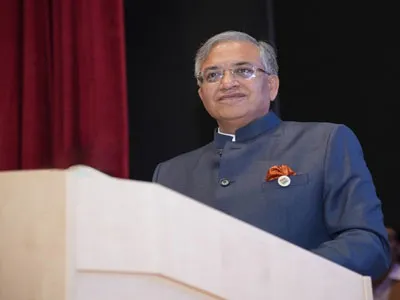
Chief Election Commissioner of India, Shri Gyanesh Kumar, delivered an address at the Swedish Institute of International Affairs (UI) in Stockholm, where he participated in a round-table discussion titled ‘Inside India’s Democracy’. Former Swedish Foreign Minister Ms Ann Linde joined him as a co-speaker during the session. The engagement formed part of his official visit to Sweden, which concludes later today.

Shri Gyanesh Kumar assumed the Chairship of the Council of Member States of the International Institute for Democracy and Electoral Assistance (International IDEA) for the year 2026 yesterday. India’s leadership of the Council marks an important milestone, underscoring international recognition of the Election Commission of India as one of the most credible and innovative Election Management Bodies (EMBs) globally. As a founding member of International IDEA, India has consistently contributed to the organisation’s governance, democratic dialogue and institutional initiatives.

On arrival in Stockholm, the CEC was received by India’s Ambassador to Sweden, Shri Anurag Bhushan. He also held discussions with International IDEA Secretary-General Dr Kevin Casas-Zamora. In his acceptance remarks, Shri Kumar highlighted the vast scale of India’s electoral process, noting that the country has more than 900 million electors across 28 states and 8 Union Territories.

Reflecting on the 2024 General Elections, he pointed out that India witnessed a remarkable democratic undertaking involving more than 20,000 candidates from 743 political parties, including 6 national and 67 state parties. Over the course of the elections, more than 20 million personnel were engaged, including over one million Booth Level Officers and five million polling staff.

He observed that India has conducted 18 general elections to Parliament and over 400 general elections to State Legislatures since independence in 1947. Emphasising India’s democratic heritage, he stated that the country seeks to share not only its experience as the world’s largest and most diverse democracy but also the values and principles rooted in its civilisational ethos.

Looking ahead, the CEC pledged that India’s Chairship would be decisive, ambitious and action-oriented. He will guide the Council’s work under India’s overarching theme: “Democracy for inclusive, peaceful, resilient and sustainable world”. The Chairship will focus on two central pillars — Reimagining Democracy for the Future, and Independent & Professional Election Management Bodies for Sustainable Democracy.

Shri Gyanesh Kumar concluded by affirming India’s commitment to ensuring that every vote counts and every voice is heard, contributing to democracies that are more inclusive, peaceful, resilient and sustainable. Alongside India, Mauritius and Mexico will serve as Vice Chairs of the International IDEA Council for 2026.

Chief Election Commissioner of India, Shri Gyanesh Kumar, delivered an address at the Swedish Institute of International Affairs (UI) in Stockholm, where he participated in a round-table discussion titled ‘Inside India’s Democracy’. Former Swedish Foreign Minister Ms Ann Linde joined him as a co-speaker during the session. The engagement formed part of his official visit to Sweden, which concludes later today. Shri Gyanesh Kumar assumed the Chairship of the Council of Member States of the International Institute for Democracy and Electoral Assistance (International IDEA) for the year 2026 yesterday. India’s leadership of the Council marks an important milestone, underscoring international recognition of the Election Commission of India as one of the most credible and innovative Election Management Bodies (EMBs) globally. As a founding member of International IDEA, India has consistently contributed to the organisation’s governance, democratic dialogue and institutional initiatives. On arrival in Stockholm, the CEC was received by India’s Ambassador to Sweden, Shri Anurag Bhushan. He also held discussions with International IDEA Secretary-General Dr Kevin Casas-Zamora. In his acceptance remarks, Shri Kumar highlighted the vast scale of India’s electoral process, noting that the country has more than 900 million electors across 28 states and 8 Union Territories. Reflecting on the 2024 General Elections, he pointed out that India witnessed a remarkable democratic undertaking involving more than 20,000 candidates from 743 political parties, including 6 national and 67 state parties. Over the course of the elections, more than 20 million personnel were engaged, including over one million Booth Level Officers and five million polling staff. He observed that India has conducted 18 general elections to Parliament and over 400 general elections to State Legislatures since independence in 1947. Emphasising India’s democratic heritage, he stated that the country seeks to share not only its experience as the world’s largest and most diverse democracy but also the values and principles rooted in its civilisational ethos. Looking ahead, the CEC pledged that India’s Chairship would be decisive, ambitious and action-oriented. He will guide the Council’s work under India’s overarching theme: “Democracy for inclusive, peaceful, resilient and sustainable world”. The Chairship will focus on two central pillars — Reimagining Democracy for the Future, and Independent & Professional Election Management Bodies for Sustainable Democracy. Shri Gyanesh Kumar concluded by affirming India’s commitment to ensuring that every vote counts and every voice is heard, contributing to democracies that are more inclusive, peaceful, resilient and sustainable. Alongside India, Mauritius and Mexico will serve as Vice Chairs of the International IDEA Council for 2026.

Next Story
Real Estate

AI: The New Recruit

From getting ideas to evaluating designs, presenting concepts to clients and tracking projects, artificial intelligence (AI) is helping architects work better and faster.“AI allows architects to spend more time doing what only they can do: think critically, synthesise complexity and design with intent,” says Dikshu C Kukreja, Managing Principal, CP Kukreja Architects. “Every minute reclaimed from repetitive processes can be invested in creativity, contextual understanding, interdisciplinary collaboration and innovation – the qualities that define meaningful architecture.”To read the ..

Next Story
Real Estate

Redevelopment 2.0

In 2017, Mumbai identified 160,000 ageing buildings due for structural audit. Close to half of these were in the Western Suburbs. Redeveloping the oldest and structurally weakest of these would help unlock new housing, much needed given the city’s growing population density and constant developed area of 437.7 sq km. At 30,600 people per sq km in 2024, Mumbai’s density was almost thrice that of Gurugram, and 60 per cent higher than Bengaluru’s.Essentially, Mumbai’s realty market has demand. It has capital. It has realty development potential.Fast forward to 2026. Mumbai has 1,094 regis..

Next Story
Technology

Cost intelligence will become a strategic contributor to project success

As India's construction industry accelerates its digital transformation, integrated platforms, AI and connected data are becoming essential to improving cost certainty, project efficiency and sustainability. Ravi Kumar, Sales Director – India, RIB Software India, shares how digital workflows are reshaping project planning, commercial management and decision-making across the construction value chain.India's construction sector is embracing digital technologies at an unprecedented pace. From your perspective, what are the biggest shifts driving this transformation and how is RIB Software enab..

Advertisement

Subscribe to Our Newsletter

Get daily newsletters around different themes from Construction world.

STAY CONNECTED

Advertisement

Advertisement

Advertisement