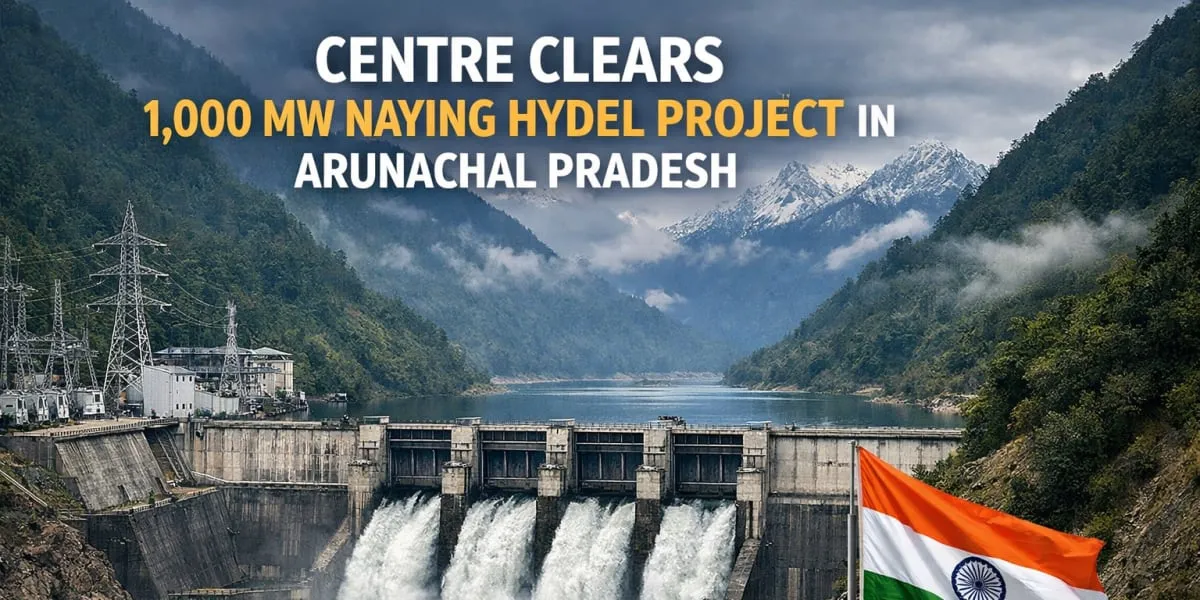
Centre Clears 1,000 MW Naying Hydel Project in Arunachal Pradesh
ECONOMY & POLICY

Centre Clears 1,000 MW Naying Hydel Project in Arunachal Pradesh

An expert panel of the Union Environment Ministry has granted environmental clearance to the 1,000 megawatt (MW) Naying Hydro Electric Project on the Siyom River in Siang and Shi?Yomi districts, close to the India?China border. The run?of?the?river scheme received the recommendation for green clearance, paving the way for further statutory approvals and eventual construction. The clearance marks a significant step in plans to harness hydropower potential in the north?east.

The project envisages four units of 250 megawatt (MW) each and is expected to generate around 4,967 gigawatt hours (GWh) annually. The development is being led by the North Eastern Electric Power Corporation (NEEPCO) and includes a concrete gravity dam and an underground powerhouse. Officials say the scheme is projected to bring economic benefits to the region and bolster national energy security.

The Central Electricity Authority had given concurrence in 2013 and initial plans foresaw construction beginning around 2015, but the project faced prolonged delays. Environmental and social concerns including forest land diversion and potential impacts on local biodiversity contributed to the pause, and public hearings were held as recently as late 2025. Following the recent clearance recommendation, construction is anticipated to commence around 2028 with full commissioning targeted for 2032.

The Naying approval accompanies progress on several major hydropower initiatives in Arunachal Pradesh, including the 2,000 megawatt (MW) Lower Subansiri project, the 2,880 megawatt (MW) Dibang Multipurpose Project and the 3,097 megawatt (MW) Etalin scheme. Other noteworthy projects include the 700 megawatt (MW) Tato?II, the 680 megawatt (MW) Attunli, the 1,720 megawatt (MW) Kamala and the 1,200 megawatt (MW) Kalai?II, many backed by central investments running into thousands of crores.

Authorities describe the decision as aligned with the Centre's push to expand green energy and reduce reliance on imported fossil fuels. Hydropower is presented as a reliable renewable resource that can support grid stability, create employment and improve infrastructure in remote districts while pursuing sustainable development in ecologically sensitive border areas.

"Join industry leaders at RAHSTA Expo, India's premier platform for roads, highways and traffic infrastructure. Register now to explore innovations, network with experts and shape the future of mobility."

An expert panel of the Union Environment Ministry has granted environmental clearance to the 1,000 megawatt (MW) Naying Hydro Electric Project on the Siyom River in Siang and Shi?Yomi districts, close to the India?China border. The run?of?the?river scheme received the recommendation for green clearance, paving the way for further statutory approvals and eventual construction. The clearance marks a significant step in plans to harness hydropower potential in the north?east. The project envisages four units of 250 megawatt (MW) each and is expected to generate around 4,967 gigawatt hours (GWh) annually. The development is being led by the North Eastern Electric Power Corporation (NEEPCO) and includes a concrete gravity dam and an underground powerhouse. Officials say the scheme is projected to bring economic benefits to the region and bolster national energy security. The Central Electricity Authority had given concurrence in 2013 and initial plans foresaw construction beginning around 2015, but the project faced prolonged delays. Environmental and social concerns including forest land diversion and potential impacts on local biodiversity contributed to the pause, and public hearings were held as recently as late 2025. Following the recent clearance recommendation, construction is anticipated to commence around 2028 with full commissioning targeted for 2032. The Naying approval accompanies progress on several major hydropower initiatives in Arunachal Pradesh, including the 2,000 megawatt (MW) Lower Subansiri project, the 2,880 megawatt (MW) Dibang Multipurpose Project and the 3,097 megawatt (MW) Etalin scheme. Other noteworthy projects include the 700 megawatt (MW) Tato?II, the 680 megawatt (MW) Attunli, the 1,720 megawatt (MW) Kamala and the 1,200 megawatt (MW) Kalai?II, many backed by central investments running into thousands of crores. Authorities describe the decision as aligned with the Centre's push to expand green energy and reduce reliance on imported fossil fuels. Hydropower is presented as a reliable renewable resource that can support grid stability, create employment and improve infrastructure in remote districts while pursuing sustainable development in ecologically sensitive border areas.

Next Story
Infrastructure Transport

Uttar Pradesh Accelerates National Highway Projects

Uttar Pradesh Chief Minister Yogi Adityanath met Union Road Transport and Highways Minister Nitin Gadkari to review National Highway and road infrastructure projects. Officials from the National Highways Authority of India presented progress updates and proposals. Ministers directed acceleration of land acquisition, forest clearances, utility shifting and other formalities to expedite delivery. Officials said that since 2014 about 10,204 kilometres of National Highway projects have been awarded and nearly 9,329 kilometres completed, with 606 kilometres approved and 1,010 kilometres completed b..

Next Story
Infrastructure Transport

NHAI Completes Repairs at 33 of 40 Spots Along Gurugram NH-48

The National Highways Authority of India has rectified 33 of 40 deficient locations along an 11km stretch of the Delhi–Gurugram NH-48 corridor, following a joint inspection by the authority, the Municipal Corporation of Gurugram and the Gurugram Metropolitan Development Authority. The audit identified damaged footpaths, crash barriers, inadequate lane markings and poor sanitation at multiple points between Rajiv Chowk and Signature Towers. Repairs and maintenance works have been carried out over May and June as part of the exercise. The report noted broken crash barriers and roadside litteri..

Next Story
Infrastructure Urban

Mankhurd Maharashtra Nagar Flyover To Open By August 2027

The Brihanmumbai Municipal Corporation has said the Mankhurd-Maharashtra Nagar flyover will be operational by August 2027, as part of measures to ease congestion in the eastern suburbs. The structure will provide a direct link from the T Junction on the Sion-Panvel highway to the existing Ghatkopar-Mankhurd Link Road. The T Junction is one of the major traffic choke points in the eastern suburbs and records heavy flows of vehicles travelling to and from Navi Mumbai and Pune. Motorists currently spend more than 15 minutes at the signal during peak periods, according to civic data, prompting the..

Advertisement

Subscribe to Our Newsletter

Get daily newsletters around different themes from Construction world.

STAY CONNECTED

Advertisement

Advertisement

Advertisement