Centre Unveils Second Tranche Of Critical Mineral Exploration Auctions
ECONOMY & POLICY

Centre Unveils Second Tranche Of Critical Mineral Exploration Auctions

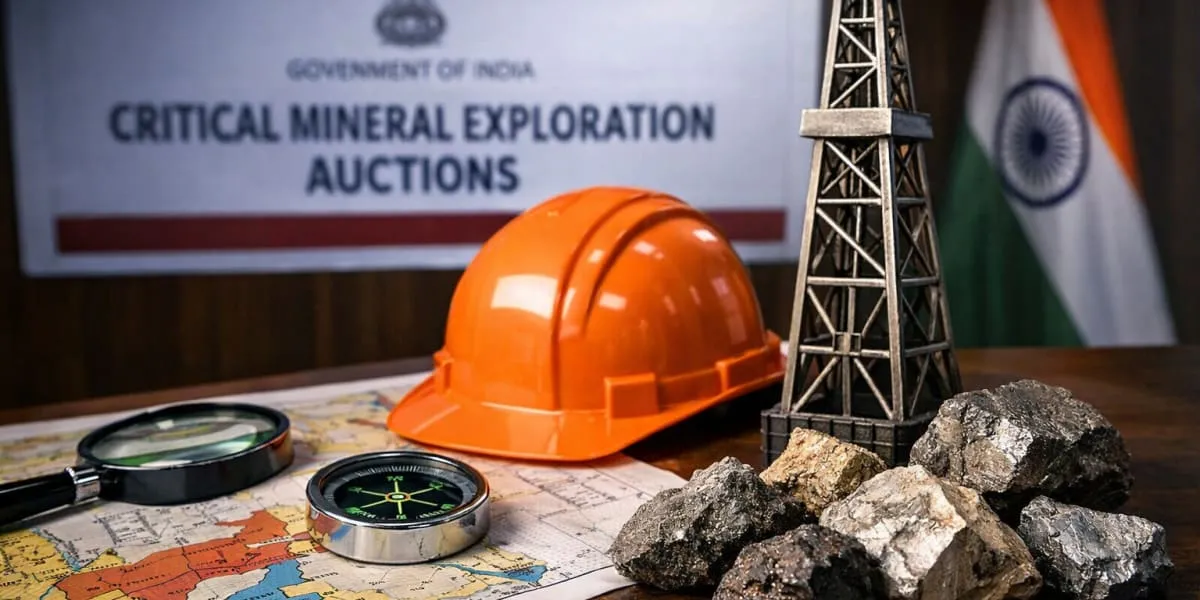
The government launched the second tranche of auctions for Exploration Licence (EL) blocks on Wednesday in New Delhi, with the Union Minister for Coal and Mines G Kishan Reddy presiding over the event. The move signals a focused effort to expand the domestic mineral base and to catalyse investment in upstream activity. Officials presented the package as part of a broader drive to identify and unlock deep-seated resources that have remained underexplored. The initiative follows earlier measures to streamline regulatory approvals and promote private sector participation.

The auctions will offer eleven blocks of critical and deep-seated minerals across eight states, reflecting policy emphasis on materials required for clean energy technologies, electronics and advanced manufacturing. Officials said the programme seeks to reduce import dependence by mapping indigenous reserves and accelerating discovery timelines. Analysts expect a mix of domestic and foreign investors to bid, drawn by clearer rules and potential downstream opportunities in processing and value addition.

The auctions proceed under the Exploration Licence regime introduced by the Mines and Minerals (Development and Regulation) Amendment Act, 2023 and operationalised through the Mineral (Auction) Amendment Rules, 2023, providing a statutory basis for early-stage exploration. The framework permits private players to undertake initial prospecting and data generation through competitive bidding. Authorities emphasised that transparent tenure conditions and relinquishment clauses are intended to encourage risk capital while preserving state oversight and environmental safeguards standards.

Tranche-II comprises eleven blocks that the government described as hosting critical and deep-seated mineral deposits, with bidding open to qualified firms under published tender conditions. Officials said the timeline will include defined exploration periods, work programme commitments and periodic reporting of findings. The authorities anticipate that data from awarded licences will rapidly inform follow-up drilling, beneficiation studies and potential downstream investment, and support domestic supply chains and technology adoption plans sustainably.

The government launched the second tranche of auctions for Exploration Licence (EL) blocks on Wednesday in New Delhi, with the Union Minister for Coal and Mines G Kishan Reddy presiding over the event. The move signals a focused effort to expand the domestic mineral base and to catalyse investment in upstream activity. Officials presented the package as part of a broader drive to identify and unlock deep-seated resources that have remained underexplored. The initiative follows earlier measures to streamline regulatory approvals and promote private sector participation. The auctions will offer eleven blocks of critical and deep-seated minerals across eight states, reflecting policy emphasis on materials required for clean energy technologies, electronics and advanced manufacturing. Officials said the programme seeks to reduce import dependence by mapping indigenous reserves and accelerating discovery timelines. Analysts expect a mix of domestic and foreign investors to bid, drawn by clearer rules and potential downstream opportunities in processing and value addition. The auctions proceed under the Exploration Licence regime introduced by the Mines and Minerals (Development and Regulation) Amendment Act, 2023 and operationalised through the Mineral (Auction) Amendment Rules, 2023, providing a statutory basis for early-stage exploration. The framework permits private players to undertake initial prospecting and data generation through competitive bidding. Authorities emphasised that transparent tenure conditions and relinquishment clauses are intended to encourage risk capital while preserving state oversight and environmental safeguards standards. Tranche-II comprises eleven blocks that the government described as hosting critical and deep-seated mineral deposits, with bidding open to qualified firms under published tender conditions. Officials said the timeline will include defined exploration periods, work programme commitments and periodic reporting of findings. The authorities anticipate that data from awarded licences will rapidly inform follow-up drilling, beneficiation studies and potential downstream investment, and support domestic supply chains and technology adoption plans sustainably.

Next Story
Infrastructure Urban

Centre Clears Power Distribution Upgrade for Uttar Pradesh

The Central Government has approved power distribution projects worth Rs 407.39 billion for Uttar Pradesh under the Revamped Distribution Sector Scheme (RDSS). The investment will be used to modernise the state's electricity distribution infrastructure and strengthen network capacity across urban and rural areas. The package targets one of the country's largest distribution networks as the state experiences rapid urbanisation and rising electricity consumption. Planned interventions include the strengthening of distribution lines, modernisation of substations, replacement of ageing electrical ..

Next Story
Infrastructure Energy

India Data Centres To Consume 191 TWh By 2040 Driving Renewables

A Wood Mackenzie report says India's operational data centre capacity is projected to increase more than fivefold to 12 gigawatt (GW) by 2030 from 2.2 GW in 2025 as artificial intelligence (AI) and cloud computing drive demand. It projects electricity consumption to rise from 10 terawatt-hour (TWh) in 2025 to 191 TWh by 2040. The study forecasts a compound annual growth rate of around 40 per cent and notes AI-dedicated capacity will surge nearly 24-fold from 275 megawatt (MW) in 2025 to 6,546 MW by 2030. The report places India's digital economy at Rs 32 trillion (tn) in 2025 and says it contr..

Next Story
Infrastructure Transport

Hydrogen Train Completes 1,200 Kilometres Of Trials

India's first hydrogen train was flagged off between Jind and Sonipat on July 17 and has travelled over 1,200 kilometres in trials, saving diesel consumption of more than 3,200 litres, a Railway Ministry press release said. The deployment marks the introduction of a zero-emission fuel cell train into route testing and represents a milestone in domestic rail innovation. The train generates electricity onboard through a chemical reaction between hydrogen and oxygen, producing electricity to propel the vehicle while emitting only water vapour as a by-product. There is no smoke and no tailpipe car..

Advertisement

Subscribe to Our Newsletter

Get daily newsletters around different themes from Construction world.

STAY CONNECTED

Advertisement

Advertisement

Advertisement