PHDCCI Urges Easier MSME Lending At RBI Panel In Jammu
ECONOMY & POLICY

PHDCCI Urges Easier MSME Lending At RBI Panel In Jammu

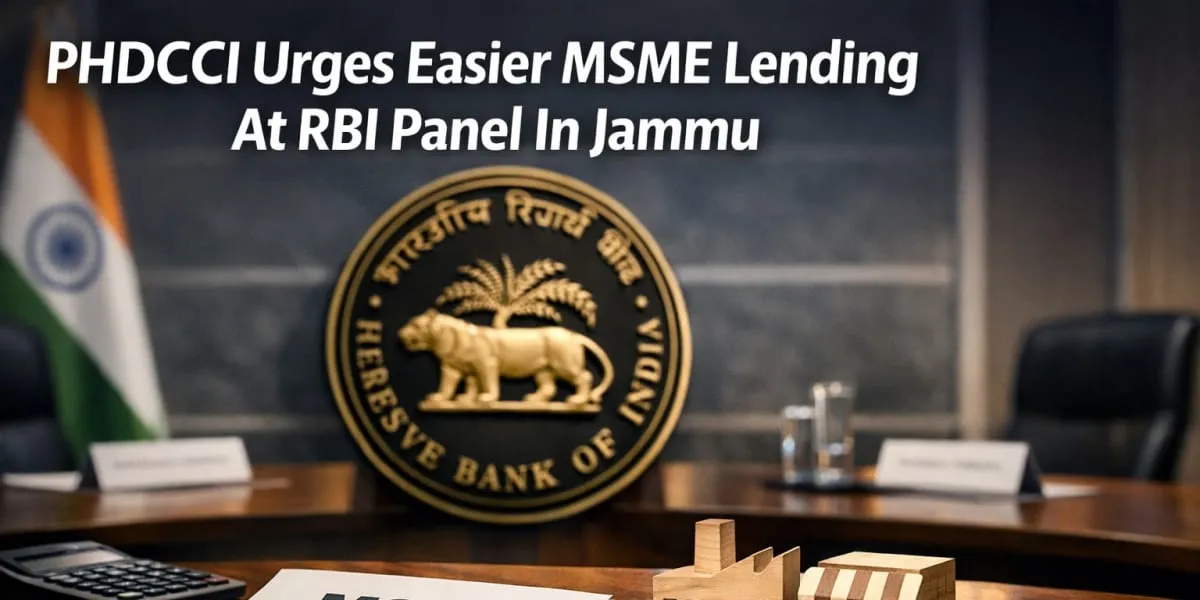
The PHD Chamber of Commerce and Industry, Jammu and Kashmir, participated in the 69th meeting of the Empowered Committee on micro, small and medium enterprises for the Union Territories of Jammu and Kashmir and Ladakh at the Reserve Bank of India office in Jammu for the quarter ending 31 December 2025. The session was chaired by the RBI regional director and attended by officials from the Khadi and Village Industries Commission, the MSME Development and Facilitation Office, the Department of Industries and Commerce, major banks and the UT Level Bankers’ Committee. PHDCCI was represented by Bilal Kawoosa and Mushtaq Ahmad Mir.

PHDCCI representatives urged banks to adopt more liberal lending norms to strengthen the MSME sector, emphasising the need to ensure adequate working capital and term loans for genuine entrepreneurs. They pressed for streamlined procedures to facilitate quicker credit disbursal and highlighted obstacles faced by nascent firms in accessing formal finance. The delegates also stressed the importance of accelerated infrastructure development to support enterprise growth across urban and rural areas.

The committee reached a consensus on enhancing awareness of the Credit Guarantee Fund Trust for Micro and Small Enterprises. PHDCCI announced plans to launch an awareness campaign in March 2026 to promote collateral-free credit for first generation entrepreneurs and to explain eligibility and claim processes under the guarantee scheme. Officials agreed that improved outreach would help channel formal credit to underserved segments.

The RBI regional director underlined the critical role of micro, small and medium enterprises in the industrial economy and outlined key measures proposed in the Union Budget for 2026–27, including a proposed Rs 100 billion (Rs 100 bn) SME Growth Fund and an additional Rs 20 billion (Rs 20 bn) to boost risk capital for micro units. He noted the RBI decision to raise collateral-free loan limits for micro and small enterprises from Rs one million (Rs 1 mn) to Rs two million (Rs 2 mn) and urged banks and stakeholders to align credit delivery with policy intentions to accelerate job creation and local economic activity.

The PHD Chamber of Commerce and Industry, Jammu and Kashmir, participated in the 69th meeting of the Empowered Committee on micro, small and medium enterprises for the Union Territories of Jammu and Kashmir and Ladakh at the Reserve Bank of India office in Jammu for the quarter ending 31 December 2025. The session was chaired by the RBI regional director and attended by officials from the Khadi and Village Industries Commission, the MSME Development and Facilitation Office, the Department of Industries and Commerce, major banks and the UT Level Bankers’ Committee. PHDCCI was represented by Bilal Kawoosa and Mushtaq Ahmad Mir. PHDCCI representatives urged banks to adopt more liberal lending norms to strengthen the MSME sector, emphasising the need to ensure adequate working capital and term loans for genuine entrepreneurs. They pressed for streamlined procedures to facilitate quicker credit disbursal and highlighted obstacles faced by nascent firms in accessing formal finance. The delegates also stressed the importance of accelerated infrastructure development to support enterprise growth across urban and rural areas. The committee reached a consensus on enhancing awareness of the Credit Guarantee Fund Trust for Micro and Small Enterprises. PHDCCI announced plans to launch an awareness campaign in March 2026 to promote collateral-free credit for first generation entrepreneurs and to explain eligibility and claim processes under the guarantee scheme. Officials agreed that improved outreach would help channel formal credit to underserved segments. The RBI regional director underlined the critical role of micro, small and medium enterprises in the industrial economy and outlined key measures proposed in the Union Budget for 2026–27, including a proposed Rs 100 billion (Rs 100 bn) SME Growth Fund and an additional Rs 20 billion (Rs 20 bn) to boost risk capital for micro units. He noted the RBI decision to raise collateral-free loan limits for micro and small enterprises from Rs one million (Rs 1 mn) to Rs two million (Rs 2 mn) and urged banks and stakeholders to align credit delivery with policy intentions to accelerate job creation and local economic activity.

Next Story
Infrastructure Urban

Güntner Showcases Cooling Tech at China Expo

Güntner showcased its latest refrigeration and air conditioning innovations at China Refrigeration 2026, highlighting digital intelligence and carbon-neutral solutions.The company presented its aicore™ Controls and IoT platform, designed to optimise energy consumption, enable remote monitoring and enhance lifecycle management of cooling systems. The solution integrates advanced controllers and cloud-based capabilities to improve operational efficiency and reduce energy use.Güntner also demonstrated advancements in heat pump technologies, including its role in projects such as the Ordos Zer..

Next Story
Real Estate

Superb Realty Ties Up with Praan for AI Air Tech

Superb Realty has partnered with Praan to deploy AI-powered autonomous air infrastructure across over one million sq ft of real estate in Mumbai, marking a significant move towards intelligent indoor environments.The rollout will begin at Superb Altura and expand across upcoming residential and mixed-use developments. The initiative aims to integrate real-time sensing, adaptive purification and AI-led optimisation to improve indoor air quality and occupant experience.Praan’s technology is designed to remove ultrafine particles significantly smaller than conventional systems and eliminate har..

Next Story
Technology

DAAKit Raises $138,000 in Pre-Seed Round

DAAKit has raised $138,000 in a pre-seed funding round led by Inflection Point Ventures to expand its hyperlocal fulfilment network and strengthen technology capabilities.The company plans to use the funds to launch 25 new dark stores across Tier I and Tier II cities, enhance its technology infrastructure, and expand its leadership and operations teams. Currently operational in Delhi, Gurugram, Mumbai, Bengaluru and Kolkata, DAAKit is also piloting expansion into Tier II markets through Lucknow.Built on an asset-light, technology-driven model, the platform enables brands to position inventory ..

Advertisement

Subscribe to Our Newsletter

Get daily newsletters around different themes from Construction world.

STAY CONNECTED

Advertisement

Advertisement

Advertisement