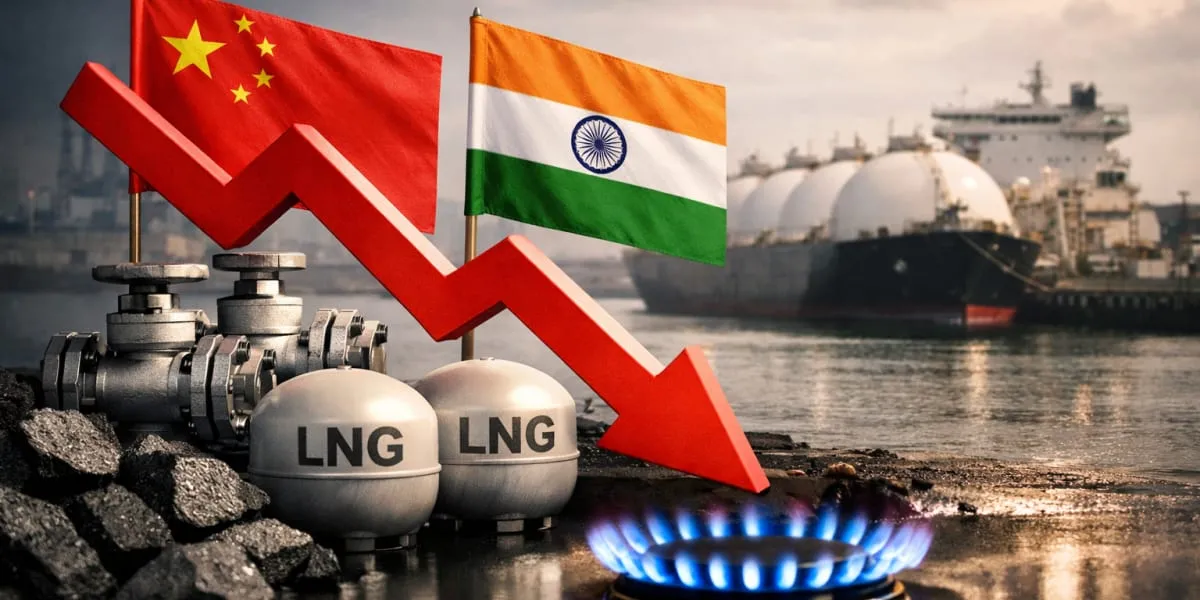
China And India Record Sharpest LNG Import Decline In 2025
ECONOMY & POLICY

China And India Record Sharpest LNG Import Decline In 2025

China and India recorded the steepest decline in liquefied natural gas (LNG) imports among major Asian economies in 2025, as elevated global spot prices, improved domestic gas production and softer industrial demand reduced purchases, according to ship-tracking data compiled by Bloomberg. The slowdown contributed to Asia's largest contraction in LNG imports since 2022 amid supply disruptions and higher prices. Imports by both China and India fell by around 20 per cent from a year earlier, making them the principal drivers of the regional decline.

China relied more on rising domestic output and pipeline gas from neighbouring suppliers, while Indian purchases reflected strong price sensitivity and a shift towards cheaper alternatives such as coal. For India, policymakers have sought to boost local production and expand gas infrastructure, which helped cushion the impact of volatile global prices even as imports remained important for fertiliser plants, city gas networks and industrial users. Chinese buyers also resold some cargoes in response to high international prices, which helped rebalance regional flows.

The decline followed disruptions to global supply routes, notably in the Middle East, which tightened availability and pushed up spot rates, prompting Asian buyers to reduce spot purchases. Market observers noted that higher costs made imported LNG less competitive against domestic fuels and long term contracts, accelerating a tilt towards energy diversification. The trend is expected to affect investment planning across the gas value chain, including import terminals, pipeline projects and storage capacity.

Industry analysts assess that demand in both markets may recover once global prices stabilise and supply conditions normalise, although near term prospects remain uncertain. The episode underlines the importance of boosting domestic gas output, securing long term supplies and diversifying fuel mixes to enhance energy security. Policymakers and investors are likely to reassess priorities for infrastructure and contractual arrangements in light of recent volatility.

China and India recorded the steepest decline in liquefied natural gas (LNG) imports among major Asian economies in 2025, as elevated global spot prices, improved domestic gas production and softer industrial demand reduced purchases, according to ship-tracking data compiled by Bloomberg. The slowdown contributed to Asia's largest contraction in LNG imports since 2022 amid supply disruptions and higher prices. Imports by both China and India fell by around 20 per cent from a year earlier, making them the principal drivers of the regional decline. China relied more on rising domestic output and pipeline gas from neighbouring suppliers, while Indian purchases reflected strong price sensitivity and a shift towards cheaper alternatives such as coal. For India, policymakers have sought to boost local production and expand gas infrastructure, which helped cushion the impact of volatile global prices even as imports remained important for fertiliser plants, city gas networks and industrial users. Chinese buyers also resold some cargoes in response to high international prices, which helped rebalance regional flows. The decline followed disruptions to global supply routes, notably in the Middle East, which tightened availability and pushed up spot rates, prompting Asian buyers to reduce spot purchases. Market observers noted that higher costs made imported LNG less competitive against domestic fuels and long term contracts, accelerating a tilt towards energy diversification. The trend is expected to affect investment planning across the gas value chain, including import terminals, pipeline projects and storage capacity. Industry analysts assess that demand in both markets may recover once global prices stabilise and supply conditions normalise, although near term prospects remain uncertain. The episode underlines the importance of boosting domestic gas output, securing long term supplies and diversifying fuel mixes to enhance energy security. Policymakers and investors are likely to reassess priorities for infrastructure and contractual arrangements in light of recent volatility.

Next Story
Real Estate

We will continue to invest in integrated commercial destinations: Amrita Gupta

Amrita Gupta, Director, Manglam Group and CEO, Manglam Spa and Resorts, speaks on how projects like Westin Jaipur Resort and Sheraton Jaipur are strengthening Manglam Group's integrated real estate and hospitality strategy.Manglam Group has announced a Rs 1,000 crore hospitality expansion in Rajasthan—what strategic vision is driving this next phase of growth?Hospitality has emerged as a defining pillar of Manglam Group’s long-term growth strategy, underpinned by a vision of creating destination-led experiences that transcend conventional hospitality. The genesis of this journey was The We..

Next Story
Infrastructure Energy

Batliboi Wins Rs 520 Mn Contract For Solar Cell Pollution Controls

Batliboi Limited has secured a major contract from SAEL Industries Limited to supply pollution control systems for a new solar cell manufacturing facility at Jewar in Uttar Pradesh. The order instructs Batliboi Limited's EEG Division to design, engineer, supply, install and commission a PEX system to support SAEL Industries Limited's six GW solar cell line. The contract is domestic in origin and was submitted to the stock exchanges under regulatory disclosure requirements. The contract value is Rs 520 mn, reflecting a substantial order for environmental control equipment for the manufacturing ..

Next Story
Infrastructure Urban

Delhi Approves PARIVARTAN Scheme To Replace Old Trucks And Buses

The Delhi government has approved the Programme for Accelerated Renewal and Incentivisation of Vehicle Assets for Reducing Transport Air Pollution and Network Emissions (PARIVARTAN) to cut transport-related emissions in the national capital. The scheme, supported by the Ministry of Road Transport and Highways (MoRTH), will phase out old, polluting trucks and buses and replace them with BS-VI, higher-emission-standard or electric vehicles. The initiative is intended to modernise the commercial vehicle fleet and strengthen the capital's clean transport system. Owners of Light Goods Vehicles that..

Advertisement

Subscribe to Our Newsletter

Get daily newsletters around different themes from Construction world.

STAY CONNECTED

Advertisement

Advertisement

Advertisement