CSC Celebrates 16 Years of Rural Digital Empowerment
ECONOMY & POLICY

CSC Celebrates 16 Years of Rural Digital Empowerment

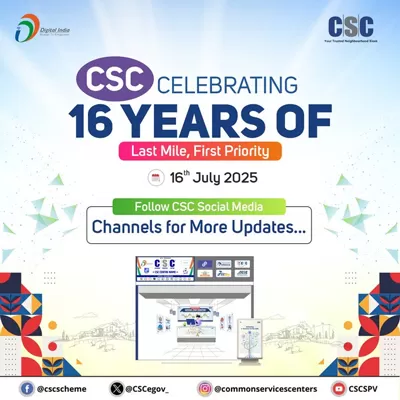
The Common Services Centres (CSC), a key initiative under the Government of India’s Digital India programme, will celebrate its 16th Establishment Day on 16 July 2025 at the Yashobhoomi Convention Centre in Dwarka, New Delhi. Now operating through over 650,000 centres across rural and urban India, CSC has grown into one of the world’s largest digital service delivery networks.

Union Minister of Home Affairs and Minister of Cooperation, Shri Amit Shah, will inaugurate the celebrations, joined by Shri Ashwini Vaishnaw, Union Minister for Electronics & Information Technology, and Shri Jitin Prasada, Minister of State for Electronics & IT.

The event will showcase CSC’s future roadmap focused on deeper outreach, expanded services, and tech-driven innovation. Plans include AI-enabled services, cloud integration, and enhanced support for digitally-enabled livelihoods. This marks a new phase for CSCs as engines of rural innovation and self-reliance under the Atmanirbhar Bharat vision.
Celebrations will be held at national, state, and district levels, honouring outstanding Village Level Entrepreneurs (VLEs) and community leaders. Their efforts have made CSCs a model of public-private partnership and a cornerstone of citizen-centric digital governance.

As part of CSC's collaboration with the cooperative sector, agreements signed in 2022 with NABARD and the Ministry of Cooperation enabled Primary Agricultural Credit Societies (PACS) and LAMPS to function as CSCs. These societies, after training and receiving CSC IDs, now offer services in remote locations, benefitting thousands of members and creating a ripple effect of digital empowerment.

Launched in 2006 under the Ministry of Electronics and IT, CSC SPV has transformed rural access to government, financial, health, legal, and educational services. Each centre is operated by a local VLE, bridging the digital divide between citizens and the government.

CSCs offer a wide range of services:

  • G2C services: Aadhaar, PAN, passport, birth/death certificates, utility payments, DigiLocker
  • Financial inclusion: Banking, DigiPay, insurance, pensions, loans
  • Education: CSC Academy, online courses, IGNOU, NIOS, CSC Olympiad
  • Health: Telemedicine, Ayushman Bharat support
  • Agriculture: Kisan Credit Cards, PM-KISAN, soil health cards, agri-input eStore, FPO assistance
  • Digital utilities: Rural e-commerce, LED distribution, recharges
  • Legal and governance: Tele-Law, eStamp, document registration
  • Other services: Travel booking, IRCTC, mobile sales

Through these services, CSCs have empowered rural citizens — especially women, farmers, and marginalised communities — providing last-mile access and building a digitally inclusive India.

The Common Services Centres (CSC), a key initiative under the Government of India’s Digital India programme, will celebrate its 16th Establishment Day on 16 July 2025 at the Yashobhoomi Convention Centre in Dwarka, New Delhi. Now operating through over 650,000 centres across rural and urban India, CSC has grown into one of the world’s largest digital service delivery networks.Union Minister of Home Affairs and Minister of Cooperation, Shri Amit Shah, will inaugurate the celebrations, joined by Shri Ashwini Vaishnaw, Union Minister for Electronics & Information Technology, and Shri Jitin Prasada, Minister of State for Electronics & IT.The event will showcase CSC’s future roadmap focused on deeper outreach, expanded services, and tech-driven innovation. Plans include AI-enabled services, cloud integration, and enhanced support for digitally-enabled livelihoods. This marks a new phase for CSCs as engines of rural innovation and self-reliance under the Atmanirbhar Bharat vision.Celebrations will be held at national, state, and district levels, honouring outstanding Village Level Entrepreneurs (VLEs) and community leaders. Their efforts have made CSCs a model of public-private partnership and a cornerstone of citizen-centric digital governance.As part of CSC's collaboration with the cooperative sector, agreements signed in 2022 with NABARD and the Ministry of Cooperation enabled Primary Agricultural Credit Societies (PACS) and LAMPS to function as CSCs. These societies, after training and receiving CSC IDs, now offer services in remote locations, benefitting thousands of members and creating a ripple effect of digital empowerment.Launched in 2006 under the Ministry of Electronics and IT, CSC SPV has transformed rural access to government, financial, health, legal, and educational services. Each centre is operated by a local VLE, bridging the digital divide between citizens and the government.CSCs offer a wide range of services:G2C services: Aadhaar, PAN, passport, birth/death certificates, utility payments, DigiLockerFinancial inclusion: Banking, DigiPay, insurance, pensions, loansEducation: CSC Academy, online courses, IGNOU, NIOS, CSC OlympiadHealth: Telemedicine, Ayushman Bharat supportAgriculture: Kisan Credit Cards, PM-KISAN, soil health cards, agri-input eStore, FPO assistanceDigital utilities: Rural e-commerce, LED distribution, rechargesLegal and governance: Tele-Law, eStamp, document registrationOther services: Travel booking, IRCTC, mobile salesThrough these services, CSCs have empowered rural citizens — especially women, farmers, and marginalised communities — providing last-mile access and building a digitally inclusive India. 

Next Story
Infrastructure Transport

Large Format Store Planned At M G Road Metro Station

M G Road station in Bengaluru is set to host the city’s first large-format commercial and experience space, with planning led by Bangalore Metro Rail Corporation Limited. BMRCL has invited proposals to develop and operate a central business district destination at the Purple?Pink Line interchange. The plan positions the station as a commercial hub designed to serve a broad commuter base across the city. The proposal is part of a broader effort to activate transit nodes commercially. Tender documents set a minimum monthly rental of Rs 0.944 million (mn), inclusive of GST, for the large-format..

Next Story
Infrastructure Energy

Government Cancels Auction Of Eleven Critical Mineral Blocks

The government has cancelled the auction of 11 critical and strategic mineral blocks after receiving a poor investor response and failing to attract a sufficient number of qualified bidders. The decision represents a setback to plans to ramp up domestic exploration and production of critical minerals amid global supply chain disruptions and rising demand for materials used in clean energy and advanced technologies. The mines ministry issued an annulment notice setting out the reasons for the cancellations. The annulment notice indicated that the auction process for five mineral blocks was canc..

Next Story
Infrastructure Energy

Gujarat Pushes Biogas Growth With 193 Operational Units

Gujarat has operationalised 193 biogas plants across the state and is planning to add 60 more units as part of a broader push to scale up clean and sustainable energy solutions. The existing plants, established under various government-supported schemes, process organic waste including cattle dung and agricultural residue to produce biogas and a nutrient-rich slurry. The output is mainly used for cooking and other energy needs in rural and semi-urban communities, while also improving local waste management practices. The Gujarat Energy Development Agency (GEDA) is leading the initiative and is..

Advertisement

Subscribe to Our Newsletter

Get daily newsletters around different themes from Construction world.

STAY CONNECTED

Advertisement

Advertisement

Advertisement