




DDA Prepares Zero Draft Of Delhi Yamuna Compact
ECONOMY & POLICY

DDA Prepares Zero Draft Of Delhi Yamuna Compact

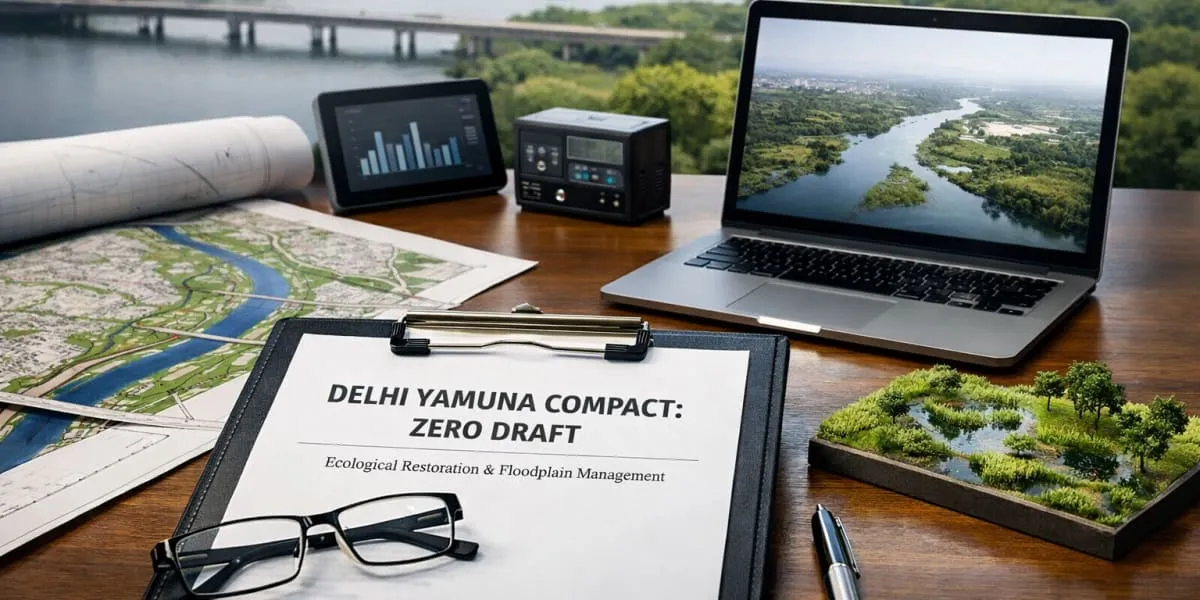
The Delhi Development Authority (DDA) has prepared the zero draft of the Delhi Yamuna Compact, a framework for ecological restoration and environmental monitoring of the Yamuna floodplain.

The draft will consolidate recommendations from consultations and will be circulated among stakeholders for comment and refinement before a Yamuna Dialogues event on 11 September in New Delhi. The compact is intended as an implementation oriented framework to guide planning, coordinated action and policy decisions for the floodplains.

The authority concluded three stakeholder consultation workshops under the Yamuna Dialogues, completed on 25 July. The events brought together policymakers, government agencies, environmental experts, financial institutions, scientists, urban planners, landscape architects, technical institutions and civil society organisations to develop a shared framework for restoring and sustaining the floodplains. Recommendations are consolidated into the zero draft for deliberation at the full Yamuna Dialogues event.

The workshops examined six interrelated themes: floodplain responsive planning, ghat development, nature based solutions, water quality and drainage, sustainable financing models and governance mechanisms. A recurring finding was that no single institution or intervention can achieve lasting transformation and that ecological restoration, environmental monitoring, sustainable financing, effective governance and community stewardship must function as complementary pillars. Participants emphasised the need for coordinated, long term action across organisations, experts, communities and citizens.

The initiative followed field visits to the floodplains by Lieutenant Governor Taranjit Singh Sandhu and review meetings with senior DDA officials during which he issued directions for tackling river pollution through a multi dimensional approach. The Yamuna floodplains extend through Delhi as a broad strip on both sides of the river and represent one of the most contested and ecologically degraded urban landscapes in India. Decades of encroachment, solid waste dumping, sewage discharge and infrastructure construction have compromised the river's ecological functions, its ability to absorb monsoon flows without causing flooding and its capacity to support biodiversity.

The Delhi Development Authority (DDA) has prepared the zero draft of the Delhi Yamuna Compact, a framework for ecological restoration and environmental monitoring of the Yamuna floodplain. The draft will consolidate recommendations from consultations and will be circulated among stakeholders for comment and refinement before a Yamuna Dialogues event on 11 September in New Delhi. The compact is intended as an implementation oriented framework to guide planning, coordinated action and policy decisions for the floodplains. The authority concluded three stakeholder consultation workshops under the Yamuna Dialogues, completed on 25 July. The events brought together policymakers, government agencies, environmental experts, financial institutions, scientists, urban planners, landscape architects, technical institutions and civil society organisations to develop a shared framework for restoring and sustaining the floodplains. Recommendations are consolidated into the zero draft for deliberation at the full Yamuna Dialogues event. The workshops examined six interrelated themes: floodplain responsive planning, ghat development, nature based solutions, water quality and drainage, sustainable financing models and governance mechanisms. A recurring finding was that no single institution or intervention can achieve lasting transformation and that ecological restoration, environmental monitoring, sustainable financing, effective governance and community stewardship must function as complementary pillars. Participants emphasised the need for coordinated, long term action across organisations, experts, communities and citizens. The initiative followed field visits to the floodplains by Lieutenant Governor Taranjit Singh Sandhu and review meetings with senior DDA officials during which he issued directions for tackling river pollution through a multi dimensional approach. The Yamuna floodplains extend through Delhi as a broad strip on both sides of the river and represent one of the most contested and ecologically degraded urban landscapes in India. Decades of encroachment, solid waste dumping, sewage discharge and infrastructure construction have compromised the river's ecological functions, its ability to absorb monsoon flows without causing flooding and its capacity to support biodiversity.

Related Stories

Gold Stories

Next Story
Infrastructure Urban

PMC Approves Rs 5.78 bn Waste Processing Contract

The Pune Municipal Corporation approved a Rs 5.7796 billion (bn) fifteen-year contract to process 500 metric tonnes (t) of waste daily at the Devachi Uruli depot and allowed unauthorised overhead cables to remain temporarily for one year subject to a fee. The decision was taken by the civic body to appoint a private operator for an integrated waste facility covering about 12 acres. The approval frames the contract as an operational arrangement with a fixed base rate and annual adjustments. The contract was awarded to Bhoomi Green Energy Envirocare LLP, which quoted Rs 772 per t, compared with ..

Next Story
Infrastructure Urban

Kerala High Court to Inspect Brahmapuram Waste Plant

Two judges of the Kerala High Court, Justice Bechu Kurian Thomas and Justice Gopinath P, will inspect the Brahmapuram waste management plant on 11 September as part of the suo motu proceeding on the plant's maintenance. The inspection was scheduled to allow the bench to assess conditions on site and to verify representations made by municipal and state authorities. The court listed the site visit during a hearing and directed officials to prepare for an on-site review. The bench instructed authorities to file a detailed report on the plant's present functioning ahead of the visit. It said the ..

Next Story
Infrastructure Transport

Ahmedabad Geetamandir Bus Port Terminal Two Ready with Airport Facilities

Ahmedabad’s Geetamandir Bus Port has completed a separate Terminal Two, which is ready to serve passengers travelling to Saurashtra-Kutch and North Gujarat. The facility has been developed with airport like facilities to improve passenger comfort and ease of travel. Deputy Chief Minister Harsh Sanghvi is scheduled to inaugurate the new terminal today. Authorities say the design focuses on smoother boarding and reduced congestion. Terminal Two will become operational from 13 August and is expected to handle 1,091 buses daily servicing routes to Saurashtra-Kutch and North Gujarat. The new arra..

Advertisement

Subscribe to Our Newsletter

Get daily newsletters around different themes from Construction world.

STAY CONNECTED

Advertisement














