Delhi To Adopt EMI Model For Rs 4,732.4 Million Smart Streetlight Project
ECONOMY & POLICY

Delhi To Adopt EMI Model For Rs 4,732.4 Million Smart Streetlight Project

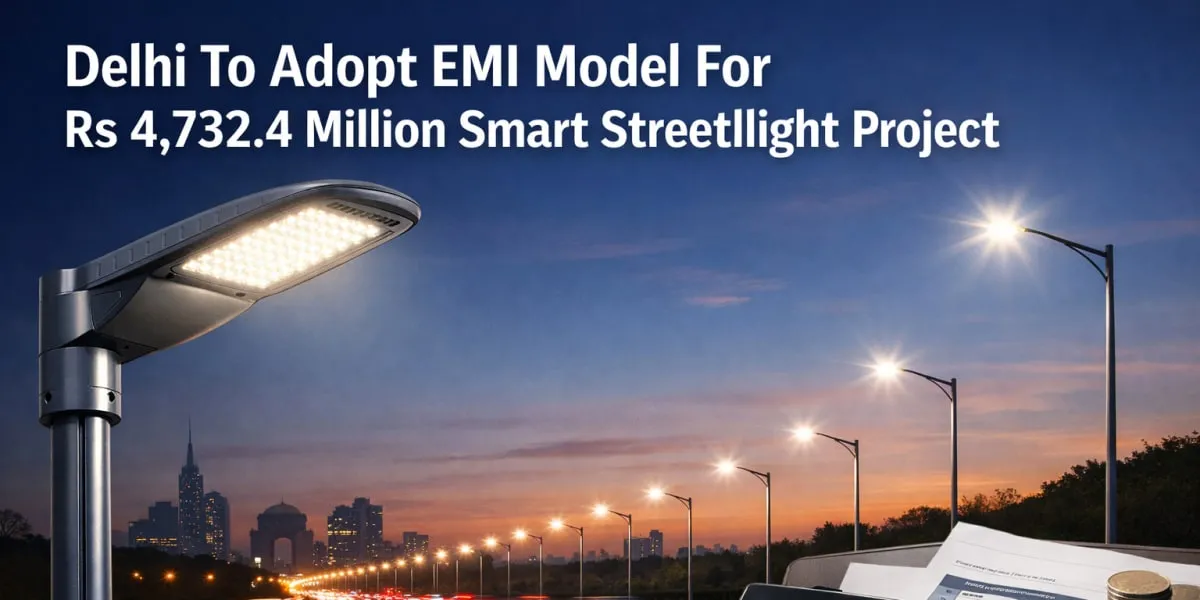
The Delhi government will implement an equated monthly instalment based payment model for a streetlight modernisation project, PWD minister Parvesh Sahib Singh said on Tuesday. He said the move will apply to a plan to convert around 93,000 streetlights on main roads, aiming to reduce electricity consumption and save around three billion (bn) in five years. Payments will be monthly and linked to performance reports to ensure proper functioning and management of the new smart streetlights.

The project is estimated to cost about Rs 4,732.4 mn and will be implemented in phases on roads maintained by the PWD. High pressure sodium vapour lights and older LED fixtures will be replaced with smart LEDs and provision has been made for 5,000 additional poles to cover future requirements and unlit stretches. The contractor will be required to ensure proper functioning of lights to receive monthly payments tied to performance.

A control and command centre will be set up at the MSO building, the PWD headquarters, with two 75-inch display computers and monitoring software to track streetlight status in real time. The system will allow dimmable, individually controlled lights to adapt to weather and traffic conditions and improve energy efficiency. Contractors will be monitored against benchmarks and payments adjusted according to agreed metrics.

The tender has been issued and authorities expect the contract to be awarded within a fortnight, with work phased across the city road network. The finance department has reviewed the proposal and indicated that power expenditure should fall significantly over five years compared with the current arrangement.

At present the department maintains around 1,400 kilometres of road network in the national capital. Officials said the scheme is intended to modernise infrastructure, ensure accountability for maintenance and provide capacity for future expansion.

"Join industry leaders at RAHSTA Expo, India's premier platform for roads, highways and traffic infrastructure. Register now to explore innovations, network with experts and shape the future of mobility."

The Delhi government will implement an equated monthly instalment based payment model for a streetlight modernisation project, PWD minister Parvesh Sahib Singh said on Tuesday. He said the move will apply to a plan to convert around 93,000 streetlights on main roads, aiming to reduce electricity consumption and save around three billion (bn) in five years. Payments will be monthly and linked to performance reports to ensure proper functioning and management of the new smart streetlights. The project is estimated to cost about Rs 4,732.4 mn and will be implemented in phases on roads maintained by the PWD. High pressure sodium vapour lights and older LED fixtures will be replaced with smart LEDs and provision has been made for 5,000 additional poles to cover future requirements and unlit stretches. The contractor will be required to ensure proper functioning of lights to receive monthly payments tied to performance. A control and command centre will be set up at the MSO building, the PWD headquarters, with two 75-inch display computers and monitoring software to track streetlight status in real time. The system will allow dimmable, individually controlled lights to adapt to weather and traffic conditions and improve energy efficiency. Contractors will be monitored against benchmarks and payments adjusted according to agreed metrics. The tender has been issued and authorities expect the contract to be awarded within a fortnight, with work phased across the city road network. The finance department has reviewed the proposal and indicated that power expenditure should fall significantly over five years compared with the current arrangement. At present the department maintains around 1,400 kilometres of road network in the national capital. Officials said the scheme is intended to modernise infrastructure, ensure accountability for maintenance and provide capacity for future expansion.

Next Story
Real Estate

VeARC leases 27,000 sq ft office space in Bengaluru

VeARC India has leased approximately 27,000 sq ft of office space at The Executive Centre's (TEC) Helios Business Park on Outer Ring Road (ORR), Bengaluru, to support the expansion of its Global Capability Centre (GCC) operations.The new workspace accommodates more than 450 workstations and is intended to support the company's growing workforce in India. VeARC India serves as the Global Capability Centre for Long Arc Capital.Located on Bengaluru's Outer Ring Road, the office provides access to one of the city's key technology and business corridors. The expansion comes amid continued growth in..

Next Story
Real Estate

Bharat Shah Family Buys Four Luxury Apartments In Worli For Rs1.8 bn

The family of veteran investor Bharat Shah has acquired four ultra-luxury apartments on the higher floors of Kalpataru One in Worli, South Mumbai, for Rs1.8 billion (bn). The purchases were registered on 6 July 2026 and were executed through Preeti Bharat Shah and Kinnari Bharat Shah, who bought the flats from Kalpataru Properties Limited. Property registration documents reviewed by Zapkey show the total consideration at Rs1.7941 billion. The transactions recorded a per square foot RERA carpet price of Rs0.101 million (mn), with each apartment valued at about Rs448.5 million. The four residenc..

Next Story
Infrastructure Urban

NITI Aayog Consultation On Critical Mineral Supply Chains

NITI Aayog convened a stakeholder consultation in New Delhi on Wednesday to assess requirements for critical minerals across strategic sectors, bringing together experts from government, research institutions, academia and industry. The meeting aimed to estimate current and future demand, identify supply chain vulnerabilities and discuss measures to strengthen domestic capabilities in exploration, processing and recycling. The exercise formed part of broader efforts to secure mineral value chains essential for economic growth, technological advancement and national security.\n\nDiscussions con..

Advertisement

Subscribe to Our Newsletter

Get daily newsletters around different themes from Construction world.

STAY CONNECTED

Advertisement

Advertisement

Advertisement