+
DGFT Extends Export Obligation Period to 31 August 2026
ECONOMY & POLICY

DGFT Extends Export Obligation Period to 31 August 2026

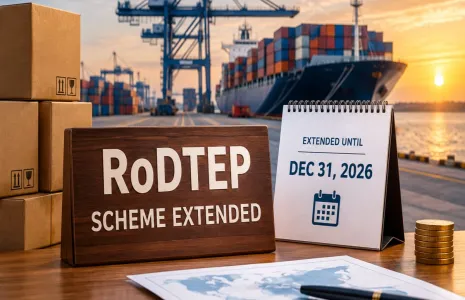
The Directorate General of Foreign Trade (DGFT), under the Ministry of Commerce and Industry, has extended the Export Obligation period for specified export promotion schemes until 31 August 2026 in response to prevailing geopolitical developments that are affecting global shipping routes, logistics corridors and international supply chains. The step is intended to provide operational flexibility to exporters facing disruptions arising from changes in trade and logistics. The extension is automatic and does not require individual applications.

Through Public Notice No. 51/2025-206 issued on six March 2026, the DGFT provided for automatic extension of the Export Obligation period or block-wise fulfilment period for Advance Authorisations, including Advance Authorisation for Annual Requirement and Special Advance Authorisation, as well as for Export Promotion Capital Goods (EPCG) Authorisations. The measure applies where the Export Obligation period is expiring between one March 2026 and 31 May 2026. The extension is additional to existing provisions under the Foreign Trade Policy and the Handbook of Procedures.

Exporters will not be required to submit separate applications or pay composition fees to avail the benefit under the Public Notice, and the relief is intended to reduce compliance burdens during the disruption. Regional authorities of the DGFT will verify compliance with Export Obligation requirements at the time of issuance of the Export Obligation Discharge Certificate, closure or regularisation of the authorisation. Customs authorities have been informed to permit exports in accordance with the revised timelines.

The announcement reflects the Government's continuing commitment to support exporters and to ensure that temporary global disruptions do not adversely affect India’s export performance or obligations under export promotion schemes. The automatic extension is designed to maintain continuity of export operations while preserving the regulatory framework for later verification and regularisation. Exporters are expected to cooperate with authorities during the discharge and closure processes.

The Directorate General of Foreign Trade (DGFT), under the Ministry of Commerce and Industry, has extended the Export Obligation period for specified export promotion schemes until 31 August 2026 in response to prevailing geopolitical developments that are affecting global shipping routes, logistics corridors and international supply chains. The step is intended to provide operational flexibility to exporters facing disruptions arising from changes in trade and logistics. The extension is automatic and does not require individual applications. Through Public Notice No. 51/2025-206 issued on six March 2026, the DGFT provided for automatic extension of the Export Obligation period or block-wise fulfilment period for Advance Authorisations, including Advance Authorisation for Annual Requirement and Special Advance Authorisation, as well as for Export Promotion Capital Goods (EPCG) Authorisations. The measure applies where the Export Obligation period is expiring between one March 2026 and 31 May 2026. The extension is additional to existing provisions under the Foreign Trade Policy and the Handbook of Procedures. Exporters will not be required to submit separate applications or pay composition fees to avail the benefit under the Public Notice, and the relief is intended to reduce compliance burdens during the disruption. Regional authorities of the DGFT will verify compliance with Export Obligation requirements at the time of issuance of the Export Obligation Discharge Certificate, closure or regularisation of the authorisation. Customs authorities have been informed to permit exports in accordance with the revised timelines. The announcement reflects the Government's continuing commitment to support exporters and to ensure that temporary global disruptions do not adversely affect India’s export performance or obligations under export promotion schemes. The automatic extension is designed to maintain continuity of export operations while preserving the regulatory framework for later verification and regularisation. Exporters are expected to cooperate with authorities during the discharge and closure processes.

Next Story
Infrastructure Urban

Implementation Status of Jal Jeevan Mission

Since August 2019 the Government has implemented Jal Jeevan Mission to provide assured potable water through household tap connections in rural India. At the start of the mission only 32.3 million (mn) rural households, representing 16.7 per cent, were reported to have tap water connections. States and union territories have reported that 125.8 mn additional rural households have since been provided with tap connections. As a result, of about 193.6 mn rural households roughly 158.2 mn, or 81.71 per cent, are reported to have tap water supply at home.\n\nThe State, district and village level st..

Next Story
Infrastructure Urban

Jal Jeevan Mission Reaches Eighty One Per Cent Rural Coverage

The Government reported substantial progress under the Jal Jeevan Mission, launched in August 2019 to provide tap water to every rural household. At launch only 32.3 million (mn) rural households had tap connections and states and Union territories reported provision of 125.8 mn additional households by March 2026. Consequently, out of about 193.6 mn rural households around 158.2 mn, or 81.71 per cent, are reported to have tap water at home. The Finance Minister announced extension of the mission until 2028 in the 2025-26 budget speech. The Swachh Bharat Mission Grameen, launched in October 20..

Next Story
Infrastructure Urban

Empowering Local Governance for Sustainable Rural Water Supply

The Ministry of Jal Shakti has aligned the Jal Jeevan Mission (JJM) with the 73rd Amendment to strengthen village level planning and community ownership of water supply. Gram Panchayats, village water and sanitation committees and Pani Samitis are to plan, implement, manage and maintain piped water systems, with gram sabha processes formalising handover and oversight. Implementation support agencies including non government organisations, community based organisations and self help groups have been empanelled to train local committees and promote women participation. Under JJM, the department ..

Advertisement

Subscribe to Our Newsletter

Get daily newsletters around different themes from Construction world.

STAY CONNECTED

Advertisement

Advertisement

Advertisement