+
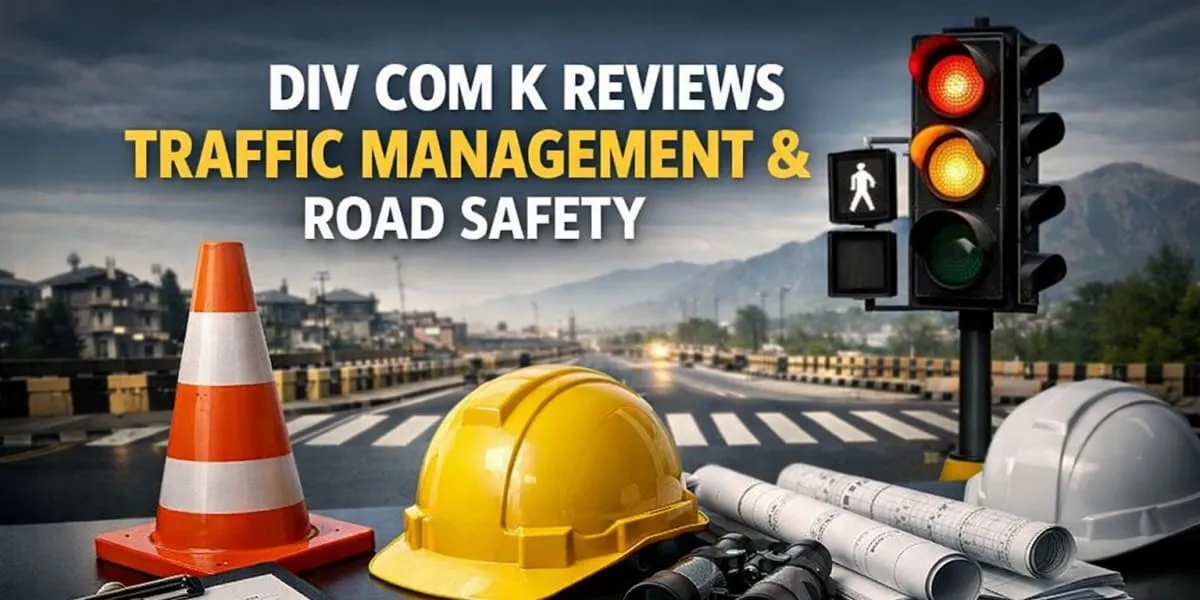
Div Com K Reviews Traffic Management And Road Safety
ECONOMY & POLICY

Div Com K Reviews Traffic Management And Road Safety

Divisional Commissioner Kashmir (Div Com K) reviewed progress of traffic management and road safety projects in Srinagar, focusing on timely completion and operational readiness. The review covered initiatives such as junction improvements, pedestrian crossings and traffic signal installations across the city. The Div Com K assessed implementation plans and directed departments to expedite work where delays were evident. The Div Com K noted the importance of minimising disruption to daily commutes while ensuring safety measures remained robust.

Representatives of the Public Works Department (PWD), Srinagar Municipal Corporation (SMC) and the traffic wing of Jammu and Kashmir Police presented status updates and timelines. The meeting addressed prioritisation of accident-prone stretches and measures to improve vehicular flow, including temporary diversions during construction. Officials were instructed to coordinate closely and submit revised schedules for completion. Departments were asked to employ low-cost, high-impact interventions where feasible to deliver visible improvements quickly.

The Div Com K emphasised optimal utilisation of allocated funds and adherence to safety standards in design and execution, seeking progress reports at regular intervals. Attention was drawn to provision of adequate signage, street lighting and pedestrian amenities to reduce risks for vulnerable road users. A focus was placed on integrating traffic management with upcoming urban development works to avoid recurrent disruptions. Community feedback and accident data were to be used to refine interventions and target resources effectively.

Monitoring mechanisms were outlined to ensure contractors meet milestones and quality benchmarks, with a directive for enhanced on-site supervision and timely removal of obstructions. Interagency coordination was to be strengthened for enforcement of traffic regulations and rapid response to emergent safety issues. The Div Com K asked for consolidated updates to be submitted weekly for review.

Divisional Commissioner Kashmir (Div Com K) reviewed progress of traffic management and road safety projects in Srinagar, focusing on timely completion and operational readiness. The review covered initiatives such as junction improvements, pedestrian crossings and traffic signal installations across the city. The Div Com K assessed implementation plans and directed departments to expedite work where delays were evident. The Div Com K noted the importance of minimising disruption to daily commutes while ensuring safety measures remained robust. Representatives of the Public Works Department (PWD), Srinagar Municipal Corporation (SMC) and the traffic wing of Jammu and Kashmir Police presented status updates and timelines. The meeting addressed prioritisation of accident-prone stretches and measures to improve vehicular flow, including temporary diversions during construction. Officials were instructed to coordinate closely and submit revised schedules for completion. Departments were asked to employ low-cost, high-impact interventions where feasible to deliver visible improvements quickly. The Div Com K emphasised optimal utilisation of allocated funds and adherence to safety standards in design and execution, seeking progress reports at regular intervals. Attention was drawn to provision of adequate signage, street lighting and pedestrian amenities to reduce risks for vulnerable road users. A focus was placed on integrating traffic management with upcoming urban development works to avoid recurrent disruptions. Community feedback and accident data were to be used to refine interventions and target resources effectively. Monitoring mechanisms were outlined to ensure contractors meet milestones and quality benchmarks, with a directive for enhanced on-site supervision and timely removal of obstructions. Interagency coordination was to be strengthened for enforcement of traffic regulations and rapid response to emergent safety issues. The Div Com K asked for consolidated updates to be submitted weekly for review.

Next Story
Infrastructure Urban

Implementation Status of Jal Jeevan Mission

Since August 2019 the Government has implemented Jal Jeevan Mission to provide assured potable water through household tap connections in rural India. At the start of the mission only 32.3 million (mn) rural households, representing 16.7 per cent, were reported to have tap water connections. States and union territories have reported that 125.8 mn additional rural households have since been provided with tap connections. As a result, of about 193.6 mn rural households roughly 158.2 mn, or 81.71 per cent, are reported to have tap water supply at home.\n\nThe State, district and village level st..

Next Story
Infrastructure Urban

Jal Jeevan Mission Reaches Eighty One Per Cent Rural Coverage

The Government reported substantial progress under the Jal Jeevan Mission, launched in August 2019 to provide tap water to every rural household. At launch only 32.3 million (mn) rural households had tap connections and states and Union territories reported provision of 125.8 mn additional households by March 2026. Consequently, out of about 193.6 mn rural households around 158.2 mn, or 81.71 per cent, are reported to have tap water at home. The Finance Minister announced extension of the mission until 2028 in the 2025-26 budget speech. The Swachh Bharat Mission Grameen, launched in October 20..

Next Story
Infrastructure Urban

Empowering Local Governance for Sustainable Rural Water Supply

The Ministry of Jal Shakti has aligned the Jal Jeevan Mission (JJM) with the 73rd Amendment to strengthen village level planning and community ownership of water supply. Gram Panchayats, village water and sanitation committees and Pani Samitis are to plan, implement, manage and maintain piped water systems, with gram sabha processes formalising handover and oversight. Implementation support agencies including non government organisations, community based organisations and self help groups have been empanelled to train local committees and promote women participation. Under JJM, the department ..

Advertisement

Subscribe to Our Newsletter

Get daily newsletters around different themes from Construction world.

STAY CONNECTED

Advertisement

Advertisement

Advertisement