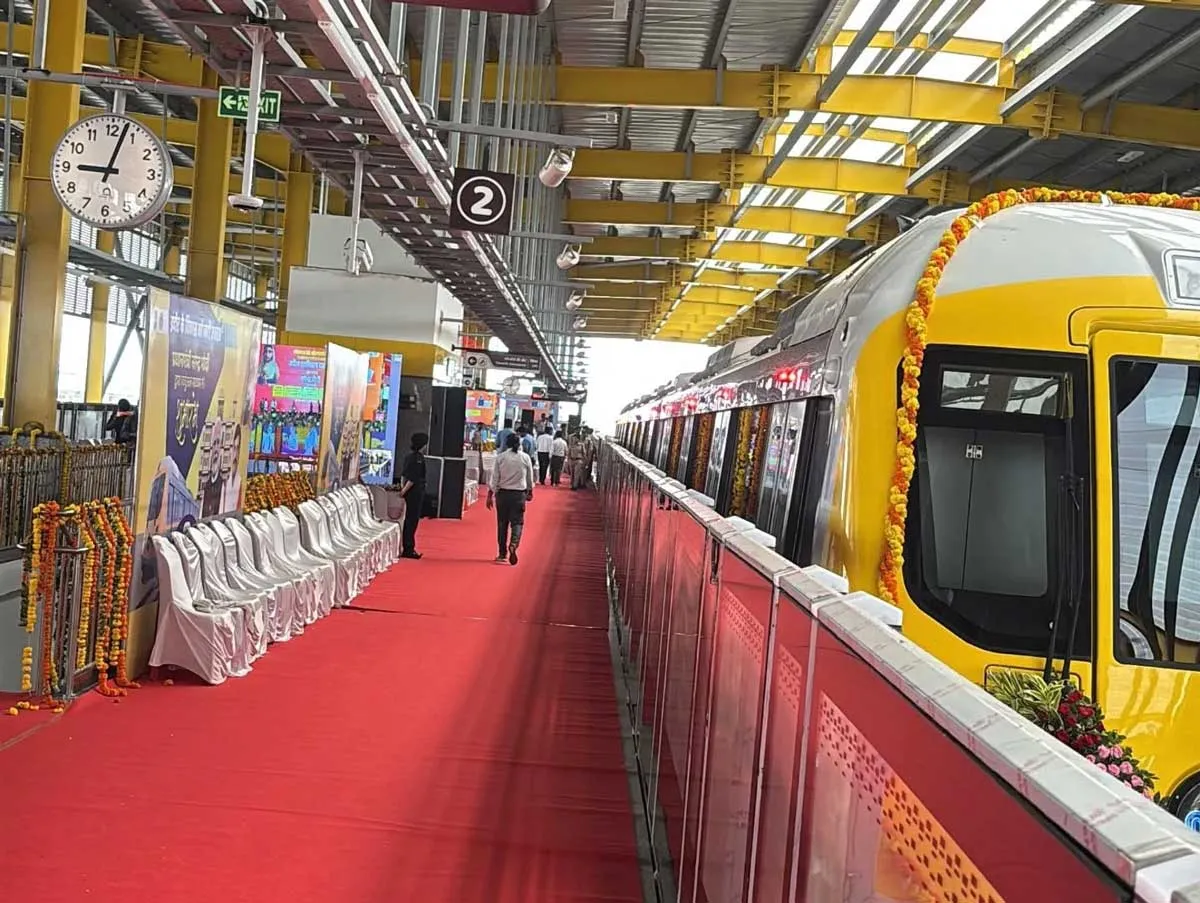
Madhya Pradesh pushes Indore-Ujjain Metro project, DPR under review
RAILWAYS & METRO RAIL

Madhya Pradesh pushes Indore-Ujjain Metro project, DPR under review

The proposed Indore-Ujjain Metro project in Madhya Pradesh has reached a crucial stage, with the Delhi Metro Rail Corporation (DMRC) submitting the Detailed Project Report (DPR) to the management for review. Officials said the report is currently being examined by engineers, and major revisions are expected before it receives final approval.

According to sources, the review process is focusing on key aspects such as station locations, route alignment and the feasibility of underground stretches. The DPR initially proposed 11 stations along the corridor, but authorities indicated that changes may be made depending on projected ridership, traffic patterns and land availability.

Officials said there is also a proposal to shift certain portions of the metro alignment underground within Ujjain city. If implemented, this modification could impact the final station count and alter the overall route design. Once the revised DPR is cleared, the project is expected to move towards implementation, strengthening inter-city connectivity between Indore and Ujjain.

As per the current plan, the metro corridor will begin at Lavkush Square in Indore and terminate near the Mahakal Temple in Ujjain. Proposed stations along the route include Bhaurasla, Baroli, Ninora, Triveni Ghat, Nanakheda and the ISBT. However, officials noted that the final connectivity map for these areas will depend on the outcome of the ongoing technical review.

DMRC was earlier appointed to conduct a feasibility survey and prepare the DPR. Following the survey, which reportedly indicated strong ridership potential, engineers began a detailed evaluation to ensure that the project remains technically viable and financially balanced.

The metro project is estimated to cost around ₹10,000 crore and is being fast-tracked with the goal of completion before Simhastha 2028. The Simhastha Mahakumbh, held once every 12 years in Ujjain, is scheduled from 27 March 2028 to 27 May 2028. Authorities expect the festival to draw over 14 crore devotees, making improved transport infrastructure a priority.

The proposed Indore-Ujjain Metro project in Madhya Pradesh has reached a crucial stage, with the Delhi Metro Rail Corporation (DMRC) submitting the Detailed Project Report (DPR) to the management for review. Officials said the report is currently being examined by engineers, and major revisions are expected before it receives final approval.According to sources, the review process is focusing on key aspects such as station locations, route alignment and the feasibility of underground stretches. The DPR initially proposed 11 stations along the corridor, but authorities indicated that changes may be made depending on projected ridership, traffic patterns and land availability.Officials said there is also a proposal to shift certain portions of the metro alignment underground within Ujjain city. If implemented, this modification could impact the final station count and alter the overall route design. Once the revised DPR is cleared, the project is expected to move towards implementation, strengthening inter-city connectivity between Indore and Ujjain.As per the current plan, the metro corridor will begin at Lavkush Square in Indore and terminate near the Mahakal Temple in Ujjain. Proposed stations along the route include Bhaurasla, Baroli, Ninora, Triveni Ghat, Nanakheda and the ISBT. However, officials noted that the final connectivity map for these areas will depend on the outcome of the ongoing technical review.DMRC was earlier appointed to conduct a feasibility survey and prepare the DPR. Following the survey, which reportedly indicated strong ridership potential, engineers began a detailed evaluation to ensure that the project remains technically viable and financially balanced.The metro project is estimated to cost around ₹10,000 crore and is being fast-tracked with the goal of completion before Simhastha 2028. The Simhastha Mahakumbh, held once every 12 years in Ujjain, is scheduled from 27 March 2028 to 27 May 2028. Authorities expect the festival to draw over 14 crore devotees, making improved transport infrastructure a priority.

Next Story
Infrastructure Transport

Sector 51-52 Metro skywalk in Noida remains shut despite being ready for over a year

Thousands of commuters travelling between Delhi Metro Rail Corporation’s (DMRC) Sector 52 station and Noida Metro Rail Corporation’s (NMRC) Sector 51 station continue to face daily inconvenience as the 300-metre air-conditioned skywalk connecting the two stations remains closed, despite being completed over a year ago, according to a report.The Noida Metro Rail Corporation built the foot overbridge to enable a seamless interchange between the Delhi Metro and Noida Metro networks. However, pending finishing work and a structural obstruction have delayed its opening.Krishna Karunesh, Chief E..

Next Story
Infrastructure Transport

Maharashtra clears Metro Line 5A, expansion of Mumbai Metro Line 5

The Maharashtra government has approved the expansion of Mumbai Metro Line 5 along with a new integrated corridor, Metro Line 5A, forming a combined 34.2-km metro network across the Thane-Bhiwandi-Kalyan-Ulhasnagar belt. The integrated project has been cleared at an estimated cost of ₹18,130.55 crore, according to a government resolution (GR).Metro Line 5 was originally approved in October 2017 as a 24.9-km fully elevated corridor with 17 stations connecting Thane, Bhiwandi and Kalyan, with an initial project cost of ₹8,416.51 crore. The corridor is being developed in two phases.The first ..

Next Story
Infrastructure Transport

Bengaluru Metro expansion seen driving office demand

Bengaluru’s expanding metro network is expected to emerge as a major catalyst for real estate growth, with the Yellow and Pink Lines likely to boost both office demand and residential prices across key micro-markets, according to a report by Colliers India.The report estimates that over the next two years, Bengaluru could witness an additional 5–7 million sq ft of Grade A office space demand across the Central Business District (CBD), Secondary Business District (SBD) and Electronic City. Improved metro connectivity and reduced commute times are expected to drive higher occupier interest a..

Advertisement

Subscribe to Our Newsletter

Get daily newsletters around different themes from Construction world.

STAY CONNECTED

Advertisement

Advertisement

Advertisement