FGD Exemptions Drive Majority of SO2 Emissions Near Delhi NCR
ECONOMY & POLICY

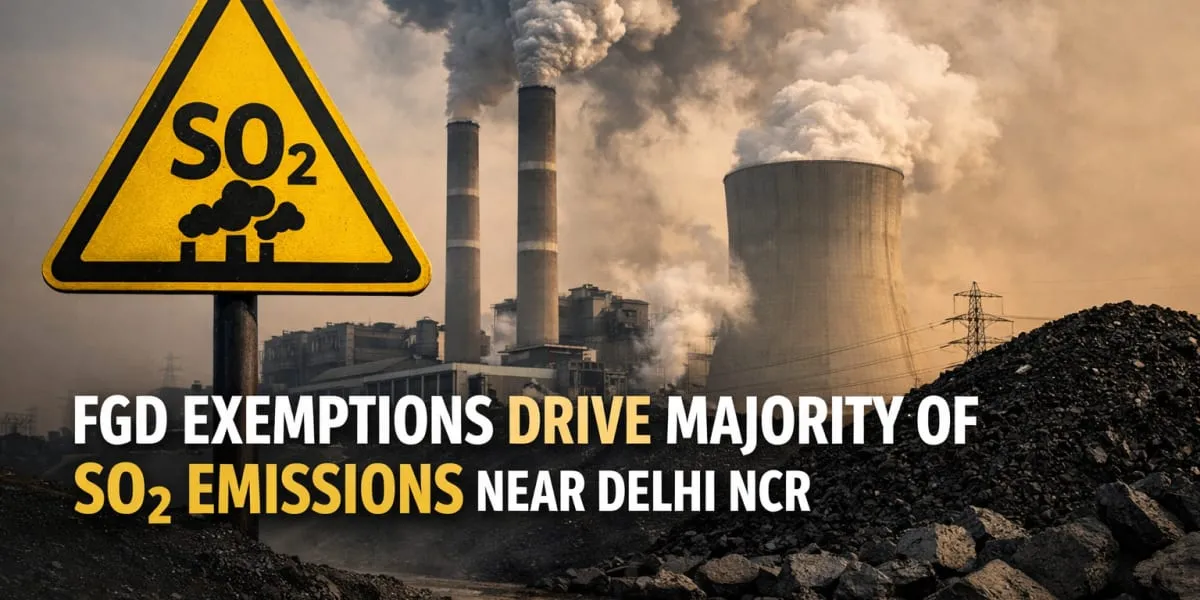
FGD Exemptions Drive Majority of SO2 Emissions Near Delhi NCR

A report by the Centre for Research on Energy and Clean Air (CREA) found that at least 81 per cent of sulphur dioxide emissions from coal-fired power plants within 300 km of Delhi-NCR originated from units exempted from installing flue gas desulphurisation (FGD) systems. CREA analysed emissions from 25 of the 37 coal-fired power plants in the zone for which public data were available and estimated total emissions of 154,000 tonne (t) of SO2 in 2025.

CREA noted that about 90 per cent of that estimated SO2 came from plants operating without FGD systems and that 81 per cent of the emissions were attributable to Category C plants removed from mandatory SO2 control by the July 2025 notification. The analysis therefore attributed the bulk of regional SO2 releases to units no longer required to fit controls under the revised rules.

Under the government’s 2015 emission standards all coal-fired power plants were required to install FGDs, but the Ministry of Environment, Forest and Climate Change revised the obligation in July 2025. The notification resulted in 78 per cent of India’s coal-fired units being exempted from mandatory SO2 control, with 11 per cent assessed on a case-by-case basis and 11 per cent remaining subject to the requirement.

The report recalled that India is the world’s largest SO2 emitter in the power sector, releasing over six mn t annually, and used plant-level comparisons to illustrate the impact of controls. Mahatma Gandhi Thermal Power Plant Units one and two, fitted with FGDs, generate roughly 3,400-4,000 mn units of electricity each year while emitting an estimated 1,775 t and 2,154 t of SO2 respectively.

By contrast, Rajpura Thermal Power Plant Units one and two log similar generation but emit an estimated 20,851 t and 22,690 t of SO2 without effective controls, making them the largest emitters in the assessed set. CREA recommended reinstating mandatory FGD installation for all coal-fired plants, making Continuous Emission Monitoring Systems (CEMS) data publicly available and disclosing the operational status of FGDs to strengthen compliance and reduce air pollution and health harm.

"Join industry leaders at RAHSTA Expo, India's premier platform for roads, highways and traffic infrastructure. Register now to explore innovations, network with experts and shape the future of mobility."

A report by the Centre for Research on Energy and Clean Air (CREA) found that at least 81 per cent of sulphur dioxide emissions from coal-fired power plants within 300 km of Delhi-NCR originated from units exempted from installing flue gas desulphurisation (FGD) systems. CREA analysed emissions from 25 of the 37 coal-fired power plants in the zone for which public data were available and estimated total emissions of 154,000 tonne (t) of SO2 in 2025. CREA noted that about 90 per cent of that estimated SO2 came from plants operating without FGD systems and that 81 per cent of the emissions were attributable to Category C plants removed from mandatory SO2 control by the July 2025 notification. The analysis therefore attributed the bulk of regional SO2 releases to units no longer required to fit controls under the revised rules. Under the government’s 2015 emission standards all coal-fired power plants were required to install FGDs, but the Ministry of Environment, Forest and Climate Change revised the obligation in July 2025. The notification resulted in 78 per cent of India’s coal-fired units being exempted from mandatory SO2 control, with 11 per cent assessed on a case-by-case basis and 11 per cent remaining subject to the requirement. The report recalled that India is the world’s largest SO2 emitter in the power sector, releasing over six mn t annually, and used plant-level comparisons to illustrate the impact of controls. Mahatma Gandhi Thermal Power Plant Units one and two, fitted with FGDs, generate roughly 3,400-4,000 mn units of electricity each year while emitting an estimated 1,775 t and 2,154 t of SO2 respectively. By contrast, Rajpura Thermal Power Plant Units one and two log similar generation but emit an estimated 20,851 t and 22,690 t of SO2 without effective controls, making them the largest emitters in the assessed set. CREA recommended reinstating mandatory FGD installation for all coal-fired plants, making Continuous Emission Monitoring Systems (CEMS) data publicly available and disclosing the operational status of FGDs to strengthen compliance and reduce air pollution and health harm.

Next Story
Infrastructure Urban

Ion Exchange Wins USD 52.83 Million Supply Contract From Hyundai

Ion Exchange (India) (Ion Exchange) has been awarded an international contract by Hyundai Engineering and Construction Co., (Hyundai Engineering) for the supply of filtration units in the Middle East. The contract is valued at USD 52.83 million and is to be executed over a period of 18 months. The order aggregates to approximately Rs 5.03 bn based on the prevailing exchange rate. Delivery schedules and technical specifications will be governed by the contract terms. The scope covers manufacture and supply of filtration units to be deployed across projects in the Middle East and follows the pro..

Next Story
Infrastructure Urban

3i Infotech Subsidiary Wins Talent Deployment Contract With Krung Thai Bank

3i Infotech (Thailand), a wholly owned step down subsidiary of 3i Infotech, has won a contract from Krung Thai Bank Public Company on nine July 2026. The order covers talent deployment to support application development, enhancement, testing and digital transformation programmes. Roles specified include full stack development, backend development in Java, frontend development using Angular, DevOps engineering, quality assurance and test automation, business analysis and solution architecture. The engagement reflects the subsidiary's continued focus on banking technology services in the region...

Next Story
Infrastructure Urban

HFCL Secures Export Order For Data Centre Fibre Connectivity

HFCL (HFCL) has secured an export order worth US dollar (USD) 51.98 million (mn), equivalent to Rs 4,958 mn, for the supply of optical fibre cable based data centre connectivity solutions through its overseas wholly owned material subsidiary. The contract was awarded by an international customer and underscores HFCL's manufacturing capabilities, technological competence and product quality in global markets. The company stated the award arises from normal business operations and aligns with its export strategy. The scope covers the supply of optical fibre cable based data centre connectivity s..

Advertisement

Subscribe to Our Newsletter

Get daily newsletters around different themes from Construction world.

STAY CONNECTED

Advertisement

Advertisement

Advertisement