+
GeM Marks Seven Years of SWAYATT Boosting Inclusive Procurement
ECONOMY & POLICY

GeM Marks Seven Years of SWAYATT Boosting Inclusive Procurement

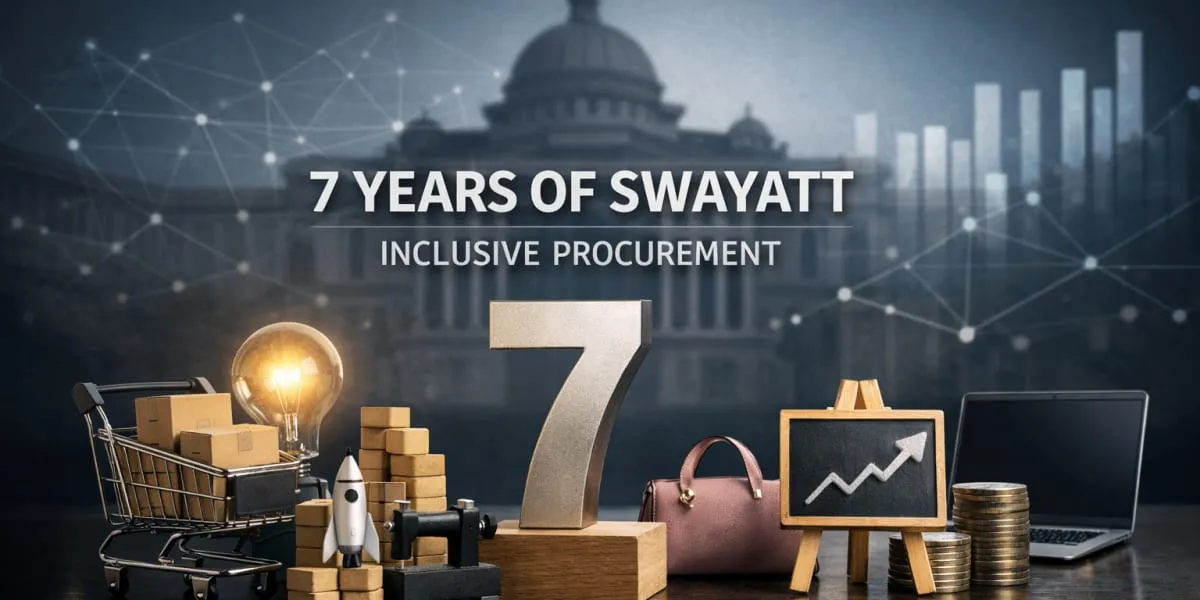
Government e-Marketplace (GeM) marked the seven-year journey of the SWAYATT initiative, stressing efforts to make public procurement more inclusive for startups, women entrepreneurs and youth. Launched on 19 February 2019, SWAYATT was designed to democratise government procurement by enabling startups, women entrepreneurs, youth, micro and small enterprises, self help groups and last-mile sellers to participate directly through GeM. The initiative seeks to reduce entry barriers for emerging enterprises by widening access to government markets through digital procurement infrastructure.

SWAYATT concentrates on access to markets, access to finance and access to value addition, tackling challenges faced by emerging enterprises. The programme supports capacity building, outreach and dedicated storefronts such as Startup Runway and Womaniya to improve discoverability among buyers. A commemorative programme at the GeM office brought together policymakers, founders and ecosystem partners to reflect on impact and roadmap.

Senior officials including the Additional Chief Executive Officer, Ajit B. Chavan, presented perspectives on SWAYATT and representatives from NEDAR Foundation, the Ministry of Micro, Small and Medium Enterprises and the Department for Promotion of Industry and Internal Trade also addressed the event. Entrepreneurs recounted participation experiences on GeM, with founders from Club First Robotics and Surprise Someone describing how the platform enabled access to government markets and business scaling. The Chief Executive Officer of GeM, Mihir Kumar, said SWAYATT embodies GeM's vision of inclusive procurement through technology and partnerships.

The initiative's impact is reflected in transaction values and volumes. Women entrepreneurs saw cumulative order values rise from Rs12,656.2 mn in FY 2018–19 to Rs833,230 mn by FY 2025–26, while order volumes increased from 101,530 to 4,448,894. Startups recorded growth from Rs4,972.4 mn in FY 2018–19 to Rs540,058 mn by FY 2025–26, with volumes expanding from 17,434 to 530,578. These outcomes indicate that SWAYATT has helped convert digital access into market participation.

Government e-Marketplace (GeM) marked the seven-year journey of the SWAYATT initiative, stressing efforts to make public procurement more inclusive for startups, women entrepreneurs and youth. Launched on 19 February 2019, SWAYATT was designed to democratise government procurement by enabling startups, women entrepreneurs, youth, micro and small enterprises, self help groups and last-mile sellers to participate directly through GeM. The initiative seeks to reduce entry barriers for emerging enterprises by widening access to government markets through digital procurement infrastructure. SWAYATT concentrates on access to markets, access to finance and access to value addition, tackling challenges faced by emerging enterprises. The programme supports capacity building, outreach and dedicated storefronts such as Startup Runway and Womaniya to improve discoverability among buyers. A commemorative programme at the GeM office brought together policymakers, founders and ecosystem partners to reflect on impact and roadmap. Senior officials including the Additional Chief Executive Officer, Ajit B. Chavan, presented perspectives on SWAYATT and representatives from NEDAR Foundation, the Ministry of Micro, Small and Medium Enterprises and the Department for Promotion of Industry and Internal Trade also addressed the event. Entrepreneurs recounted participation experiences on GeM, with founders from Club First Robotics and Surprise Someone describing how the platform enabled access to government markets and business scaling. The Chief Executive Officer of GeM, Mihir Kumar, said SWAYATT embodies GeM's vision of inclusive procurement through technology and partnerships. The initiative's impact is reflected in transaction values and volumes. Women entrepreneurs saw cumulative order values rise from Rs12,656.2 mn in FY 2018–19 to Rs833,230 mn by FY 2025–26, while order volumes increased from 101,530 to 4,448,894. Startups recorded growth from Rs4,972.4 mn in FY 2018–19 to Rs540,058 mn by FY 2025–26, with volumes expanding from 17,434 to 530,578. These outcomes indicate that SWAYATT has helped convert digital access into market participation.

Next Story
Infrastructure Urban

Implementation Status of Jal Jeevan Mission

Since August 2019 the Government has implemented Jal Jeevan Mission to provide assured potable water through household tap connections in rural India. At the start of the mission only 32.3 million (mn) rural households, representing 16.7 per cent, were reported to have tap water connections. States and union territories have reported that 125.8 mn additional rural households have since been provided with tap connections. As a result, of about 193.6 mn rural households roughly 158.2 mn, or 81.71 per cent, are reported to have tap water supply at home.\n\nThe State, district and village level st..

Next Story
Infrastructure Urban

Jal Jeevan Mission Reaches Eighty One Per Cent Rural Coverage

The Government reported substantial progress under the Jal Jeevan Mission, launched in August 2019 to provide tap water to every rural household. At launch only 32.3 million (mn) rural households had tap connections and states and Union territories reported provision of 125.8 mn additional households by March 2026. Consequently, out of about 193.6 mn rural households around 158.2 mn, or 81.71 per cent, are reported to have tap water at home. The Finance Minister announced extension of the mission until 2028 in the 2025-26 budget speech. The Swachh Bharat Mission Grameen, launched in October 20..

Next Story
Infrastructure Urban

Empowering Local Governance for Sustainable Rural Water Supply

The Ministry of Jal Shakti has aligned the Jal Jeevan Mission (JJM) with the 73rd Amendment to strengthen village level planning and community ownership of water supply. Gram Panchayats, village water and sanitation committees and Pani Samitis are to plan, implement, manage and maintain piped water systems, with gram sabha processes formalising handover and oversight. Implementation support agencies including non government organisations, community based organisations and self help groups have been empanelled to train local committees and promote women participation. Under JJM, the department ..

Advertisement

Subscribe to Our Newsletter

Get daily newsletters around different themes from Construction world.

STAY CONNECTED

Advertisement

Advertisement

Advertisement