Government Proposes Three Year PUCC Validity For BS-VI Vehicles
ECONOMY & POLICY

Government Proposes Three Year PUCC Validity For BS-VI Vehicles

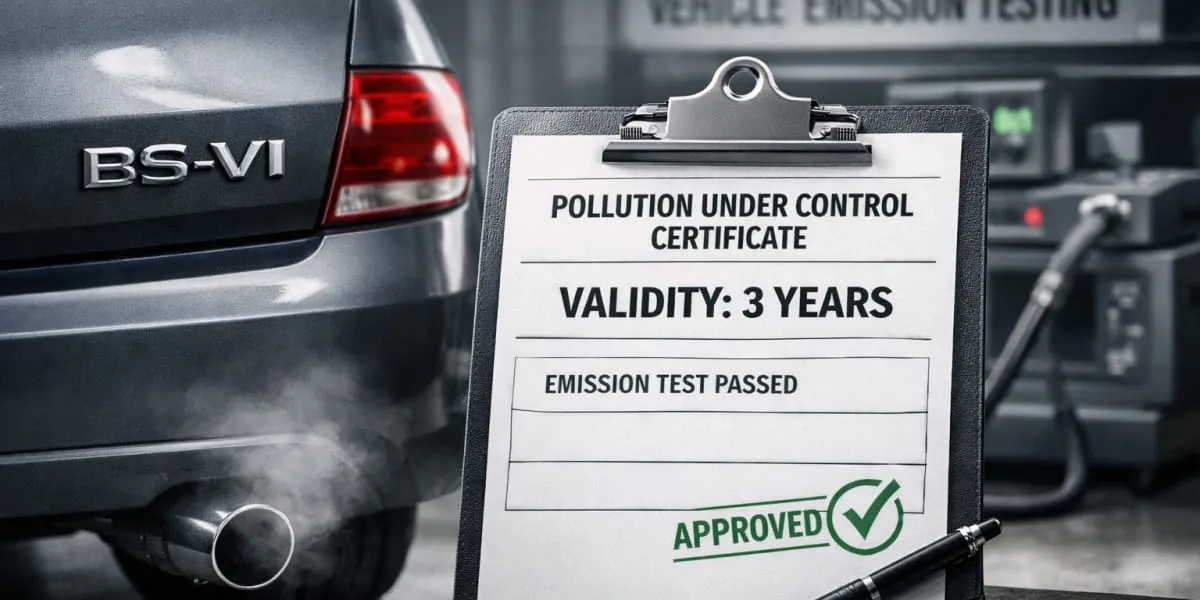
The government has proposed to extend the validity of the Pollution Under Control Certificate (PUCC) for private vehicles complying with Bharat Stage VI (BS-VI) emission standards to three years for vehicles up to six years old, instead of the current one year, in a move intended to ease the compliance burden on owners. The Ministry of Road Transport and Highways has published a draft notification setting out the change and the criteria for staggered renewal obligations. The proposal is presented as an administrative amendment to the existing PUCC regime.

The draft specifies that BS-VI vehicles aged between six and ten years will be required to renew their PUCC certificate and that vehicles above ten years will be subject to renewal every six years according to the text. Officials working on the notification have framed the schedule to reflect the durability and emissions profile of different vehicle cohorts. Motorists and fleet operators are expected to note the differentiated timelines for certificate validity.

The notification also clarifies that all motor vehicles complying with Bharat Stage IV (BS-IV) will need PUCC renewal every six months while those meeting Bharat Stage I, II and III norms will require renewal every three months. The ministry explained that the staggered intervals reflect the relative emissions performance and the need to phase out higher polluting vehicles more effectively. The move is intended to reduce administrative load on newer compliant vehicles while maintaining environmental safeguards.

Bharat Stage norms align with European emission standards and set limits on pollutants such as carbon monoxide, nitrogen oxides, hydrocarbons and particulate matter. BS-IV was applicable from 2017 to 2020 and BS-VI has been in force since April 2020 after India skipped BS-V to accelerate pollution control. The draft further noted that BS-VI vehicles emit far lower pollutants and require low-sulphur BS-VI fuel.

The government has proposed to extend the validity of the Pollution Under Control Certificate (PUCC) for private vehicles complying with Bharat Stage VI (BS-VI) emission standards to three years for vehicles up to six years old, instead of the current one year, in a move intended to ease the compliance burden on owners. The Ministry of Road Transport and Highways has published a draft notification setting out the change and the criteria for staggered renewal obligations. The proposal is presented as an administrative amendment to the existing PUCC regime. The draft specifies that BS-VI vehicles aged between six and ten years will be required to renew their PUCC certificate and that vehicles above ten years will be subject to renewal every six years according to the text. Officials working on the notification have framed the schedule to reflect the durability and emissions profile of different vehicle cohorts. Motorists and fleet operators are expected to note the differentiated timelines for certificate validity. The notification also clarifies that all motor vehicles complying with Bharat Stage IV (BS-IV) will need PUCC renewal every six months while those meeting Bharat Stage I, II and III norms will require renewal every three months. The ministry explained that the staggered intervals reflect the relative emissions performance and the need to phase out higher polluting vehicles more effectively. The move is intended to reduce administrative load on newer compliant vehicles while maintaining environmental safeguards. Bharat Stage norms align with European emission standards and set limits on pollutants such as carbon monoxide, nitrogen oxides, hydrocarbons and particulate matter. BS-IV was applicable from 2017 to 2020 and BS-VI has been in force since April 2020 after India skipped BS-V to accelerate pollution control. The draft further noted that BS-VI vehicles emit far lower pollutants and require low-sulphur BS-VI fuel.

Next Story
Infrastructure Urban

SCLR Extension Nears Completion Linking BKC With Signal-Free Route

The Santacruz-Chembur Link Road (SCLR) extension towards Bandra-Kurla Complex (BKC) via the Mumbai University campus has entered its final stage, bringing motorists closer to a direct, signal-free connection between the Western Express Highway and the city’s commercial district. The elevated connector is being built as an arm from the SCLR alignment and will link the western suburbs with BKC without surface signals. The link is designed to reduce journey times for commuters travelling from the western suburbs to BKC and to improve access to eastern Mumbai. By carrying through traffic above s..

Next Story
Infrastructure Transport

Raiganj MP Seeks Bengal Only Highway Link To Siliguri

Raiganj Member of Parliament Kartik Chandra Paul met Union Minister for Road Transport and Highways Nitin Gadkari in New Delhi to press for a new stretch of national highway in North Dinajpur district. He urged approval for a Bengal-to-Bengal link that would connect National Highways 12 and 27 to allow vehicles bound for Siliguri to avoid the current route through Kishanganj in neighbouring Bihar. He also submitted a proposed alignment of the new road to the ministry for consideration. At present vehicles from Raiganj travel along NH-12 and join NH-27 at Purnia More in Dalkhola, a route that p..

Next Story
Infrastructure Transport

Airport Kilambakkam Metro Line To Be Extended To Chengalpattu

Chennai Metro Rail (CMRL) has invited tenders for two detailed project reports that would extend its rail network to Chengalpattu in the south and extend Corridor-5 to Wimco Nagar in the north as part of a second wave of expansion beyond the operator's corridors under construction. The move signals an acceleration of planning for suburban links and interchange nodes. The larger of the two studies covers a roughly 27km extension from the planned Kilambakkam metro station to Chengalpattu under Corridor-1, Phase I. CMRL floated the tender at an estimated cost of Rs 21.6 mn. The proposed line woul..

Advertisement

Subscribe to Our Newsletter

Get daily newsletters around different themes from Construction world.

STAY CONNECTED

Advertisement

Advertisement

Advertisement