Goyal Calls For Trillion-Dollar Tech Ambition By 2035
ECONOMY & POLICY

Goyal Calls For Trillion-Dollar Tech Ambition By 2035

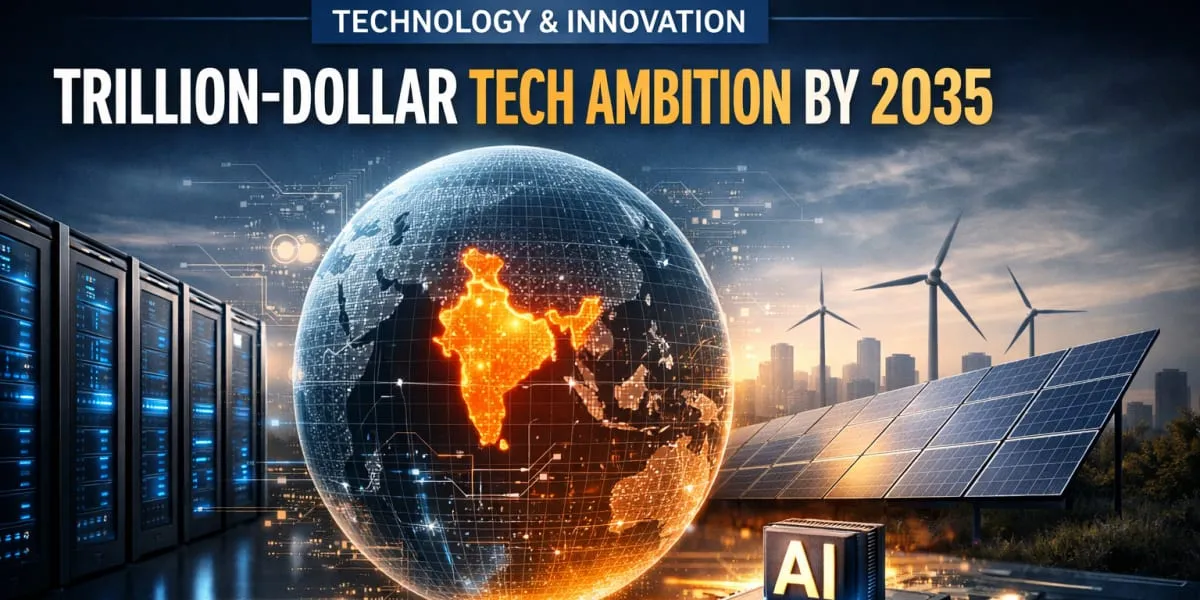
The Union minister of commerce and industry urged India’s technology sector to reset ambitions towards a trillion-dollar future by 2035 and embrace artificial intelligence (AI), data centres and clean energy. He launched NITI Frontier Tech Hub roadmap titled Reimagination Ahead and said India should target at least 10 gigawatt (GW) of data centre capacity by 2030 and become a global hub for AI driven services. He said emphasis should be on applied AI, reskilling at scale, domestic value creation and talent retention.

He noted India has nearly one billion internet users and high per capita data consumption, and that affordable data, 5G rollout and upcoming 6G capabilities have strengthened the digital ecosystem. He said these factors support $250–$300 billion (bn) technology services industry and provide a foundation for expansion. He called on industry to leverage domestic demand and focus on value creation.

He attributed growth to infrastructure reforms and said the 1999 New Telecom Policy under Prime Minister Atal Bihari Vajpayee laid the groundwork for digital transformation. He said post-2014 measures have strengthened India’s unified national power grid, which now has 500 GW installed capacity including 250 GW of clean energy. He added that renewable expansion has been supported by transparent reverse bidding.

He said reverse bidding brought solar tariffs down to nearly Rs2.31–Rs2.41 per unit and wind tariffs to Rs2.5 per unit, and that India supplies 24 hour clean energy under Rs6 per kilowatt hour. He said the country aims for 500 GW of renewable capacity by 2030. He indicated Budget measures offering income tax benefits up to 2047 will boost foreign direct investment, foreign exchange inflows and job creation around data centres.

He said clean energy integration, nuclear expansion, storage, green hydrogen and green ammonia initiatives will reinforce competitiveness. He urged widespread AI education for business leaders, policymakers and decision makers and emphasised cybersecurity, human validation and data integrity as critical. He proposed structured engagement between government and industry and coordinated action with states to streamline approvals and infrastructure for high intensity AI and data centre operations.

The Union minister of commerce and industry urged India’s technology sector to reset ambitions towards a trillion-dollar future by 2035 and embrace artificial intelligence (AI), data centres and clean energy. He launched NITI Frontier Tech Hub roadmap titled Reimagination Ahead and said India should target at least 10 gigawatt (GW) of data centre capacity by 2030 and become a global hub for AI driven services. He said emphasis should be on applied AI, reskilling at scale, domestic value creation and talent retention. He noted India has nearly one billion internet users and high per capita data consumption, and that affordable data, 5G rollout and upcoming 6G capabilities have strengthened the digital ecosystem. He said these factors support $250–$300 billion (bn) technology services industry and provide a foundation for expansion. He called on industry to leverage domestic demand and focus on value creation. He attributed growth to infrastructure reforms and said the 1999 New Telecom Policy under Prime Minister Atal Bihari Vajpayee laid the groundwork for digital transformation. He said post-2014 measures have strengthened India’s unified national power grid, which now has 500 GW installed capacity including 250 GW of clean energy. He added that renewable expansion has been supported by transparent reverse bidding. He said reverse bidding brought solar tariffs down to nearly Rs2.31–Rs2.41 per unit and wind tariffs to Rs2.5 per unit, and that India supplies 24 hour clean energy under Rs6 per kilowatt hour. He said the country aims for 500 GW of renewable capacity by 2030. He indicated Budget measures offering income tax benefits up to 2047 will boost foreign direct investment, foreign exchange inflows and job creation around data centres. He said clean energy integration, nuclear expansion, storage, green hydrogen and green ammonia initiatives will reinforce competitiveness. He urged widespread AI education for business leaders, policymakers and decision makers and emphasised cybersecurity, human validation and data integrity as critical. He proposed structured engagement between government and industry and coordinated action with states to streamline approvals and infrastructure for high intensity AI and data centre operations.

Next Story
Infrastructure Urban

Güntner Showcases Cooling Tech at China Expo

Güntner showcased its latest refrigeration and air conditioning innovations at China Refrigeration 2026, highlighting digital intelligence and carbon-neutral solutions.The company presented its aicore™ Controls and IoT platform, designed to optimise energy consumption, enable remote monitoring and enhance lifecycle management of cooling systems. The solution integrates advanced controllers and cloud-based capabilities to improve operational efficiency and reduce energy use.Güntner also demonstrated advancements in heat pump technologies, including its role in projects such as the Ordos Zer..

Next Story
Real Estate

Superb Realty Ties Up with Praan for AI Air Tech

Superb Realty has partnered with Praan to deploy AI-powered autonomous air infrastructure across over one million sq ft of real estate in Mumbai, marking a significant move towards intelligent indoor environments.The rollout will begin at Superb Altura and expand across upcoming residential and mixed-use developments. The initiative aims to integrate real-time sensing, adaptive purification and AI-led optimisation to improve indoor air quality and occupant experience.Praan’s technology is designed to remove ultrafine particles significantly smaller than conventional systems and eliminate har..

Next Story
Technology

DAAKit Raises $138,000 in Pre-Seed Round

DAAKit has raised $138,000 in a pre-seed funding round led by Inflection Point Ventures to expand its hyperlocal fulfilment network and strengthen technology capabilities.The company plans to use the funds to launch 25 new dark stores across Tier I and Tier II cities, enhance its technology infrastructure, and expand its leadership and operations teams. Currently operational in Delhi, Gurugram, Mumbai, Bengaluru and Kolkata, DAAKit is also piloting expansion into Tier II markets through Lucknow.Built on an asset-light, technology-driven model, the platform enables brands to position inventory ..

Advertisement

Subscribe to Our Newsletter

Get daily newsletters around different themes from Construction world.

STAY CONNECTED

Advertisement

Advertisement

Advertisement