+
ICDS 2026 Launches Guidelines And Digital Platforms For Dam Safety
ECONOMY & POLICY

ICDS 2026 Launches Guidelines And Digital Platforms For Dam Safety

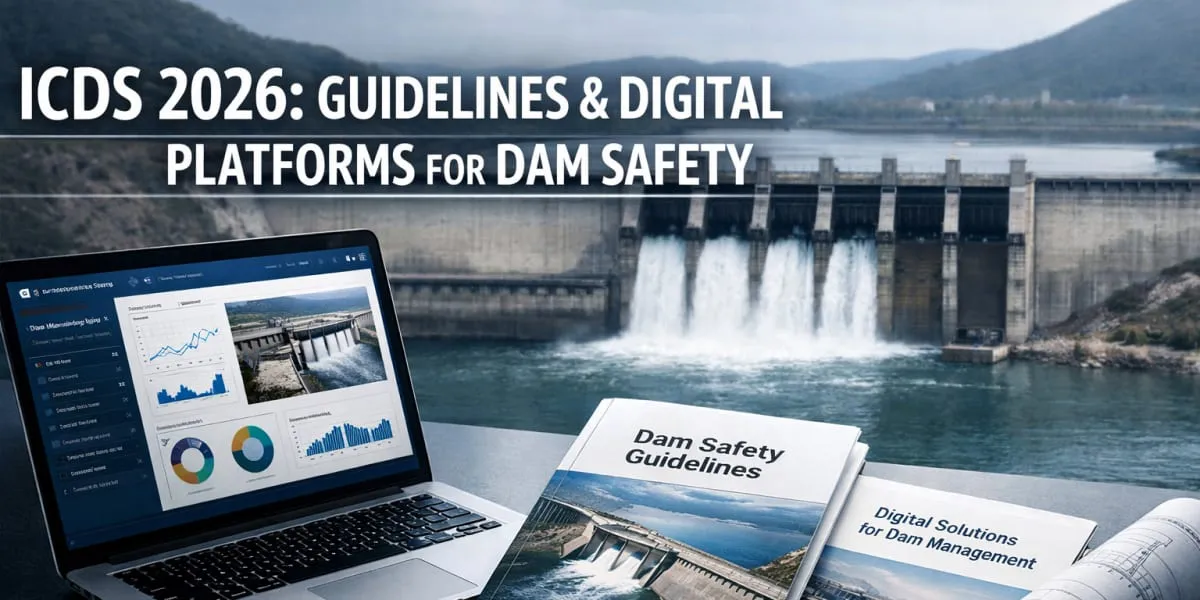
The International Conference on Dam Safety (ICDS) 2026 marked the release of key guidelines and the launch of digital platforms to strengthen dam safety governance in India. The conference brought together regulators, dam owners, engineers, researchers, policymakers and industry professionals to exchange insights on regulatory frameworks and risk-informed approaches. It aimed to support capacity building and collaboration for more resilient dam infrastructure amid changing climatic and developmental contexts.

Among the launches was DAMCHAT, an AI-powered dam safety knowledge platform developed by the International Centre of Excellence for Dams (ICED) at the Indian Institute of Technology Roorkee. The platform, launched by D.K. Shivakumar, Deputy Chief Minister of Karnataka, enables dam owners, engineers and field officials to query regulatory documentation and receive source-cited responses in real time. It is intended to support informed decision making and improve compliance across the sector.

The Jal Shakti data management and decision support platform was launched by Raj Bhushan Choudary, Union Minister of State for the Ministry of Jal Shakti, and developed by the National Water Informatics Centre (NWIC) with technical support from BISAG-N. The platform enables visualisation and analysis of water data from multiple national and state agencies and currently hosts 59 use cases across data groups such as Water Quantity, Water Quality, Water Planning, Ecosystem and Wildlife, Infrastructure, Climate and Utilities, Studies and Surveys. It offers tools for policymakers, researchers and administrators to explore critical water issues.

Publications from the Advanced Centre for Integrated Water Resources Management (ACIWRM), Karnataka, and guidelines on design flood estimation for dams with mini and micro catchment areas developed by the Central Water Commission (CWC) were also released. The guidelines, released by Siddaramaiah, Chief Minister of Karnataka, aim to address practices that focus only on peak flood estimation by providing procedures to derive full flood hydrographs required for dam break and downstream impact studies. The framework is expected to enable uniform, transparent and technically sound flood studies and support implementation of the Dam Safety Act, 2021.

The International Conference on Dam Safety (ICDS) 2026 marked the release of key guidelines and the launch of digital platforms to strengthen dam safety governance in India. The conference brought together regulators, dam owners, engineers, researchers, policymakers and industry professionals to exchange insights on regulatory frameworks and risk-informed approaches. It aimed to support capacity building and collaboration for more resilient dam infrastructure amid changing climatic and developmental contexts. Among the launches was DAMCHAT, an AI-powered dam safety knowledge platform developed by the International Centre of Excellence for Dams (ICED) at the Indian Institute of Technology Roorkee. The platform, launched by D.K. Shivakumar, Deputy Chief Minister of Karnataka, enables dam owners, engineers and field officials to query regulatory documentation and receive source-cited responses in real time. It is intended to support informed decision making and improve compliance across the sector. The Jal Shakti data management and decision support platform was launched by Raj Bhushan Choudary, Union Minister of State for the Ministry of Jal Shakti, and developed by the National Water Informatics Centre (NWIC) with technical support from BISAG-N. The platform enables visualisation and analysis of water data from multiple national and state agencies and currently hosts 59 use cases across data groups such as Water Quantity, Water Quality, Water Planning, Ecosystem and Wildlife, Infrastructure, Climate and Utilities, Studies and Surveys. It offers tools for policymakers, researchers and administrators to explore critical water issues. Publications from the Advanced Centre for Integrated Water Resources Management (ACIWRM), Karnataka, and guidelines on design flood estimation for dams with mini and micro catchment areas developed by the Central Water Commission (CWC) were also released. The guidelines, released by Siddaramaiah, Chief Minister of Karnataka, aim to address practices that focus only on peak flood estimation by providing procedures to derive full flood hydrographs required for dam break and downstream impact studies. The framework is expected to enable uniform, transparent and technically sound flood studies and support implementation of the Dam Safety Act, 2021.

Next Story
Equipment

Kabelschlepp India Installs Robotic VMC in Bengaluru

Kabelschlepp India, part of the Tsubaki Group, has installed a state-of-the-art Vertical Machining Center (VMC) integrated with robotic automation at its Bengaluru facility. The inauguration was held in the presence of Henning Preis, President & CEO, Kabelschlepp Group, Jörg Schulz, Vice President – Production, and Srinivas P. Kamisetty, Managing Director, Kabelschlepp India.The high-precision CNC VMC is designed for advanced milling, drilling, tapping and multi-axis machining. Equipped with a vertical spindle orientation, automatic tool changer and intelligent CNC control system, it en..

Next Story
Infrastructure Transport

Highway Delivery Reset!

Project delays and inefficiencies continue to bedevil the progress of India’s National Highways network. A multi-pronged reform agenda is needed to inject greater transparency and accountability at every stage – from planning and procurement to execution, maintenance and oversight. This article offers key recommendations and reform strategies that government stakeholders – from the Ministry of Road Transport & Highways (MoRTH) and the National Highways Authority of India (NHAI) to state agencies and oversight bodies – should pursue to put highway development on a better track.Decen..

Next Story
Infrastructure Transport

MSIDC Executes ₹37,000 Crore Road Programme

With Rs 37,000 crore worth of road projects under execution across Maharashtra, Maharashtra State Infrastructure Development Corporation (MSIDC) is driving one of the state’s largest infrastructure programmes. Dr Brijesh Dixit, Managing Director, discusses the institutional reforms, execution frameworks, financing strategies and technology adoption enabling timely, high-quality delivery, in conversation with PRATAP PADODE, Editor-in-Chief, CW.With over Rs 37,000 crore worth of road projects underway across districts – many under tight timelines – what institutional and executio..

Advertisement

Subscribe to Our Newsletter

Get daily newsletters around different themes from Construction world.

STAY CONNECTED

Advertisement

Advertisement

Advertisement

Open In App