


+
India Advances New Generation Free Trade Agreements
ECONOMY & POLICY

India Advances New Generation Free Trade Agreements

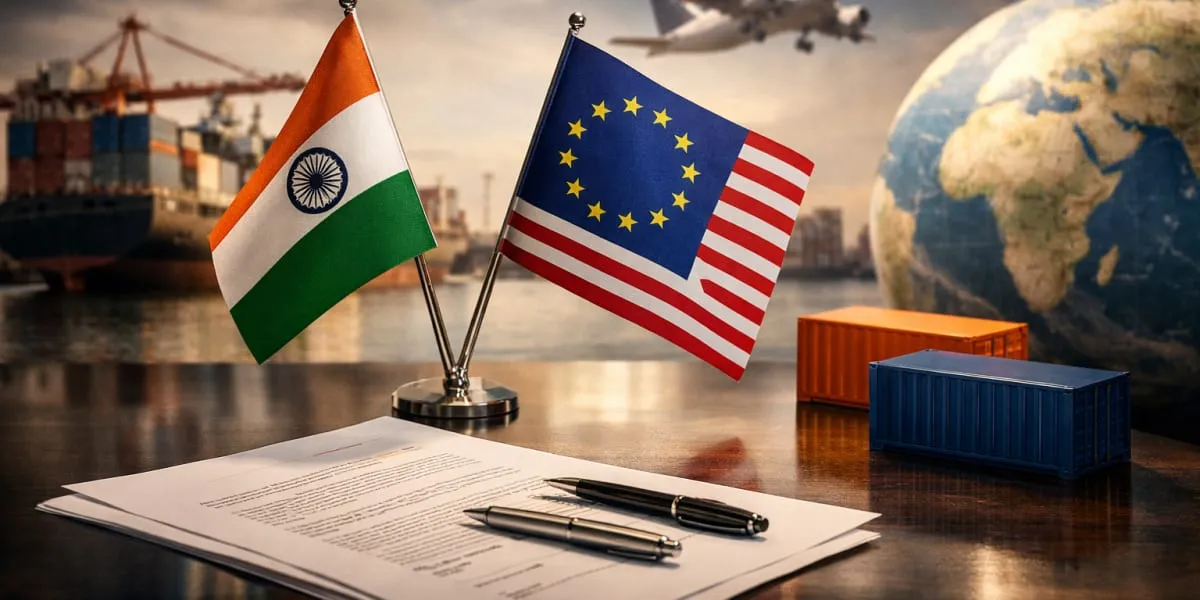
Over the past one decade India has pursued an ambitious agenda of modern free trade agreements, redrawing its global trade engagement and delivering a new generation of comprehensive accords. The government has steadily expanded its network to nine free trade agreements (FTAs) spanning 38 countries, with pacts moving from India–Mauritius in 2021 to the India–EU FTA announced on 27 January 2026 and an interim framework with the United States agreed on 7 February 2026. Major milestones included implementation of the India–Australia Economic and Trade Agreement in December 2022, entry into force of the EFTA trade and economic partnership agreement on 1 October 2025, and signatures with the United Kingdom and Oman in 2025.

Each agreement has been framed to reflect the scale of India's market and its economic potential, addressing the needs of one point four billion (bn) Indians while protecting national priorities. The accords are intended to open developed markets for farmers and to enhance competitiveness for entrepreneurs and women-led micro, small and medium enterprises exporting garments, leather and handicrafts. Sensitive sectors have been identified and safeguards have been incorporated to secure dairy, agriculture and domestic industry.

The instruments also seek to improve mobility and opportunities for students, IT professionals and other skilled service providers through clearer pathways, post-study work visas and social security arrangements. Attention has been given to trade in digital services, including enabling technologies such as artificial intelligence, and to traditional wellness, organic produce and AYUSH systems. Promotion of these sectors is expected to catalyse investment and deepen economic linkages with partner countries.

Negotiations have been presented as balanced and aligned with the objective of an atmanirbhar bharat, combining openness with protections for vulnerable stakeholders and market access commitments. The government has positioned the FTAs as a tool for structural transformation that will support jobs, exports and the strategic ambition of Viksit Bharat by 2047. A detailed summary and key highlights have been published by the Ministry of Commerce and Industry.

Over the past one decade India has pursued an ambitious agenda of modern free trade agreements, redrawing its global trade engagement and delivering a new generation of comprehensive accords. The government has steadily expanded its network to nine free trade agreements (FTAs) spanning 38 countries, with pacts moving from India–Mauritius in 2021 to the India–EU FTA announced on 27 January 2026 and an interim framework with the United States agreed on 7 February 2026. Major milestones included implementation of the India–Australia Economic and Trade Agreement in December 2022, entry into force of the EFTA trade and economic partnership agreement on 1 October 2025, and signatures with the United Kingdom and Oman in 2025. Each agreement has been framed to reflect the scale of India's market and its economic potential, addressing the needs of one point four billion (bn) Indians while protecting national priorities. The accords are intended to open developed markets for farmers and to enhance competitiveness for entrepreneurs and women-led micro, small and medium enterprises exporting garments, leather and handicrafts. Sensitive sectors have been identified and safeguards have been incorporated to secure dairy, agriculture and domestic industry. The instruments also seek to improve mobility and opportunities for students, IT professionals and other skilled service providers through clearer pathways, post-study work visas and social security arrangements. Attention has been given to trade in digital services, including enabling technologies such as artificial intelligence, and to traditional wellness, organic produce and AYUSH systems. Promotion of these sectors is expected to catalyse investment and deepen economic linkages with partner countries. Negotiations have been presented as balanced and aligned with the objective of an atmanirbhar bharat, combining openness with protections for vulnerable stakeholders and market access commitments. The government has positioned the FTAs as a tool for structural transformation that will support jobs, exports and the strategic ambition of Viksit Bharat by 2047. A detailed summary and key highlights have been published by the Ministry of Commerce and Industry.

Next Story
Infrastructure Urban

Implementation Status of Jal Jeevan Mission

Since August 2019 the Government has implemented Jal Jeevan Mission to provide assured potable water through household tap connections in rural India. At the start of the mission only 32.3 million (mn) rural households, representing 16.7 per cent, were reported to have tap water connections. States and union territories have reported that 125.8 mn additional rural households have since been provided with tap connections. As a result, of about 193.6 mn rural households roughly 158.2 mn, or 81.71 per cent, are reported to have tap water supply at home.\n\nThe State, district and village level st..

Next Story
Infrastructure Urban

Jal Jeevan Mission Reaches Eighty One Per Cent Rural Coverage

The Government reported substantial progress under the Jal Jeevan Mission, launched in August 2019 to provide tap water to every rural household. At launch only 32.3 million (mn) rural households had tap connections and states and Union territories reported provision of 125.8 mn additional households by March 2026. Consequently, out of about 193.6 mn rural households around 158.2 mn, or 81.71 per cent, are reported to have tap water at home. The Finance Minister announced extension of the mission until 2028 in the 2025-26 budget speech. The Swachh Bharat Mission Grameen, launched in October 20..

Next Story
Infrastructure Urban

Empowering Local Governance for Sustainable Rural Water Supply

The Ministry of Jal Shakti has aligned the Jal Jeevan Mission (JJM) with the 73rd Amendment to strengthen village level planning and community ownership of water supply. Gram Panchayats, village water and sanitation committees and Pani Samitis are to plan, implement, manage and maintain piped water systems, with gram sabha processes formalising handover and oversight. Implementation support agencies including non government organisations, community based organisations and self help groups have been empanelled to train local committees and promote women participation. Under JJM, the department ..

Advertisement

Subscribe to Our Newsletter

Get daily newsletters around different themes from Construction world.

STAY CONNECTED

Advertisement

Advertisement

Advertisement