+
India and Rwanda Deepen Cooperation in AI and Bio-Manufacturing
ECONOMY & POLICY

India and Rwanda Deepen Cooperation in AI and Bio-Manufacturing

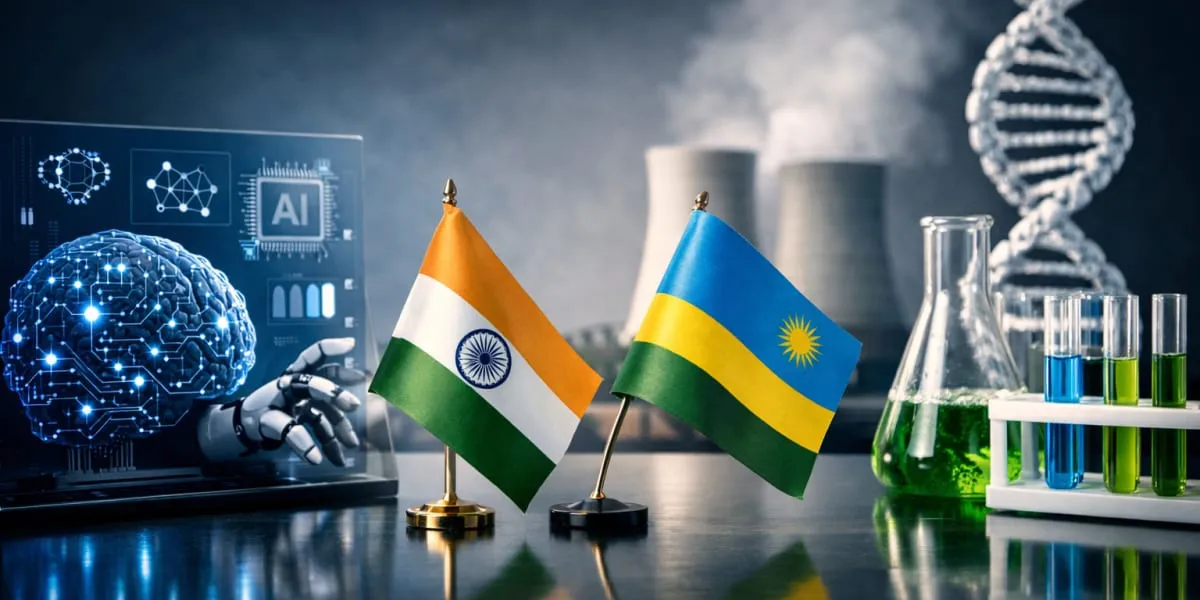
Union Minister Dr Jitendra Singh held bilateral talks with Rwanda's Minister of ICT and Innovation, Paula Ingabire, at Seva Teerth in New Delhi to explore a framework for cooperation in emerging technologies and innovation ecosystems. The Rwandan delegation included the High Commissioner to India and senior ministry officials.

Dr Jitendra Singh expressed India's readiness to deepen engagement with Rwanda across artificial intelligence, biotechnology, genomics and nuclear energy, and outlined an open model that unites government, industry, startups and academia for collaborative projects. He noted that space and nuclear sectors have been opened to private participation and referred to work on small modular reactors (SMRs) as an example of new collaboration opportunities.

The minister highlighted national initiatives in life sciences, genomics, gene therapy and bio-manufacturing, and cited the Bio-Manufacturing Shakti Mission with an initial allocation of Rs 100 billion (bn) to promote high quality, cost effective medical devices and advanced healthcare solutions. He said India had accelerated deep-tech research including quantum technologies, space applications and artificial intelligence, and emphasised the need for skills and technology transfer to scale benefits.

Rwanda outlined its ambition to become a Pan-African technology and innovation hub through initiatives such as Kigali Innovation City and the AI Scaling Hub, and emphasised investments in digital adoption and innovation led growth given that nearly 70 per cent of its 14 million (mn) population is below the age of 25. The Rwandan delegation expressed interest in collaboration on AI, health technologies, life sciences and energy, and in connecting innovation hubs, incubators and startups for mentoring, training and joint research.

Officials said a draft memorandum of understanding on science, technology and innovation cooperation had been shared and that both sides preferred to identify specific priority programmes and activities to ensure an outcome oriented agreement. They agreed to maintain close coordination through the High Commission and concerned ministries to finalise priority areas and pursue a structured time bound collaboration framework.

Union Minister Dr Jitendra Singh held bilateral talks with Rwanda's Minister of ICT and Innovation, Paula Ingabire, at Seva Teerth in New Delhi to explore a framework for cooperation in emerging technologies and innovation ecosystems. The Rwandan delegation included the High Commissioner to India and senior ministry officials. Dr Jitendra Singh expressed India's readiness to deepen engagement with Rwanda across artificial intelligence, biotechnology, genomics and nuclear energy, and outlined an open model that unites government, industry, startups and academia for collaborative projects. He noted that space and nuclear sectors have been opened to private participation and referred to work on small modular reactors (SMRs) as an example of new collaboration opportunities. The minister highlighted national initiatives in life sciences, genomics, gene therapy and bio-manufacturing, and cited the Bio-Manufacturing Shakti Mission with an initial allocation of Rs 100 billion (bn) to promote high quality, cost effective medical devices and advanced healthcare solutions. He said India had accelerated deep-tech research including quantum technologies, space applications and artificial intelligence, and emphasised the need for skills and technology transfer to scale benefits. Rwanda outlined its ambition to become a Pan-African technology and innovation hub through initiatives such as Kigali Innovation City and the AI Scaling Hub, and emphasised investments in digital adoption and innovation led growth given that nearly 70 per cent of its 14 million (mn) population is below the age of 25. The Rwandan delegation expressed interest in collaboration on AI, health technologies, life sciences and energy, and in connecting innovation hubs, incubators and startups for mentoring, training and joint research. Officials said a draft memorandum of understanding on science, technology and innovation cooperation had been shared and that both sides preferred to identify specific priority programmes and activities to ensure an outcome oriented agreement. They agreed to maintain close coordination through the High Commission and concerned ministries to finalise priority areas and pursue a structured time bound collaboration framework.

Next Story
Equipment

Kabelschlepp India Installs Robotic VMC in Bengaluru

Kabelschlepp India, part of the Tsubaki Group, has installed a state-of-the-art Vertical Machining Center (VMC) integrated with robotic automation at its Bengaluru facility. The inauguration was held in the presence of Henning Preis, President & CEO, Kabelschlepp Group, Jörg Schulz, Vice President – Production, and Srinivas P. Kamisetty, Managing Director, Kabelschlepp India.The high-precision CNC VMC is designed for advanced milling, drilling, tapping and multi-axis machining. Equipped with a vertical spindle orientation, automatic tool changer and intelligent CNC control system, it en..

Next Story
Infrastructure Transport

Highway Delivery Reset!

Project delays and inefficiencies continue to bedevil the progress of India’s National Highways network. A multi-pronged reform agenda is needed to inject greater transparency and accountability at every stage – from planning and procurement to execution, maintenance and oversight. This article offers key recommendations and reform strategies that government stakeholders – from the Ministry of Road Transport & Highways (MoRTH) and the National Highways Authority of India (NHAI) to state agencies and oversight bodies – should pursue to put highway development on a better track.Decen..

Next Story
Infrastructure Transport

MSIDC Executes ₹37,000 Crore Road Programme

With Rs 37,000 crore worth of road projects under execution across Maharashtra, Maharashtra State Infrastructure Development Corporation (MSIDC) is driving one of the state’s largest infrastructure programmes. Dr Brijesh Dixit, Managing Director, discusses the institutional reforms, execution frameworks, financing strategies and technology adoption enabling timely, high-quality delivery, in conversation with PRATAP PADODE, Editor-in-Chief, CW.With over Rs 37,000 crore worth of road projects underway across districts – many under tight timelines – what institutional and executio..

Advertisement

Subscribe to Our Newsletter

Get daily newsletters around different themes from Construction world.

STAY CONNECTED

Advertisement

Advertisement

Advertisement

Open In App