



India And UK Activate CETA And Social Security Pact
ECONOMY & POLICY

India And UK Activate CETA And Social Security Pact

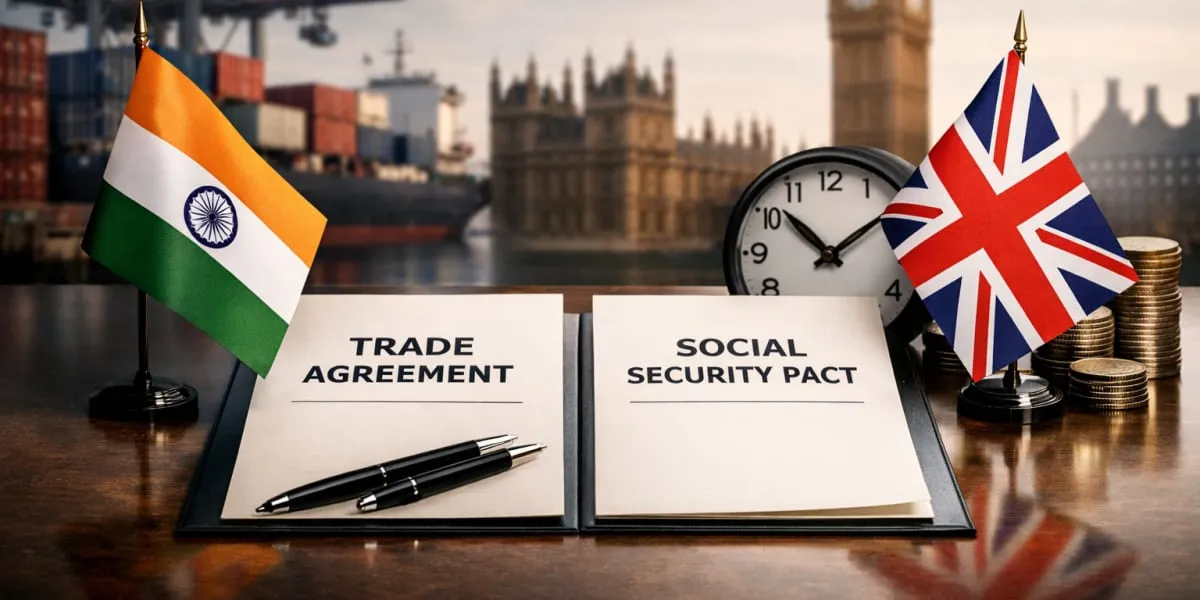
In a major diplomatic and commercial advance, India and the United Kingdom will bring the Comprehensive Economic and Trade Agreement (CETA) and the Agreement on Social Security, the Double Contribution Convention (DCC), into force on 15 July 2026. The DCC raises the exemption from social security contributions from three years to five years for temporary assignments. CETA will grant immediate zero-duty access on 99 per cent of India’s exports to the United Kingdom, covering nearly all bilateral trade value.

Negotiations concluded after 14 rounds, with the trade text finalised on 6 May 2025 and signatures exchanged on 24 July 2025; the social security pact was signed on 10 February 2026. The arrangements build on the Enhanced Trade Partnership and the India–UK Roadmap 2030, which seek to double bilateral trade to USD 100 billion (bn) by 2030. CETA comprises 30 chapters and modernises engagement across goods, services and newer disciplines such as digital trade, telecommunications and government procurement. The framework also embeds provisions for innovation, small and medium enterprises and sustainability.

The UK’s services commitments cover 137 sub-sectors and aim to expand access for Indian providers in information technology and IT-enabled services, finance, professional services and education. Mobility provisions create predictable pathways for business visitors, intra-corporate transferees, contractual service suppliers, independent professionals and investors, and allocate 1,800 annual slots for chefs, yoga instructors and classical musicians. CETA will eliminate major tariffs across processed food, marine, engineering, textiles and other goods while maintaining exclusion lists for sensitive agricultural items.

The social security pact is expected to benefit more than 75,000 Indian professionals and over 900 companies by preventing dual contributions during temporary postings and supporting continued coverage. The partners also agreed on measures to protect steel trade and reduce disruption from UK policies beginning 1 July 2026, placing 85 per cent of India’s exports outside those measures and providing targeted safeguards on remaining lines. Implementation is presented as a people-centric step to deepen economic ties, boost competitiveness and advance the long-term Viksit Bharat 2047 vision.

"Join industry leaders at RAHSTA Expo, India's premier platform for roads, highways and traffic infrastructure. Register now to explore innovations, network with experts and shape the future of mobility."

In a major diplomatic and commercial advance, India and the United Kingdom will bring the Comprehensive Economic and Trade Agreement (CETA) and the Agreement on Social Security, the Double Contribution Convention (DCC), into force on 15 July 2026. The DCC raises the exemption from social security contributions from three years to five years for temporary assignments. CETA will grant immediate zero-duty access on 99 per cent of India’s exports to the United Kingdom, covering nearly all bilateral trade value. Negotiations concluded after 14 rounds, with the trade text finalised on 6 May 2025 and signatures exchanged on 24 July 2025; the social security pact was signed on 10 February 2026. The arrangements build on the Enhanced Trade Partnership and the India–UK Roadmap 2030, which seek to double bilateral trade to USD 100 billion (bn) by 2030. CETA comprises 30 chapters and modernises engagement across goods, services and newer disciplines such as digital trade, telecommunications and government procurement. The framework also embeds provisions for innovation, small and medium enterprises and sustainability. The UK’s services commitments cover 137 sub-sectors and aim to expand access for Indian providers in information technology and IT-enabled services, finance, professional services and education. Mobility provisions create predictable pathways for business visitors, intra-corporate transferees, contractual service suppliers, independent professionals and investors, and allocate 1,800 annual slots for chefs, yoga instructors and classical musicians. CETA will eliminate major tariffs across processed food, marine, engineering, textiles and other goods while maintaining exclusion lists for sensitive agricultural items. The social security pact is expected to benefit more than 75,000 Indian professionals and over 900 companies by preventing dual contributions during temporary postings and supporting continued coverage. The partners also agreed on measures to protect steel trade and reduce disruption from UK policies beginning 1 July 2026, placing 85 per cent of India’s exports outside those measures and providing targeted safeguards on remaining lines. Implementation is presented as a people-centric step to deepen economic ties, boost competitiveness and advance the long-term Viksit Bharat 2047 vision.

Next Story
Infrastructure Transport

Railways To Operate Over 300 Special Trains For Rath Yatra

Union Railway Minister Ashwini Vaishnaw announced that Indian Railways (IR) will operate more than 300 special trains for the annual Jagannath Rath Yatra in Odisha and over 100 special trains during the Onam festival in Keralam. He flagged off the Nanded–Mumbai and Tanakpur–Nanded Express trains and inaugurated the extension of the Tanakpur–Pilibhit service up to Shahjahanpur via video conference from Rail Sadan in Bhubaneswar. He noted that the summer season, which concluded on 30 June, had seen a record 15,000 special trains. Vaishnaw stated that the newly launched services are intende..

Next Story
Infrastructure Transport

Vande Bharat Express To Start From Tripura Soon

Tripura Chief Minister Manik Saha said the Vande Bharat Express will commence operations from Tripura in the coming days after he flagged off the Agartala–Karimganj MEMU service at Agartala Railway Station. He recalled the rail history of the state, noting that a metre-gauge service first arrived in 1964 and that broad gauge reached Agartala in 2008 following national projects and later upgrades under the Act East policy. The event was described as a milestone for regional connectivity and the MEMU was presented as the first electric passenger train to originate from Tripura.\n\nSaha said he..

Next Story
Infrastructure Urban

MEMU Suspension Disrupts Commuters Between Vadodara And Dahod

The Vadodara–Dahod Mainline Electric Multiple Unit (MEMU) service has been temporarily suspended for 26 days after its rake was diverted to Odisha to manage the surge in passenger traffic during the annual Rath Yatra in Puri. Indian Railways redeployed several MEMU rakes from different zones to meet the additional travel demand for the festival scheduled from the seventh of July to the second of August. As a result, train numbers 69233 and 69234 operating between Vadodara and Dahod will remain cancelled for the duration. Railway authorities advised passengers to use alternative train service..

Advertisement

Subscribe to Our Newsletter

Get daily newsletters around different themes from Construction world.

STAY CONNECTED

Advertisement

Advertisement

Advertisement