India Commits Rs 200 Billion To Accelerate CCUS Deployment
ECONOMY & POLICY

India Commits Rs 200 Billion To Accelerate CCUS Deployment

Union Finance Minister Nirmala Sitharaman announced a commitment of Rs 200 billion (bn) over the next five years to accelerate Carbon Capture, Utilisation and Storage (CCUS) technologies across India. The funding aims to reduce industrial carbon emissions while supporting continued economic and industrial growth. The programme is intended to balance emissions reduction with the needs of key sectors fundamental to the national economy.

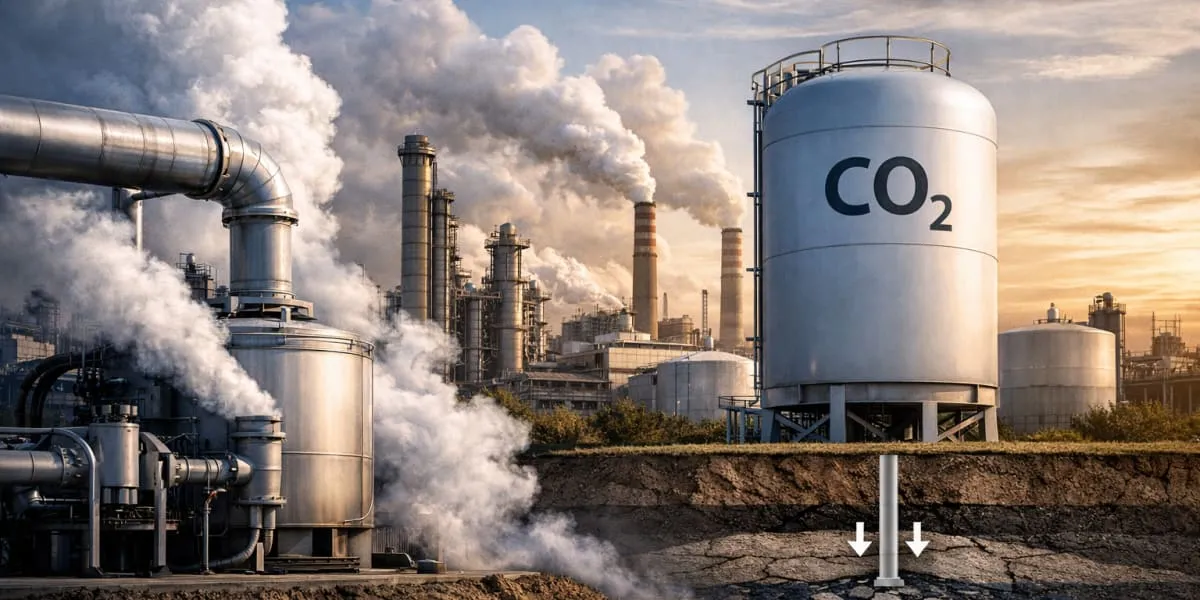
CCUS captures carbon dioxide emissions from industrial plants before release, with captured gas either utilised in chemical production or stored in underground geological formations. The government highlighted steel, cement, chemical manufacturing, power generation and oil refineries as primary beneficiaries because these sectors are hard to decarbonise through renewables alone. The policy seeks to make low carbon processes commercially viable in these industries.

Authorities plan to deploy the Rs 200 bn across research and development, pilot projects, carbon transport systems and storage infrastructure to foster domestic technological capability and reduce reliance on imported solutions. The initiative is described as a strategic response to evolving international trade measures, noting that the European Union carbon border mechanism is expected to impose additional charges on high carbon imports. By lowering product carbon intensity the government aims to preserve export competitiveness.

The package is projected to attract private investment through public private partnerships and to create skilled employment in carbon management and clean technology sectors. It forms part of a broader CCUS roadmap for 2025 and complements ongoing green infrastructure projects including high speed rail, renewable energy expansions and inland waterways development. Observers note that effective implementation and a clear regulatory framework for carbon markets and storage systems will be essential to realise the programme benefits.

"Join industry leaders at RAHSTA Expo, India's premier platform for roads, highways and traffic infrastructure. Register now to explore innovations, network with experts and shape the future of mobility."

Union Finance Minister Nirmala Sitharaman announced a commitment of Rs 200 billion (bn) over the next five years to accelerate Carbon Capture, Utilisation and Storage (CCUS) technologies across India. The funding aims to reduce industrial carbon emissions while supporting continued economic and industrial growth. The programme is intended to balance emissions reduction with the needs of key sectors fundamental to the national economy. CCUS captures carbon dioxide emissions from industrial plants before release, with captured gas either utilised in chemical production or stored in underground geological formations. The government highlighted steel, cement, chemical manufacturing, power generation and oil refineries as primary beneficiaries because these sectors are hard to decarbonise through renewables alone. The policy seeks to make low carbon processes commercially viable in these industries. Authorities plan to deploy the Rs 200 bn across research and development, pilot projects, carbon transport systems and storage infrastructure to foster domestic technological capability and reduce reliance on imported solutions. The initiative is described as a strategic response to evolving international trade measures, noting that the European Union carbon border mechanism is expected to impose additional charges on high carbon imports. By lowering product carbon intensity the government aims to preserve export competitiveness. The package is projected to attract private investment through public private partnerships and to create skilled employment in carbon management and clean technology sectors. It forms part of a broader CCUS roadmap for 2025 and complements ongoing green infrastructure projects including high speed rail, renewable energy expansions and inland waterways development. Observers note that effective implementation and a clear regulatory framework for carbon markets and storage systems will be essential to realise the programme benefits.

Next Story
Real Estate

India Office Leasing Hits 43 Million Sq Ft in H1 2026: Cushman & Wakefield

India's office market recorded its strongest first-half leasing performance on record, with gross leasing volume (GLV) reaching approximately 43 million sq ft in H1 2026, a five per cent year-on-year increase, according to Cushman & Wakefield's Q2 2026 Office Market Beat Report.Global Capability Centres (GCCs) remained the key demand driver, leasing 16.5 million sq ft, up around 38 per cent year on year, accounting for 38 per cent of total office demand. Bengaluru led GCC leasing with 5.36 million sq ft, followed by Pune, Delhi-NCR and Mumbai.Flexible workspace operators also posted their ..

Next Story
Products

Window Magic Opens Luxury Fenestration Experience Centre

Window Magic has launched Window Magic Atelier, a luxury fenestration experience centre in New Delhi, alongside WM AURA, its new ultra-luxury range of aluminium window, door and façade systems developed in collaboration with a European architectural systems specialist.The experience centre has been designed as an interactive space for architects, developers, interior designers and homeowners to explore premium aluminium and uPVC fenestration solutions through curated display zones showcasing the company's latest products and design capabilities.The newly launched WM AURA range features alumin..

Next Story
Real Estate

Peninsula Land Launches Villa Plot Project in Alibaug

Peninsula Land has launched Peninsula Estates, Alibaug ONE, an 11-acre plotted development offering 92 villa-ready plots in Alibaug, targeting homebuyers seeking low-density living within reach of Mumbai.The project offers plots ranging from 2,454 sq ft to 5,000 sq ft and is positioned around the concept of enabling buyers to build customised bungalows in one of the Mumbai Metropolitan Region's emerging growth corridors.According to the company, infrastructure projects such as the Mumbai Trans Harbour Link (Atal Setu), the upcoming Navi Mumbai International Airport, the Virar–Alibaug Multimo..

Advertisement

Subscribe to Our Newsletter

Get daily newsletters around different themes from Construction world.

STAY CONNECTED

Advertisement

Advertisement

Advertisement