

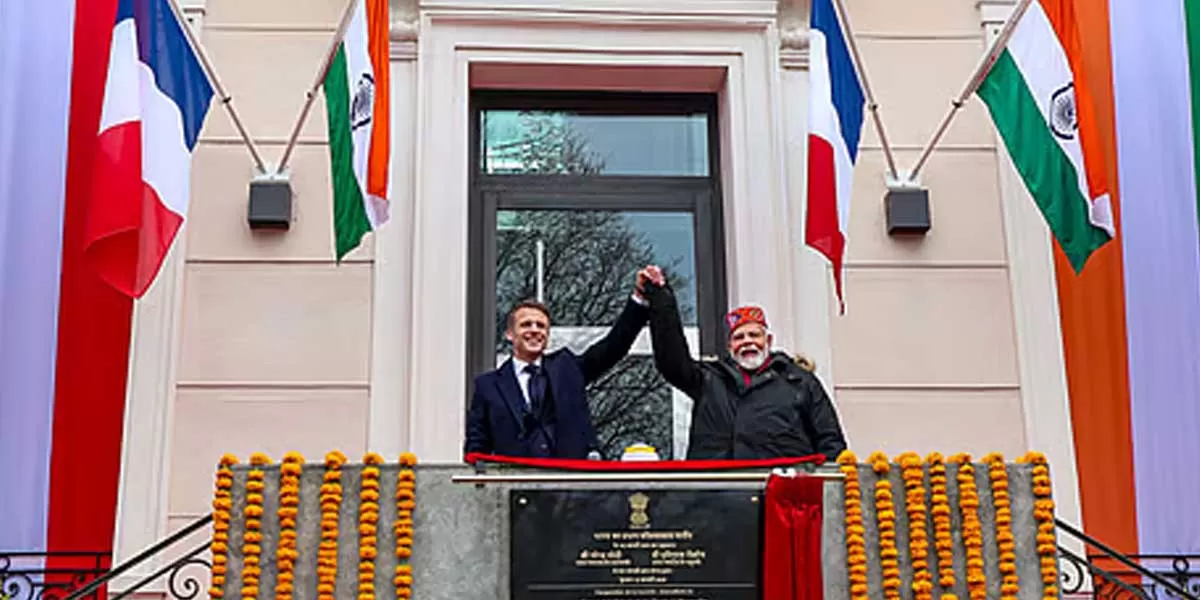



India, France to jointly develop N-reactors, AI
ECONOMY & POLICY

India, France to jointly develop N-reactors, AI

India and France decided to strengthen their strategic partnership as Prime Minister Narendra Modi sat down with French President Emmanuel Macron to firm up plans to bolster cooperation in nuclear energy and artificial intelligence (AI). 

Both countries will join hands to develop small modular reactors (SMRs) as well as advanced modular reactors (AMRs). New Delhi and Paris will also work together to develop safe, secure and trustworthy AI. France has already announced plans to invest €110 billion in AI. 

Modi and Macron agreed to enhance cooperation in the Indo-Pacific region with a joint declaration of intent for ‘triangular development’ to support the economic growth of countries in the region. 

The two leaders also visited Marseille—the second-most populous French city after Paris—where Macron hosted a private dinner for Modi. There they jointly inaugurated India’s Consulate General and toured the International Thermonuclear Experimental Reactor (ITER) facility. 

The bilateral roadmap on AI envisions that the norms reflect democratic values and promote human development.

India and France decided to strengthen their strategic partnership as Prime Minister Narendra Modi sat down with French President Emmanuel Macron to firm up plans to bolster cooperation in nuclear energy and artificial intelligence (AI). Both countries will join hands to develop small modular reactors (SMRs) as well as advanced modular reactors (AMRs). New Delhi and Paris will also work together to develop safe, secure and trustworthy AI. France has already announced plans to invest €110 billion in AI. Modi and Macron agreed to enhance cooperation in the Indo-Pacific region with a joint declaration of intent for ‘triangular development’ to support the economic growth of countries in the region. The two leaders also visited Marseille—the second-most populous French city after Paris—where Macron hosted a private dinner for Modi. There they jointly inaugurated India’s Consulate General and toured the International Thermonuclear Experimental Reactor (ITER) facility. The bilateral roadmap on AI envisions that the norms reflect democratic values and promote human development.

Next Story
Infrastructure Urban

Implementation Status of Jal Jeevan Mission

Since August 2019 the Government has implemented Jal Jeevan Mission to provide assured potable water through household tap connections in rural India. At the start of the mission only 32.3 million (mn) rural households, representing 16.7 per cent, were reported to have tap water connections. States and union territories have reported that 125.8 mn additional rural households have since been provided with tap connections. As a result, of about 193.6 mn rural households roughly 158.2 mn, or 81.71 per cent, are reported to have tap water supply at home.\n\nThe State, district and village level st..

Next Story
Infrastructure Urban

Jal Jeevan Mission Reaches Eighty One Per Cent Rural Coverage

The Government reported substantial progress under the Jal Jeevan Mission, launched in August 2019 to provide tap water to every rural household. At launch only 32.3 million (mn) rural households had tap connections and states and Union territories reported provision of 125.8 mn additional households by March 2026. Consequently, out of about 193.6 mn rural households around 158.2 mn, or 81.71 per cent, are reported to have tap water at home. The Finance Minister announced extension of the mission until 2028 in the 2025-26 budget speech. The Swachh Bharat Mission Grameen, launched in October 20..

Next Story
Infrastructure Urban

Empowering Local Governance for Sustainable Rural Water Supply

The Ministry of Jal Shakti has aligned the Jal Jeevan Mission (JJM) with the 73rd Amendment to strengthen village level planning and community ownership of water supply. Gram Panchayats, village water and sanitation committees and Pani Samitis are to plan, implement, manage and maintain piped water systems, with gram sabha processes formalising handover and oversight. Implementation support agencies including non government organisations, community based organisations and self help groups have been empanelled to train local committees and promote women participation. Under JJM, the department ..

Advertisement

Subscribe to Our Newsletter

Get daily newsletters around different themes from Construction world.

STAY CONNECTED

Advertisement

Advertisement

Advertisement















