India Inducts First Indigenous Hovercraft Into Coast Guard
ECONOMY & POLICY

India Inducts First Indigenous Hovercraft Into Coast Guard

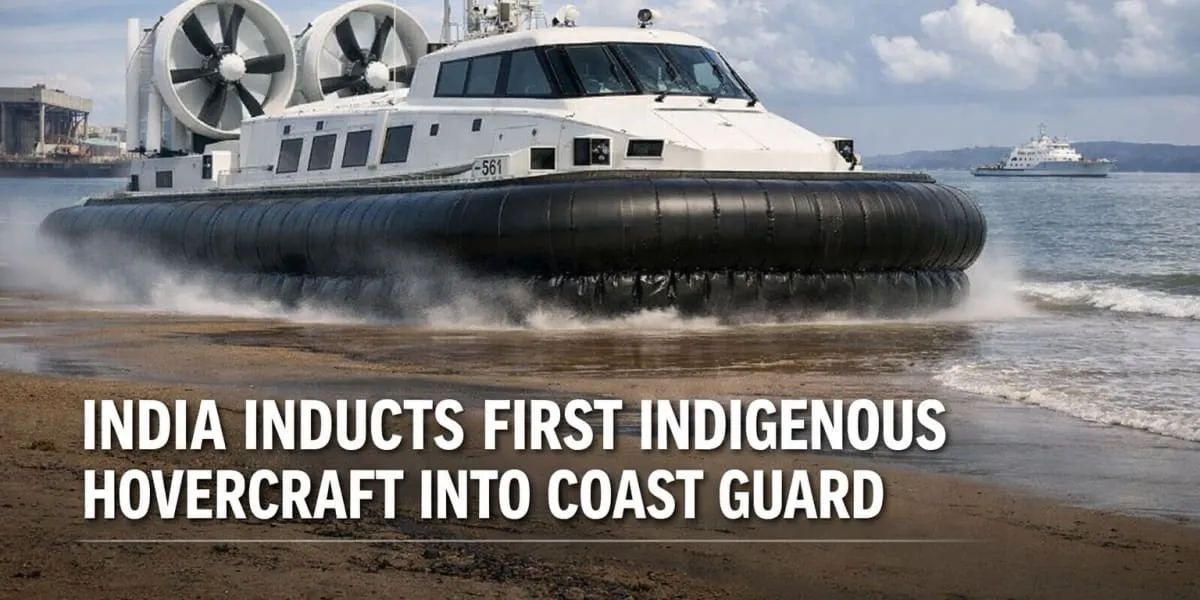
The Indian Coast Guard inducted its first indigenous Air Cushion Vehicle (ACV), designated H-561, on 18 June 2026. The craft was built at Chowgule & Company Private Limited's shipyard in Goa and is the first of six indigenous ACVs ordered for the force. The induction was presented as a milestone in local shipbuilding and maritime capability enhancement.

An Air Cushion Vehicle travels on a cushion of air created by lift fans and can operate over shallow water, mudflats, beaches and marshy terrain where conventional hull vessels face limits. ACVs enable rapid transit over mixed surfaces and reduce dependence on favourable water depth for littoral operations. Their design allows for quick deployment in search and rescue and humanitarian assistance missions.

The Indian Coast Guard uses hovercraft for coastal surveillance, rapid response, logistics and search and rescue along the littoral belt. ACVs are particularly suited to areas with sandbanks, tidal variation and low-support surfaces that restrict conventional craft. The service expects these platforms to augment patrol reach and operational flexibility.

The six ACVs are being built under an indigenous shipbuilding programme linked to Aatmanirbhar Bharat and a contract was reported as signed between the Ministry of Defence and Chowgule & Company Private Limited on 24 October 2026. Chowgule's yard in Goa was cited as the manufacturing site for the series and further vessels are under construction. Local construction of specialised platforms is intended to strengthen domestic industrial capacity and sustainment.

India's coastline spans 7,516.6 kilometres including island territories, and the Indian Coast Guard operates within the Exclusive Economic Zone and along the coastal belt for law enforcement and safety duties. The addition of hovercraft complements other assets used for anti-smuggling and maritime security tasks. The induction was portrayed as a practical enhancement to coastal response and shallow water capability.

"Join industry leaders at RAHSTA Expo, India's premier platform for roads, highways and traffic infrastructure. Register now to explore innovations, network with experts and shape the future of mobility."

The Indian Coast Guard inducted its first indigenous Air Cushion Vehicle (ACV), designated H-561, on 18 June 2026. The craft was built at Chowgule & Company Private Limited's shipyard in Goa and is the first of six indigenous ACVs ordered for the force. The induction was presented as a milestone in local shipbuilding and maritime capability enhancement. An Air Cushion Vehicle travels on a cushion of air created by lift fans and can operate over shallow water, mudflats, beaches and marshy terrain where conventional hull vessels face limits. ACVs enable rapid transit over mixed surfaces and reduce dependence on favourable water depth for littoral operations. Their design allows for quick deployment in search and rescue and humanitarian assistance missions. The Indian Coast Guard uses hovercraft for coastal surveillance, rapid response, logistics and search and rescue along the littoral belt. ACVs are particularly suited to areas with sandbanks, tidal variation and low-support surfaces that restrict conventional craft. The service expects these platforms to augment patrol reach and operational flexibility. The six ACVs are being built under an indigenous shipbuilding programme linked to Aatmanirbhar Bharat and a contract was reported as signed between the Ministry of Defence and Chowgule & Company Private Limited on 24 October 2026. Chowgule's yard in Goa was cited as the manufacturing site for the series and further vessels are under construction. Local construction of specialised platforms is intended to strengthen domestic industrial capacity and sustainment. India's coastline spans 7,516.6 kilometres including island territories, and the Indian Coast Guard operates within the Exclusive Economic Zone and along the coastal belt for law enforcement and safety duties. The addition of hovercraft complements other assets used for anti-smuggling and maritime security tasks. The induction was portrayed as a practical enhancement to coastal response and shallow water capability.

Next Story
Infrastructure Urban

PRS International marks 18 years of global advisory work

PRS International Group of Companies recently said it has strengthened its position as a sovereign-grade multinational advisory organisation, marking nearly 18 years of operations across strategic communications, institutional advisory and international cooperation. The Group, with headquarters in Washington, D.C. and New Delhi, said its work spans more than 190 countries and supports governments, multilateral institutions, investors, corporations and private clients. The organisation said its services cover government advisory, crisis management, trade and investment facilitation, nation bra..

Next Story
Infrastructure Urban

dormakaba showcases access solutions at iDAC Chandigarh

dormakaba recently participated in iDAC Chandigarh 2026 at JW Marriott, engaging with architects, interior designers, developers, hospitality professionals and industry experts. The access solutions brand showcased a range of security and architectural products, including Mechanical Key Systems, Digital Cylinder, C Lever, Lever Handle, AIDO’s SLYNK Profiled Door System and Hotel Lock. The company said AIDO’s solutions added a design-led architectural and hospitality dimension to its presence at the event. The SLYNK Profiled Door System drew attention for supporting modern interiors where ..

Next Story
Infrastructure Energy

Tata Power Secures Karnataka Transmission Project

Tata Power has won a power transmission project in Karnataka after emerging as the successful bidder in a tariff-based competitive bidding process run by PFC Consulting, a wholly owned subsidiary of Power Finance Corporation. The company received a Letter of Intent from PFC Consulting for a renewable energy evacuation scheme to be delivered under a Build, Own, Operate and Transfer model. The award follows a competitive selection and positions the firm to expand its transmission activities in the state. As part of the contract, Tata Power will acquire the special purpose vehicle (SPV) created f..

Advertisement

Subscribe to Our Newsletter

Get daily newsletters around different themes from Construction world.

STAY CONNECTED

Advertisement

Advertisement

Advertisement