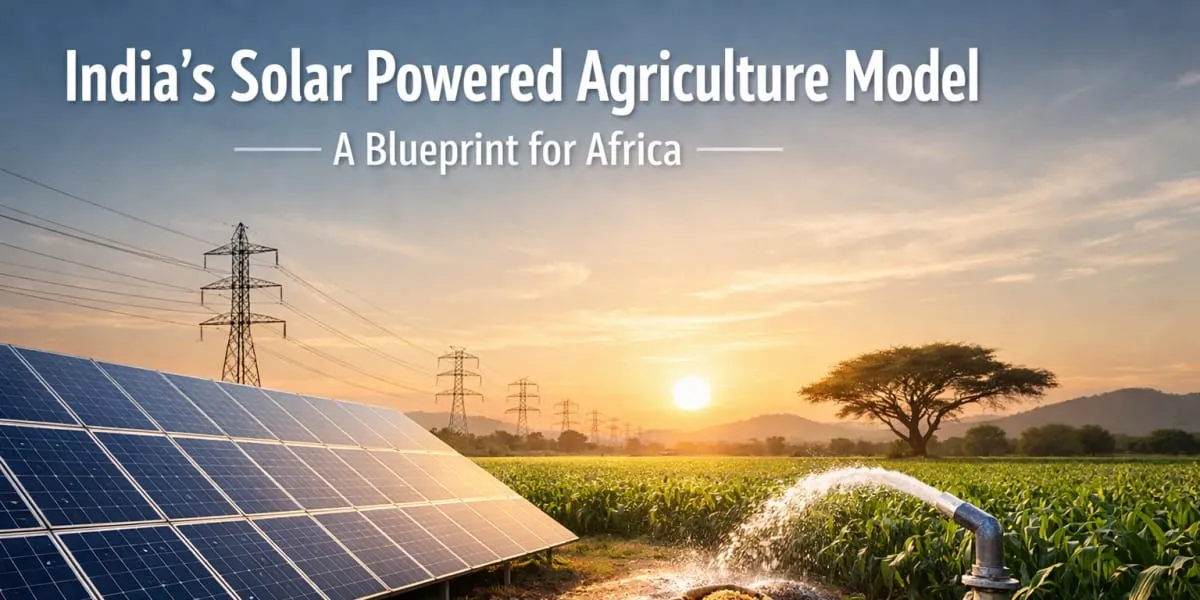
India's Solar Powered Agriculture Model A Blueprint For Africa
ECONOMY & POLICY

India's Solar Powered Agriculture Model A Blueprint For Africa

Prime Minister Narendra Modi highlighted India's growing role in advancing sustainable agriculture through clean energy and said the country's model of harnessing solar power for farming offers a scalable solution for Africa. He emphasised its potential to strengthen shared prosperity, empower communities and enhance food security, and described the achievement as a matter of pride for the nation's farmers and citizens.

The prime minister posted on X and shared an article authored by Union Minister Pralhad Joshi that outlined how India's solar revolution is creating opportunities beyond its borders. The article cited initiatives such as Pradhan Mantri Kisan Urja Suraksha evam Utthaan Mahabhiyan (PM-KUSUM) and the International Solar Alliance (ISA) as key drivers in promoting solar-powered agriculture and expanding access to clean energy.

According to the article's authors, India's experience demonstrates that renewable energy can help improve farm productivity, enhance farmer incomes and reduce dependence on conventional energy sources. The coverage noted successful adoption of solar-powered irrigation and related agricultural systems and suggested that these practices can serve as a model for regions confronting challenges related to energy access, climate resilience and food production.

The article said that PM-KUSUM and the ISA have been instrumental in scaling solar solutions and facilitating international cooperation on clean energy for agriculture. It indicated that the model's replication could contribute to strengthened food security and wider access to sustainable energy among participating countries.

The reporting framed India's solar-powered agriculture as a potential template for collaboration, technology transfer and capacity building to support rural livelihoods elsewhere. Observers were presented with the view that expanded adoption of such systems could offer practical pathways to resilient and inclusive agricultural development.

"Join industry leaders at RAHSTA Expo, India's premier platform for roads, highways and traffic infrastructure. Register now to explore innovations, network with experts and shape the future of mobility."

Prime Minister Narendra Modi highlighted India's growing role in advancing sustainable agriculture through clean energy and said the country's model of harnessing solar power for farming offers a scalable solution for Africa. He emphasised its potential to strengthen shared prosperity, empower communities and enhance food security, and described the achievement as a matter of pride for the nation's farmers and citizens. The prime minister posted on X and shared an article authored by Union Minister Pralhad Joshi that outlined how India's solar revolution is creating opportunities beyond its borders. The article cited initiatives such as Pradhan Mantri Kisan Urja Suraksha evam Utthaan Mahabhiyan (PM-KUSUM) and the International Solar Alliance (ISA) as key drivers in promoting solar-powered agriculture and expanding access to clean energy. According to the article's authors, India's experience demonstrates that renewable energy can help improve farm productivity, enhance farmer incomes and reduce dependence on conventional energy sources. The coverage noted successful adoption of solar-powered irrigation and related agricultural systems and suggested that these practices can serve as a model for regions confronting challenges related to energy access, climate resilience and food production. The article said that PM-KUSUM and the ISA have been instrumental in scaling solar solutions and facilitating international cooperation on clean energy for agriculture. It indicated that the model's replication could contribute to strengthened food security and wider access to sustainable energy among participating countries. The reporting framed India's solar-powered agriculture as a potential template for collaboration, technology transfer and capacity building to support rural livelihoods elsewhere. Observers were presented with the view that expanded adoption of such systems could offer practical pathways to resilient and inclusive agricultural development.

Next Story
Real Estate

VeARC leases 27,000 sq ft office space in Bengaluru

VeARC India has leased approximately 27,000 sq ft of office space at The Executive Centre's (TEC) Helios Business Park on Outer Ring Road (ORR), Bengaluru, to support the expansion of its Global Capability Centre (GCC) operations.The new workspace accommodates more than 450 workstations and is intended to support the company's growing workforce in India. VeARC India serves as the Global Capability Centre for Long Arc Capital.Located on Bengaluru's Outer Ring Road, the office provides access to one of the city's key technology and business corridors. The expansion comes amid continued growth in..

Next Story
Real Estate

Bharat Shah Family Buys Four Luxury Apartments In Worli For Rs1.8 bn

The family of veteran investor Bharat Shah has acquired four ultra-luxury apartments on the higher floors of Kalpataru One in Worli, South Mumbai, for Rs1.8 billion (bn). The purchases were registered on 6 July 2026 and were executed through Preeti Bharat Shah and Kinnari Bharat Shah, who bought the flats from Kalpataru Properties Limited. Property registration documents reviewed by Zapkey show the total consideration at Rs1.7941 billion. The transactions recorded a per square foot RERA carpet price of Rs0.101 million (mn), with each apartment valued at about Rs448.5 million. The four residenc..

Next Story
Infrastructure Urban

NITI Aayog Consultation On Critical Mineral Supply Chains

NITI Aayog convened a stakeholder consultation in New Delhi on Wednesday to assess requirements for critical minerals across strategic sectors, bringing together experts from government, research institutions, academia and industry. The meeting aimed to estimate current and future demand, identify supply chain vulnerabilities and discuss measures to strengthen domestic capabilities in exploration, processing and recycling. The exercise formed part of broader efforts to secure mineral value chains essential for economic growth, technological advancement and national security.\n\nDiscussions con..

Advertisement

Subscribe to Our Newsletter

Get daily newsletters around different themes from Construction world.

STAY CONNECTED

Advertisement

Advertisement

Advertisement