+
Vedanta Deploys India’s First High-Speed Hydrostatic Drill Rig
POWER & RENEWABLE ENERGY

Vedanta Deploys India’s First High-Speed Hydrostatic Drill Rig

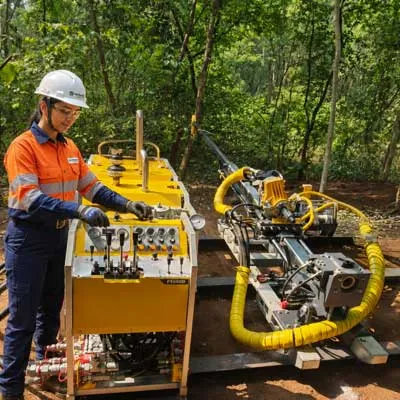
Vedanta Limited has commissioned India’s first high-tech, high-speed hydrostatic portable drilling rig equipped with advanced safety features, strengthening its technology-led mineral exploration capabilities. The rigs have been deployed at two of the company’s exploration projects in Chhattisgarh targeting gold and critical minerals including nickel, chromium and platinum group elements (PGE).

Designed for inaccessible and difficult terrain, the portable rig can drill to depths of up to 1,000 metres, compared with the typical 300–400 metre range. Its portability is expected to reduce time lost while shifting equipment between exploration locations, enabling faster, safer and less intrusive drilling operations.

The deployment forms part of Vedanta’s broader push into critical minerals. The company has secured 10 critical mineral blocks covering gold, manganese, copper, nickel-chromium-PGE, tungsten, graphite, vanadium, rare earth elements and potash. Exploration is currently underway across five blocks. Vedanta was also recently declared the successful bidder for the Punnam Manganese Block in Andhra Pradesh.

Government estimates indicate that nearly 80% of India’s mineral resources remain unexplored. Minerals such as copper and nickel are increasingly important for renewable energy, electric mobility, semiconductors, data centres, defence and advanced manufacturing, while gold continues to be used in electronics, medical applications and other strategic sectors.

According to the International Energy Agency, global demand for critical minerals used in clean-energy technologies could nearly triple by 2030 under its Net Zero Emissions Scenario and quadruple by 2040, reaching close to 40 million tonnes annually. This is driving countries to diversify critical mineral supply chains and reduce dependence on individual markets.

Under its Vedanta 2.0 strategy, the group is expanding its presence across critical minerals while strengthening technology adoption, sustainable mining and value-added processing. Vedanta Group currently has mineral assets across India, South Africa, Namibia, Liberia and Zambia, and plans to expand into additional geographies while developing mining partnerships aligned with global environmental, social and governance standards."

Vedanta Limited has commissioned India’s first high-tech, high-speed hydrostatic portable drilling rig equipped with advanced safety features, strengthening its technology-led mineral exploration capabilities. The rigs have been deployed at two of the company’s exploration projects in Chhattisgarh targeting gold and critical minerals including nickel, chromium and platinum group elements (PGE).Designed for inaccessible and difficult terrain, the portable rig can drill to depths of up to 1,000 metres, compared with the typical 300–400 metre range. Its portability is expected to reduce time lost while shifting equipment between exploration locations, enabling faster, safer and less intrusive drilling operations.The deployment forms part of Vedanta’s broader push into critical minerals. The company has secured 10 critical mineral blocks covering gold, manganese, copper, nickel-chromium-PGE, tungsten, graphite, vanadium, rare earth elements and potash. Exploration is currently underway across five blocks. Vedanta was also recently declared the successful bidder for the Punnam Manganese Block in Andhra Pradesh.Government estimates indicate that nearly 80% of India’s mineral resources remain unexplored. Minerals such as copper and nickel are increasingly important for renewable energy, electric mobility, semiconductors, data centres, defence and advanced manufacturing, while gold continues to be used in electronics, medical applications and other strategic sectors.According to the International Energy Agency, global demand for critical minerals used in clean-energy technologies could nearly triple by 2030 under its Net Zero Emissions Scenario and quadruple by 2040, reaching close to 40 million tonnes annually. This is driving countries to diversify critical mineral supply chains and reduce dependence on individual markets.Under its Vedanta 2.0 strategy, the group is expanding its presence across critical minerals while strengthening technology adoption, sustainable mining and value-added processing. Vedanta Group currently has mineral assets across India, South Africa, Namibia, Liberia and Zambia, and plans to expand into additional geographies while developing mining partnerships aligned with global environmental, social and governance standards.

Related Stories

Gold Stories

Next Story
Infrastructure Transport

Madhya Pradesh Plans Airport Every 150 Km, Airstrip Every 75 Km

The Madhya Pradesh government plans to establish an airport every 150 km, an airstrip every 75 km and a helipad every 45 km, according to the state aviation department. Airports being developed in Ujjain and Shivpuri are expected to take the state’s airport count to 10. The government stated that Madhya Pradesh currently has eight airports in eight cities. The locations named by the department include Indore, Bhopal, Jabalpur, Gwalior, Khajuraho, Rewa and Satna. The state also has more than 20 airstrips and 220 helipads, while permanent helipads are planned in all 230 Assembly constituencies..

Next Story
Infrastructure Transport

West Bengal Plans Four Airports for 2028 Completion Under UDAN

West Bengal will develop four new airports under an agreement signed between the Union Civil Aviation Ministry and the state government, with all facilities targeted for completion by 2028. Union Civil Aviation Minister K Rammohan Naidu said the airports would be located at Charra in Purulia, Kalaikunda in Paschim Medinipur, Balurghat in Dakshin Dinajpur and Hasimara in Alipurduar. The project is part of the Centre’s regional connectivity UDAN programme. The Union government has committed Rs. 290 bn for West Bengal’s aviation sector over the next decade, while the state government will pro..

Next Story
Infrastructure Transport

Mumbai Airport Bars Russian Airlines as Agent Seeks Ministry Intervention

Mumbai airport has stopped accepting cargo booked on Russian flag carrier Aeroflot, disrupting shipments and prompting the airline’s cargo sales agent, Delmos Aviation, to seek intervention from the Ministry of Civil Aviation. The restrictions also affect cargo booked on Volga-Dnepr Airlines, according to a letter submitted by Delmos Aviation to the ministry on September 30. Aeroflot operates daily flights between Moscow and Delhi and runs a winter seasonal service to Goa. Bonded cargo from Mumbai and other cities is transported by road to Delhi before being flown to Russia. The agent said t..

Advertisement

Subscribe to Our Newsletter

Get daily newsletters around different themes from Construction world.

STAY CONNECTED

Advertisement

SPECIAL OFFER
QR Code