

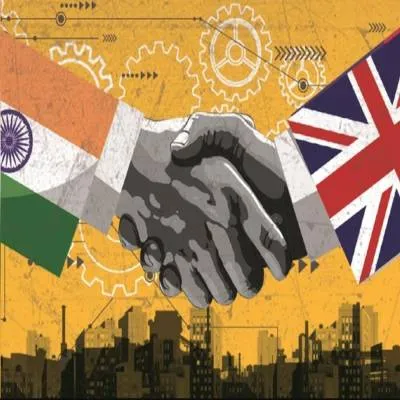
India's Top Export Winners Under UK Trade Pact
ECONOMY & POLICY

India's Top Export Winners Under UK Trade Pact

The India–UK Comprehensive Economic and Trade Agreement came into force on July 15 and a Global Trade Research Institute report identified garments, automobiles, textiles, processed foods and seafood as sectors best placed to unlock new export opportunities. The report noted that India remains a relatively small supplier to the United Kingdom, with the UK importing $928.9 billion (bn) of goods globally in 2025 but only $15.2 bn from India, representing one point six per cent of UK imports.

Garments were singled out for the highest potential: India supplied $1.3 bn, or six point one per cent, of UK garment imports in 2025 and the UK already accounts for eight per cent of India's global garment shipments. Textiles, leather and footwear also present prospects, while processed foods such as ready-to-eat meals, bakery items and sauces offer growth if sanitary and traceability standards are met.

The report highlighted cereals, vegetables, fruits, spices and seafood as areas with import demand but noted exporters will need to satisfy stringent food-safety norms. Processed foods were measured against the United Kingdom's $33.4 bn import market, where India held a one point one per cent share.

Automobiles, motorcycles and auto components were identified as sizeable long-term opportunities given the United Kingdom's large vehicle market, in which India currently has only zero point four per cent penetration. Machinery, electronics and fabricated metal products could expand through deeper supply-chain integration but progress will hinge on technology, certification and quality standards rather than tariffs alone.

GTRI advised that the largest gains would come where India's export strengths align with robust UK demand and meaningful tariff reductions under CETA, and recommended a sector-specific export strategy with parallel work on standards, certification, logistics and buyer networks. Chemicals and pharmaceuticals were described as medium potential while iron and steel, ores and petroleum were seen as having limited upside because of structural barriers and carbon-related costs.

"Join industry leaders at RAHSTA Expo, India's premier platform for roads, highways and traffic infrastructure. Register now to explore innovations, network with experts and shape the future of mobility."

The India–UK Comprehensive Economic and Trade Agreement came into force on July 15 and a Global Trade Research Institute report identified garments, automobiles, textiles, processed foods and seafood as sectors best placed to unlock new export opportunities. The report noted that India remains a relatively small supplier to the United Kingdom, with the UK importing $928.9 billion (bn) of goods globally in 2025 but only $15.2 bn from India, representing one point six per cent of UK imports. Garments were singled out for the highest potential: India supplied $1.3 bn, or six point one per cent, of UK garment imports in 2025 and the UK already accounts for eight per cent of India's global garment shipments. Textiles, leather and footwear also present prospects, while processed foods such as ready-to-eat meals, bakery items and sauces offer growth if sanitary and traceability standards are met. The report highlighted cereals, vegetables, fruits, spices and seafood as areas with import demand but noted exporters will need to satisfy stringent food-safety norms. Processed foods were measured against the United Kingdom's $33.4 bn import market, where India held a one point one per cent share. Automobiles, motorcycles and auto components were identified as sizeable long-term opportunities given the United Kingdom's large vehicle market, in which India currently has only zero point four per cent penetration. Machinery, electronics and fabricated metal products could expand through deeper supply-chain integration but progress will hinge on technology, certification and quality standards rather than tariffs alone. GTRI advised that the largest gains would come where India's export strengths align with robust UK demand and meaningful tariff reductions under CETA, and recommended a sector-specific export strategy with parallel work on standards, certification, logistics and buyer networks. Chemicals and pharmaceuticals were described as medium potential while iron and steel, ores and petroleum were seen as having limited upside because of structural barriers and carbon-related costs.

Next Story
Real Estate

VeARC leases 27,000 sq ft office space in Bengaluru

VeARC India has leased approximately 27,000 sq ft of office space at The Executive Centre's (TEC) Helios Business Park on Outer Ring Road (ORR), Bengaluru, to support the expansion of its Global Capability Centre (GCC) operations.The new workspace accommodates more than 450 workstations and is intended to support the company's growing workforce in India. VeARC India serves as the Global Capability Centre for Long Arc Capital.Located on Bengaluru's Outer Ring Road, the office provides access to one of the city's key technology and business corridors. The expansion comes amid continued growth in..

Next Story
Real Estate

Bharat Shah Family Buys Four Luxury Apartments In Worli For Rs1.8 bn

The family of veteran investor Bharat Shah has acquired four ultra-luxury apartments on the higher floors of Kalpataru One in Worli, South Mumbai, for Rs1.8 billion (bn). The purchases were registered on 6 July 2026 and were executed through Preeti Bharat Shah and Kinnari Bharat Shah, who bought the flats from Kalpataru Properties Limited. Property registration documents reviewed by Zapkey show the total consideration at Rs1.7941 billion. The transactions recorded a per square foot RERA carpet price of Rs0.101 million (mn), with each apartment valued at about Rs448.5 million. The four residenc..

Next Story
Infrastructure Urban

NITI Aayog Consultation On Critical Mineral Supply Chains

NITI Aayog convened a stakeholder consultation in New Delhi on Wednesday to assess requirements for critical minerals across strategic sectors, bringing together experts from government, research institutions, academia and industry. The meeting aimed to estimate current and future demand, identify supply chain vulnerabilities and discuss measures to strengthen domestic capabilities in exploration, processing and recycling. The exercise formed part of broader efforts to secure mineral value chains essential for economic growth, technological advancement and national security.\n\nDiscussions con..

Advertisement

Subscribe to Our Newsletter

Get daily newsletters around different themes from Construction world.

STAY CONNECTED

Advertisement

Advertisement

Advertisement