Kerala To Build Rs 250 Billion AI Township At Infopark Phase 3
ECONOMY & POLICY

Kerala To Build Rs 250 Billion AI Township At Infopark Phase 3

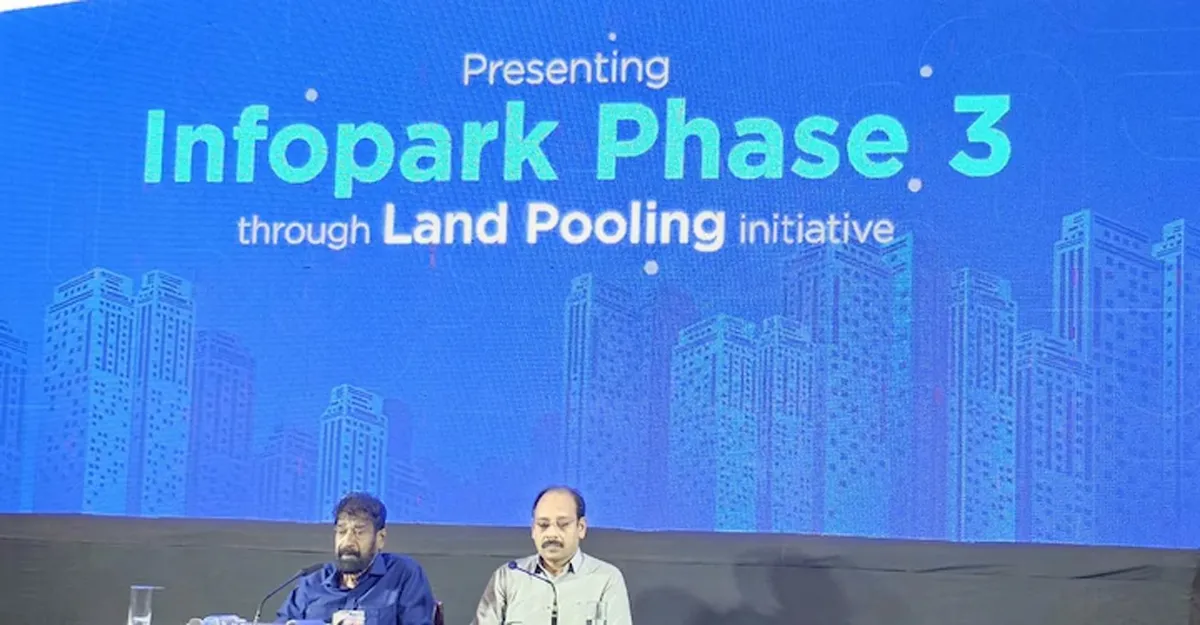
The Greater Cochin Development Authority (GCDA) has confirmed that Infopark Phase 3, Kerala’s first Integrated AI Township, will be completed by 2030. GCDA Chairman K Chandran Pillai said the master plan and detailed project report would be submitted within a year, with land pooling notifications to be issued in the next three weeks.
The project, spread across 300–500 acres in Ernakulam district, will integrate commercial and residential spaces with modern infrastructure. It will create more than 20 million sq. ft. of office space and over 5,000 housing units. Investments of Rs 250 billion are expected, with projections of 200,000 direct and 400,000 indirect jobs.
Infopark CEO Susanth Kurunthil said the township would attract global tech majors and GCCs of leading firms, establishing Kochi as a leading IT hub. GCDA will oversee land pooling while Infopark will serve as developer. Areas under consideration include Kunnathunad and Kizhakkambalam panchayats, with final selection dependent on environmental studies and landowner consultations.
Designed as a mixed-use AI-native city, the township will feature IT towers, schools, hospitals, retail spaces, sports and cultural venues, smart parking, and green zones. It will connect seamlessly to Ernakulam city, the proposed Angamaly–Nettoor NH bypass, metro lines, and public transit.
Unlike smart cities that rely on technology to manage services, the AI-native model will operate on artificial intelligence as its foundation. A central “urban city brain” will manage real-time data on power, water, waste, traffic and security, enabling proactive governance.
The township will focus on sustainability and inclusivity, aiming for carbon negativity, water positivity, and zero waste. Underground utilities will improve maintainability and aesthetics, while 24/7 AI surveillance will enhance safety.
The MoU was signed in the presence of Chief Minister Pinarayi Vijayan. Under Kerala Land Pooling Rules, the project requires the consent of at least 75 per cent of landowners, with consultations already under way.
Preparations for Infopark Phase 4 are also in progress, with both projects set to transform Kochi into a world-class IT ecosystem by the end of the decade. 

The Greater Cochin Development Authority (GCDA) has confirmed that Infopark Phase 3, Kerala’s first Integrated AI Township, will be completed by 2030. GCDA Chairman K Chandran Pillai said the master plan and detailed project report would be submitted within a year, with land pooling notifications to be issued in the next three weeks.The project, spread across 300–500 acres in Ernakulam district, will integrate commercial and residential spaces with modern infrastructure. It will create more than 20 million sq. ft. of office space and over 5,000 housing units. Investments of Rs 250 billion are expected, with projections of 200,000 direct and 400,000 indirect jobs.Infopark CEO Susanth Kurunthil said the township would attract global tech majors and GCCs of leading firms, establishing Kochi as a leading IT hub. GCDA will oversee land pooling while Infopark will serve as developer. Areas under consideration include Kunnathunad and Kizhakkambalam panchayats, with final selection dependent on environmental studies and landowner consultations.Designed as a mixed-use AI-native city, the township will feature IT towers, schools, hospitals, retail spaces, sports and cultural venues, smart parking, and green zones. It will connect seamlessly to Ernakulam city, the proposed Angamaly–Nettoor NH bypass, metro lines, and public transit.Unlike smart cities that rely on technology to manage services, the AI-native model will operate on artificial intelligence as its foundation. A central “urban city brain” will manage real-time data on power, water, waste, traffic and security, enabling proactive governance.The township will focus on sustainability and inclusivity, aiming for carbon negativity, water positivity, and zero waste. Underground utilities will improve maintainability and aesthetics, while 24/7 AI surveillance will enhance safety.The MoU was signed in the presence of Chief Minister Pinarayi Vijayan. Under Kerala Land Pooling Rules, the project requires the consent of at least 75 per cent of landowners, with consultations already under way.Preparations for Infopark Phase 4 are also in progress, with both projects set to transform Kochi into a world-class IT ecosystem by the end of the decade. 

Next Story
Infrastructure Transport

India Becomes First to Produce Bio-Bitumen for Roads

India has become the first country in the world to commercially produce bio-bitumen for use in road construction, according to Road, Transport and Highways Minister Nitin Gadkari. Bitumen, a black and viscous hydrocarbon derived from crude oil, is a key binding material in road building, and the bio-based alternative is expected to significantly improve the sector’s environmental footprint.Addressing the CSIR Technology Transfer Ceremony in New Delhi, Mr Gadkari congratulated Council of Scientific and Industrial Research on achieving the milestone, noting that the initiative would help curb ..

Next Story
Infrastructure Urban

HILT Policy Seen Boosting Telangana Revenue Sharply

The Hyderabad Industrial Land Transformation (HILT) Policy is expected to generate around Rs 1.08 billion in revenue for the Telangana state exchequer, according to Deputy Chief Minister Bhatti Vikramarka Mallu. Speaking in the Telangana Legislative Assembly, he said the policy would be implemented within a six-month timeframe in a transparent manner, with uniform rules applicable to all stakeholders. Mr Vikramarka noted that without the HILT Policy, the state would have earned only about Rs 1.2 million per acre. Under the new framework, however, revenue is projected to rise sharply to Rs 70 ..

Next Story
Infrastructure Urban

India Post, MoRD Tie Up to Boost Rural Inclusion

The Department of Posts and the Ministry of Rural Development have signed a Memorandum of Understanding to accelerate rural transformation and expand financial, digital and logistics services for Self-Help Groups (SHGs) and rural households across India. The agreement was signed in the presence of Union Minister of Communications and Development of North Eastern Region Jyotiraditya M. Scindia and Union Minister of Rural Development and Agriculture and Farmers’ Welfare Shivraj Singh Chouhan. The collaboration aligns with the government’s “Dak Sewa, Jan Sewa” vision and seeks to repositi..

Advertisement

Subscribe to Our Newsletter

Get daily newsletters around different themes from Construction world.

STAY CONNECTED

Advertisement

Advertisement

Advertisement

Advertisement

Open In App