



+
Kerala to Fully Transition to Smart Meters
ECONOMY & POLICY

Kerala to Fully Transition to Smart Meters

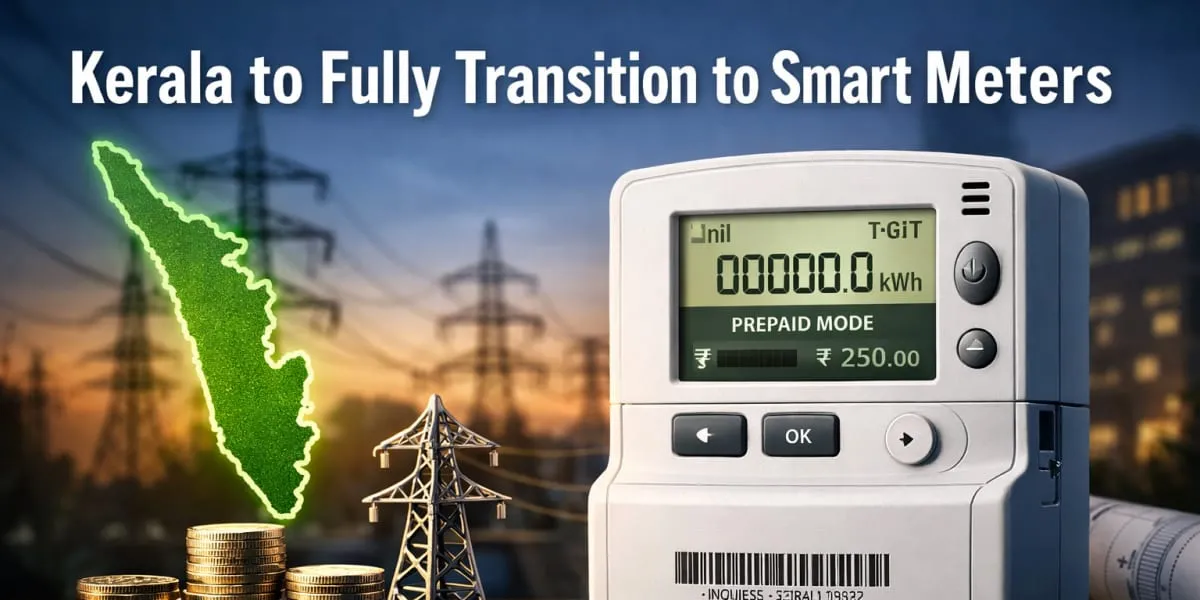
The Kerala State Electricity Board has received approval from the Power Department to install smart meters for domestic consumers and government offices across the state. Under the scheme, smart meters will be fitted for three point five million (mn) electricity consumers at an estimated cost of Rs 32.58 billion (bn), and the project cost could rise to Rs 50 billion (bn) if the number of consumers reaches five million.

In the first phase, prepaid smart meters will be installed in zero point one eight eight million (mn) state government offices. Of the Board's total 14 million (mn) consumers, zero point one eight eight million are government institutions that will be prioritised.

The Board is also installing smart meters on distribution transformers and has awarded a contract for zero point three million (mn) smart meters, including transformer units, to Iskraemeco India Private Limited, which is based in Kolkata. The contract covers procurement and initial deployment and is expected to form a significant part of the rollout. The Board stated that government offices will receive prepaid meters to enable automated disconnection when balances are exhausted.

KSEB plans to make the Smart Plus application available on the Google Play Store by the end of February so consumers can monitor consumption, check prepaid balances and recharge accounts. The application will support monitoring and automated balance alerts that will link to prepaid disconnection procedures. Officials expect the app to simplify energy management for households and institutions across the state.

The Centre increased the borrowing limit for states by zero point five per cent in the 2025–26 Union Budget and later conditioned additional borrowing on the installation of prepaid smart meters. The Centre proposed a Totex model under which the installer would bear the upfront cost and recover it through rental charges, but the Board opposed that approach. The state has therefore chosen the Capex model, under which the Board will bear the full cost of installation.

The Kerala State Electricity Board has received approval from the Power Department to install smart meters for domestic consumers and government offices across the state. Under the scheme, smart meters will be fitted for three point five million (mn) electricity consumers at an estimated cost of Rs 32.58 billion (bn), and the project cost could rise to Rs 50 billion (bn) if the number of consumers reaches five million. In the first phase, prepaid smart meters will be installed in zero point one eight eight million (mn) state government offices. Of the Board's total 14 million (mn) consumers, zero point one eight eight million are government institutions that will be prioritised. The Board is also installing smart meters on distribution transformers and has awarded a contract for zero point three million (mn) smart meters, including transformer units, to Iskraemeco India Private Limited, which is based in Kolkata. The contract covers procurement and initial deployment and is expected to form a significant part of the rollout. The Board stated that government offices will receive prepaid meters to enable automated disconnection when balances are exhausted. KSEB plans to make the Smart Plus application available on the Google Play Store by the end of February so consumers can monitor consumption, check prepaid balances and recharge accounts. The application will support monitoring and automated balance alerts that will link to prepaid disconnection procedures. Officials expect the app to simplify energy management for households and institutions across the state. The Centre increased the borrowing limit for states by zero point five per cent in the 2025–26 Union Budget and later conditioned additional borrowing on the installation of prepaid smart meters. The Centre proposed a Totex model under which the installer would bear the upfront cost and recover it through rental charges, but the Board opposed that approach. The state has therefore chosen the Capex model, under which the Board will bear the full cost of installation.

Next Story
Equipment

Kabelschlepp India Installs Robotic VMC in Bengaluru

Kabelschlepp India, part of the Tsubaki Group, has installed a state-of-the-art Vertical Machining Center (VMC) integrated with robotic automation at its Bengaluru facility. The inauguration was held in the presence of Henning Preis, President & CEO, Kabelschlepp Group, Jörg Schulz, Vice President – Production, and Srinivas P. Kamisetty, Managing Director, Kabelschlepp India.The high-precision CNC VMC is designed for advanced milling, drilling, tapping and multi-axis machining. Equipped with a vertical spindle orientation, automatic tool changer and intelligent CNC control system, it en..

Next Story
Infrastructure Transport

Highway Delivery Reset!

Project delays and inefficiencies continue to bedevil the progress of India’s National Highways network. A multi-pronged reform agenda is needed to inject greater transparency and accountability at every stage – from planning and procurement to execution, maintenance and oversight. This article offers key recommendations and reform strategies that government stakeholders – from the Ministry of Road Transport & Highways (MoRTH) and the National Highways Authority of India (NHAI) to state agencies and oversight bodies – should pursue to put highway development on a better track.Decen..

Next Story
Infrastructure Transport

MSIDC Executes ₹37,000 Crore Road Programme

With Rs 37,000 crore worth of road projects under execution across Maharashtra, Maharashtra State Infrastructure Development Corporation (MSIDC) is driving one of the state’s largest infrastructure programmes. Dr Brijesh Dixit, Managing Director, discusses the institutional reforms, execution frameworks, financing strategies and technology adoption enabling timely, high-quality delivery, in conversation with PRATAP PADODE, Editor-in-Chief, CW.With over Rs 37,000 crore worth of road projects underway across districts – many under tight timelines – what institutional and executio..

Advertisement

Subscribe to Our Newsletter

Get daily newsletters around different themes from Construction world.

STAY CONNECTED

Advertisement

Advertisement

Advertisement

Open In App