


Liebherr Launches LMC 80 Soil Mixing Cutter
ECONOMY & POLICY

Liebherr Launches LMC 80 Soil Mixing Cutter

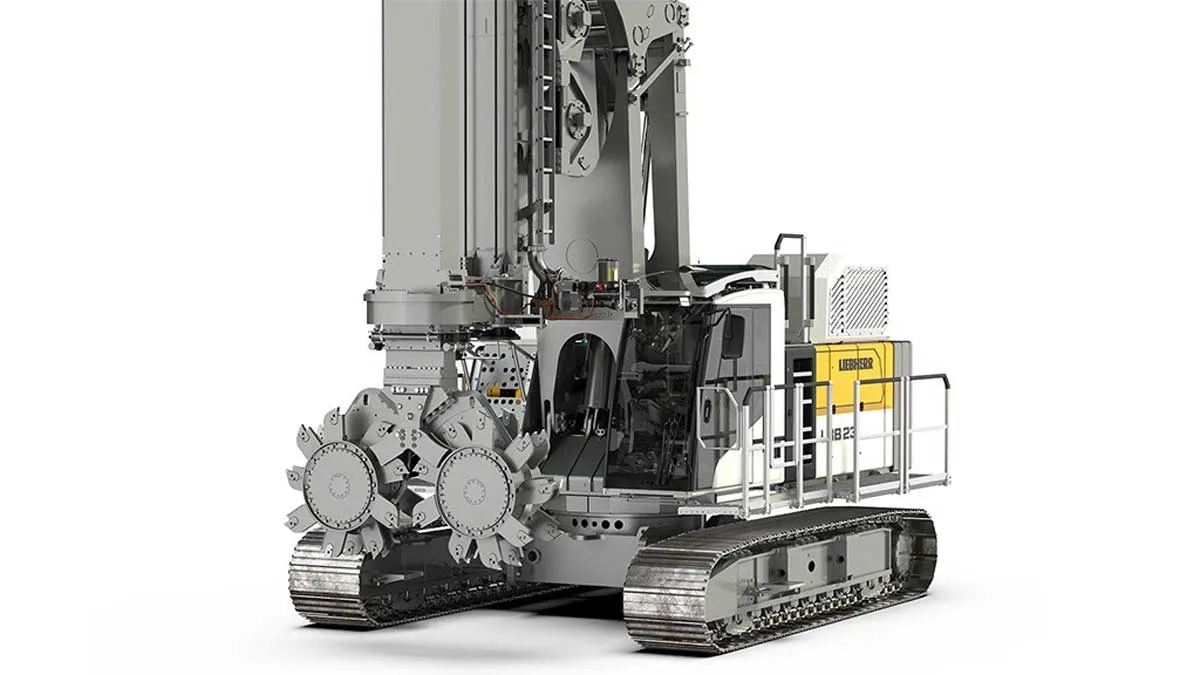
Liebherr has expanded its deep foundation portfolio with the launch of the LMC 80 cutter soil mixer, designed for noise-reduced and low-vibration ground improvement applications. The solution uses Liebherr’s LRB 23 or LRB 355 piling and drilling rigs as carrier machines, offering customers an integrated package from a single source.

The LMC 80 can be used in all mixable soil types to install load-bearing or sealing elements. Its four cutting wheels are driven by a maximum torque of 2x 80 kilonewton metres and can reach a maximum rotational speed of 30 revolutions per minute, depending on ground conditions.

Using an extension linkage, the compact LRB 23 can produce ground mixing elements up to 36 metres deep, while the larger LRB 355 can reach depths of 40 metres. Both versions can create panels with cross-sections ranging from 2,800 by 500 to 1,000 millimetres, depending on site requirements.

The LMC 80 can be swivelled by 135 degrees around the mixing axis without moving the leader, supporting flexible use on site. Liebherr has also integrated verticality measurement, LIPOS positioning and MyJobsite digital tools to help operators record, analyse and manage process, machine and jobsite data.

According to Liebherr, the LMC 80 offers economic and environmental advantages as existing soil is mixed with binding suspension, reducing the need for material delivery and excavated material transport. The model was presented during the 50th anniversary of Liebherr-Werk Nenzing GmbH in June 2026 and is now available.

Liebherr has expanded its deep foundation portfolio with the launch of the LMC 80 cutter soil mixer, designed for noise-reduced and low-vibration ground improvement applications. The solution uses Liebherr’s LRB 23 or LRB 355 piling and drilling rigs as carrier machines, offering customers an integrated package from a single source.The LMC 80 can be used in all mixable soil types to install load-bearing or sealing elements. Its four cutting wheels are driven by a maximum torque of 2x 80 kilonewton metres and can reach a maximum rotational speed of 30 revolutions per minute, depending on ground conditions.Using an extension linkage, the compact LRB 23 can produce ground mixing elements up to 36 metres deep, while the larger LRB 355 can reach depths of 40 metres. Both versions can create panels with cross-sections ranging from 2,800 by 500 to 1,000 millimetres, depending on site requirements.The LMC 80 can be swivelled by 135 degrees around the mixing axis without moving the leader, supporting flexible use on site. Liebherr has also integrated verticality measurement, LIPOS positioning and MyJobsite digital tools to help operators record, analyse and manage process, machine and jobsite data.According to Liebherr, the LMC 80 offers economic and environmental advantages as existing soil is mixed with binding suspension, reducing the need for material delivery and excavated material transport. The model was presented during the 50th anniversary of Liebherr-Werk Nenzing GmbH in June 2026 and is now available.

Next Story
Building Material

Saint-Gobain, CEPT partner on sustainable construction

Saint-Gobain and CEPT University have entered into a strategic partnership to establish a Tech Commons Centre aimed at advancing research, innovation and skill development in sustainable and energy-efficient construction.The centre will serve as a platform for building science research, prototyping, industry collaboration and knowledge exchange, bringing together Saint-Gobain's expertise in sustainable construction and CEPT's capabilities in education and research. The collaboration will focus on sustainability, energy efficiency, climate resilience and wellbeing in the built environment.Accor..

Next Story
Building Material

Aludecor launches Stonic ACP surface series

Aludecor Lamination has launched its Stonic aluminium composite panel (ACP) surface series and the second phase of its 'Test Nahi Toh Trust Nahi' campaign as part of its 24th Foundation Day celebrations.Inspired by the natural craquelure patterns found in aged stone, the Stonic series is available in seven finishes and has been developed using the company's Spray Fusion technology. The ACP range is designed for use in façades, feature walls, entranceways, soffits, balcony fascia, ceilings and other commercial, residential and hospitality applications.The company also introduced 'The Fikar-Fre..

Next Story
Real Estate

NABARD, MAHAPREIT partner on rural green infrastructure

NABARD has signed a memorandum of understanding (MoU) with Mahatma Phule Renewable Energy and Infrastructure Technology (MAHAPREIT) to finance and promote green, climate-resilient infrastructure in rural India, with an initial focus on Maharashtra.The partnership will combine NABARD's expertise in rural development and climate finance with MAHAPREIT's experience in renewable energy and sustainable infrastructure. The collaboration will identify, develop and finance projects aimed at strengthening village infrastructure, Panchayati Raj Institutions and other community assets.Priority areas incl..

Advertisement

Subscribe to Our Newsletter

Get daily newsletters around different themes from Construction world.

STAY CONNECTED

Advertisement

Advertisement

Advertisement