+
India Uzbekistan Elevate Ties With Uranium Pact And Trade Target
ECONOMY & POLICY

India Uzbekistan Elevate Ties With Uranium Pact And Trade Target

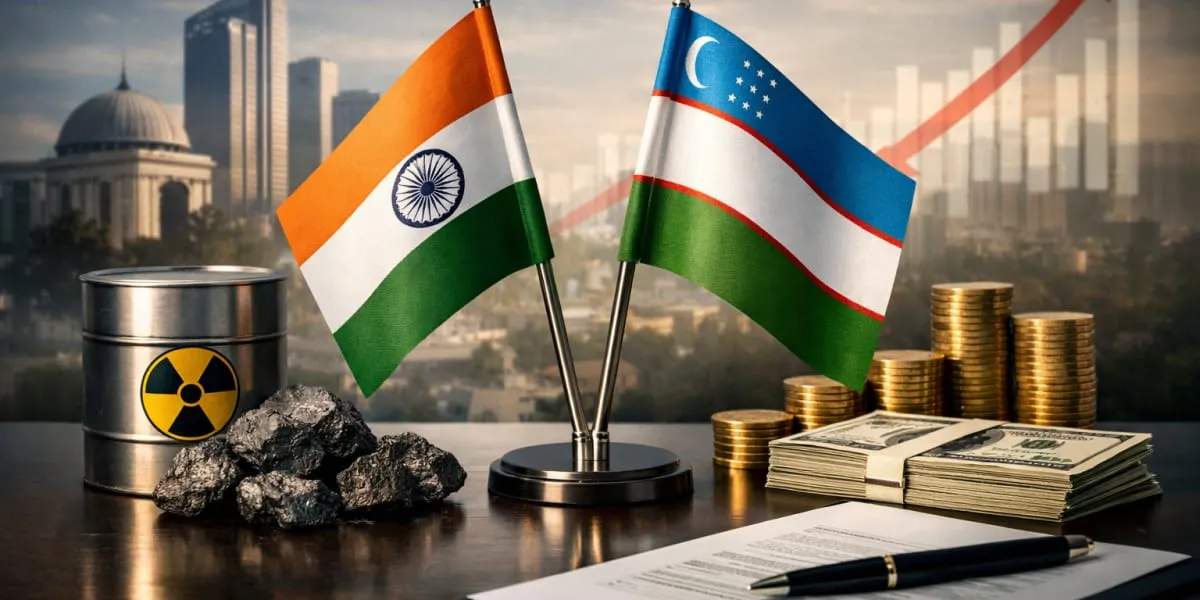
India and Uzbekistan elevated bilateral ties to a Comprehensive Strategic Partnership in Tashkent, agreeing to establish a long-term arrangement for uranium supplies under civil nuclear cooperation. The two sides set a target to raise annual bilateral trade to United States dollar (USD) five bn by 2030 and signed 11 agreements across trade, investment, infrastructure, critical minerals, defence and digital public infrastructure. Ministers were tasked to develop a roadmap to realise partnership potential.

Officials said talks on uranium supplies had been positive and that the countries were close to signing an agreement, while the upgraded partnership will create a Foreign Minister-level Coordination Group and raise the Joint Commission to ministerial level. Leaders placed strong emphasis on counter-terrorism and the joint statement condemned terrorism in all its forms, reiterating a zero tolerance approach. They called for action against terrorist organisations, their financing networks and safe havens.

Cooperation will be strengthened in intelligence-sharing, law enforcement, countering violent extremism, organised crime, illicit drug trafficking and cyber threats. Defence cooperation will be broadened to encourage defence industries to pursue direct linkages and to co-develop and co-produce military equipment. The cooperation is intended to enhance regional stability and economic integration.

Uzbekistan will remove visa requirements for Indian citizens for stays of up to 30 days to promote tourism and business travel, and Indians travelling to Uzbekistan will be able to use Unified Payments Interface (UPI)-enabled applications within one year. Leaders agreed to pursue implementation of the 11 memoranda signed during the visit and to strengthen trade and investment ties. Officials said institutional mechanisms would be activated and set timelines for implementation to monitor delivery.

The Indian prime minister received Uzbekistan’s highest state honour and dedicated the recognition to India’s 1.4 billion (bn) people as a reflection of growing ties. He described Uzbekistan as central to India’s engagement in Central Asia and framed the strengthened partnership as a force for peace, progress and prosperity. Officials said implementing the agreements and operationalising coordination mechanisms are the next steps.

India and Uzbekistan elevated bilateral ties to a Comprehensive Strategic Partnership in Tashkent, agreeing to establish a long-term arrangement for uranium supplies under civil nuclear cooperation. The two sides set a target to raise annual bilateral trade to United States dollar (USD) five bn by 2030 and signed 11 agreements across trade, investment, infrastructure, critical minerals, defence and digital public infrastructure. Ministers were tasked to develop a roadmap to realise partnership potential. Officials said talks on uranium supplies had been positive and that the countries were close to signing an agreement, while the upgraded partnership will create a Foreign Minister-level Coordination Group and raise the Joint Commission to ministerial level. Leaders placed strong emphasis on counter-terrorism and the joint statement condemned terrorism in all its forms, reiterating a zero tolerance approach. They called for action against terrorist organisations, their financing networks and safe havens. Cooperation will be strengthened in intelligence-sharing, law enforcement, countering violent extremism, organised crime, illicit drug trafficking and cyber threats. Defence cooperation will be broadened to encourage defence industries to pursue direct linkages and to co-develop and co-produce military equipment. The cooperation is intended to enhance regional stability and economic integration. Uzbekistan will remove visa requirements for Indian citizens for stays of up to 30 days to promote tourism and business travel, and Indians travelling to Uzbekistan will be able to use Unified Payments Interface (UPI)-enabled applications within one year. Leaders agreed to pursue implementation of the 11 memoranda signed during the visit and to strengthen trade and investment ties. Officials said institutional mechanisms would be activated and set timelines for implementation to monitor delivery. The Indian prime minister received Uzbekistan’s highest state honour and dedicated the recognition to India’s 1.4 billion (bn) people as a reflection of growing ties. He described Uzbekistan as central to India’s engagement in Central Asia and framed the strengthened partnership as a force for peace, progress and prosperity. Officials said implementing the agreements and operationalising coordination mechanisms are the next steps.

Related Stories

Gold Stories

Next Story
Infrastructure Energy

Alternative Fuels Overtake Petrol As August Retail Peaks

The Indian automobile industry recorded its best-ever August retail as alternative fuels such as compressed natural gas, hybrid and electric vehicles combined overtook petrol in the passenger vehicle segment for the first time. The shift coincided with oil price rises linked to the war in the Middle East and a cooled public response to higher ethanol content in petrol. Dealers attributed stronger demand to lower running costs and concerns over the E20 petrol transition. Data released by the Federation of Automobile Dealers Associations (FADA) showed total vehicle retail registrations in August..

Next Story
Infrastructure Urban

Singapore Minister Defends SIA Investment In Air India

Singapore government defended Singapore Airlines' investment in Air India after two weeks of public scrutiny over a funding request, saying the flag carrier must expand overseas and that outcomes are for the company and its shareholders to judge. The remarks in parliament followed reports that Air India had sought about US$1.5 billion (US$1.5 bn) of fresh equity from owners Tata Sons and Singapore Airlines. The issue drew attention because Singapore Airlines is majority-owned by Temasek and raised questions about Temasek's role. Officials framed the matter as a commercial decision rather than ..

Next Story
Infrastructure Transport

IndiGo To Begin Guwahati Bangkok Flights

IndiGo will launch non-stop flights between Guwahati and Bangkok from 27 October 2026, marking the carrier's first international operations from the city. A special inaugural service will operate on 27 October, with regular twice a week flights scheduled from 31 October on Wednesdays and Saturdays, subject to regulatory approvals. The new link will provide direct connectivity between Northeast India and Thailand and expand the airline's India–Thailand network. The inaugural Bangkok to Guwahati sector, flight 6E1086, is scheduled to depart Bangkok at 8:50 am and arrive in Guwahati at 10:25 am..

Advertisement

Subscribe to Our Newsletter

Get daily newsletters around different themes from Construction world.

STAY CONNECTED

Advertisement

SPECIAL OFFER
QR Code