Ludhiana Municipal Corporation Floats Tender for 50 EV Charging Stations
ECONOMY & POLICY

Ludhiana Municipal Corporation Floats Tender for 50 EV Charging Stations

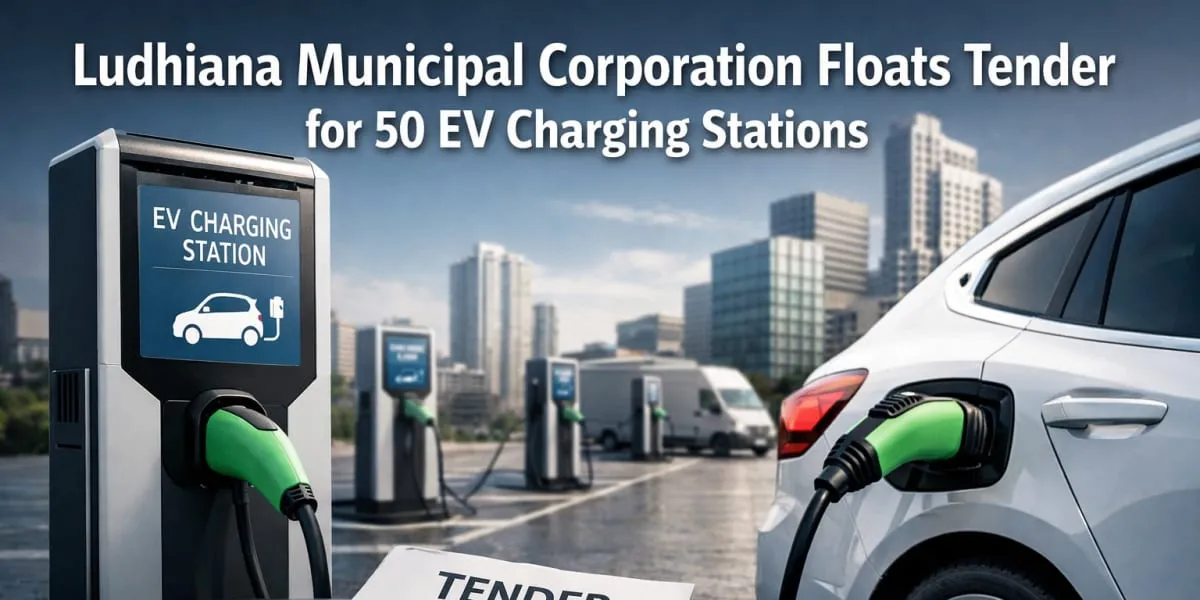
The Ludhiana Municipal Corporation (MCL) has issued a tender to establish 50 electric vehicle (EV) charging stations across the city under a 10-year public-private partnership to strengthen green mobility infrastructure. The initiative uses a user-pays model intended to make the network financially self-sustaining while supporting a shift to low-carbon transport. The civic authority said the move responds to rising demand from cars, two-wheelers and commercial vehicles.

The tender is open exclusively to central and state public-sector undertakings (PSUs), with the selected PSU accountable for end-to-end delivery. Responsibilities include installation of alternating current and direct current chargers, modular battery-swapping points and digital integration with mobile applications, QR and RFID authentication and online payment systems. The civic body will provide land and coordinate with power distribution companies to secure a stable energy supply.

Stations must include safety measures such as fire provisions, closed-circuit television surveillance, weatherproof enclosures and drainage to prevent waterlogging. Hubs are expected to incorporate IoT-enabled battery lockers and solar-integrated roofs where feasible, aligning design with central government incentives. Officials said digital integration and enhanced safety would be central to reliable operations.

The revenue framework sets a minimum payment to the municipal corporation of Rs one per kilowatt-hour (kWh) of energy dispensed, with extra income from advertising and space premiums and a 50-50 revenue split between the concessionaire and MCL. The model aims to generate municipal revenue while ensuring operator incentives for maintenance and customer service. Analysts said a commercially viable tariff and clear contractual terms will be necessary for long-term sustainability.

With EVs accounting for six per cent of the city’s vehicle registrations, MCL officials characterised Ludhiana as a high-traffic strategic hub where existing infrastructure is limited compared with growing demand, and they said the programme would prepare the city for further EV adoption. The combination of charging, swapping and solar options is intended to create a future-ready network that could serve as a model for industrial regions. The authority expects the project to improve convenience for users and contribute to decarbonisation goals.

The Ludhiana Municipal Corporation (MCL) has issued a tender to establish 50 electric vehicle (EV) charging stations across the city under a 10-year public-private partnership to strengthen green mobility infrastructure. The initiative uses a user-pays model intended to make the network financially self-sustaining while supporting a shift to low-carbon transport. The civic authority said the move responds to rising demand from cars, two-wheelers and commercial vehicles. The tender is open exclusively to central and state public-sector undertakings (PSUs), with the selected PSU accountable for end-to-end delivery. Responsibilities include installation of alternating current and direct current chargers, modular battery-swapping points and digital integration with mobile applications, QR and RFID authentication and online payment systems. The civic body will provide land and coordinate with power distribution companies to secure a stable energy supply. Stations must include safety measures such as fire provisions, closed-circuit television surveillance, weatherproof enclosures and drainage to prevent waterlogging. Hubs are expected to incorporate IoT-enabled battery lockers and solar-integrated roofs where feasible, aligning design with central government incentives. Officials said digital integration and enhanced safety would be central to reliable operations. The revenue framework sets a minimum payment to the municipal corporation of Rs one per kilowatt-hour (kWh) of energy dispensed, with extra income from advertising and space premiums and a 50-50 revenue split between the concessionaire and MCL. The model aims to generate municipal revenue while ensuring operator incentives for maintenance and customer service. Analysts said a commercially viable tariff and clear contractual terms will be necessary for long-term sustainability. With EVs accounting for six per cent of the city’s vehicle registrations, MCL officials characterised Ludhiana as a high-traffic strategic hub where existing infrastructure is limited compared with growing demand, and they said the programme would prepare the city for further EV adoption. The combination of charging, swapping and solar options is intended to create a future-ready network that could serve as a model for industrial regions. The authority expects the project to improve convenience for users and contribute to decarbonisation goals.

Next Story
Infrastructure Urban

Häfele Unveils MatrixBox Premium+ Drawer System

Häfele has introduced the MatrixBox Premium+ Drawer System, a new solution designed to deliver hassle-free installation alongside reliable long-term performance. Developed with a focus on installer convenience and functionality, the system aims to streamline assembly while maintaining high standards of design and durability.A key feature of the MatrixBox Premium+ is the use of counter-sunk head screws for mounting runners, eliminating the need for pre-drilled cabinets. This enables a faster and cleaner installation process, with screws sitting flush against the runners to ensure a neat finish..

Next Story
Infrastructure Urban

BASF Expands Ultrason® P for EU food-contact Compliance

BASF has expanded its Ultrason® P portfolio to help manufacturers comply with the European Union’s Regulation 2024/3190, which restricts bisphenols in food-contact materials. The updated range of polyphenylsulfone (PPSU) grades is free from Bisphenol A (BPA) and Bisphenol S (BPS), enabling producers to re-qualify applications affected by the regulation within the defined transition timelines.The regulation, which came into force in January 2025, prohibits hazardous bisphenols and their derivatives in food-contact articles, with transition periods extending up to January 2028 depending on th..

Next Story
Infrastructure Urban

IIT (ISM)–OMC Partner for Sustainable Mining

IIT (ISM) Dhanbad, through the TEXMiN Foundation, has signed an MoU with Odisha Mining Corporation (OMC) to advance capacity building, research, and innovation in the mining sector. The collaboration aims to promote safe, sustainable, and digitally enabled mining practices while strengthening institutional capabilities.The partnership will focus on developing a continuous learning ecosystem, enhancing managerial capabilities, and driving research-led innovation. It also includes policy and compliance training, along with collaborative projects and case studies.As part of the initiative, Manage..

Advertisement

Subscribe to Our Newsletter

Get daily newsletters around different themes from Construction world.

STAY CONNECTED

Advertisement

Advertisement

Advertisement