



Madanapalle Building A Zero Waste City
ECONOMY & POLICY

Madanapalle Building A Zero Waste City

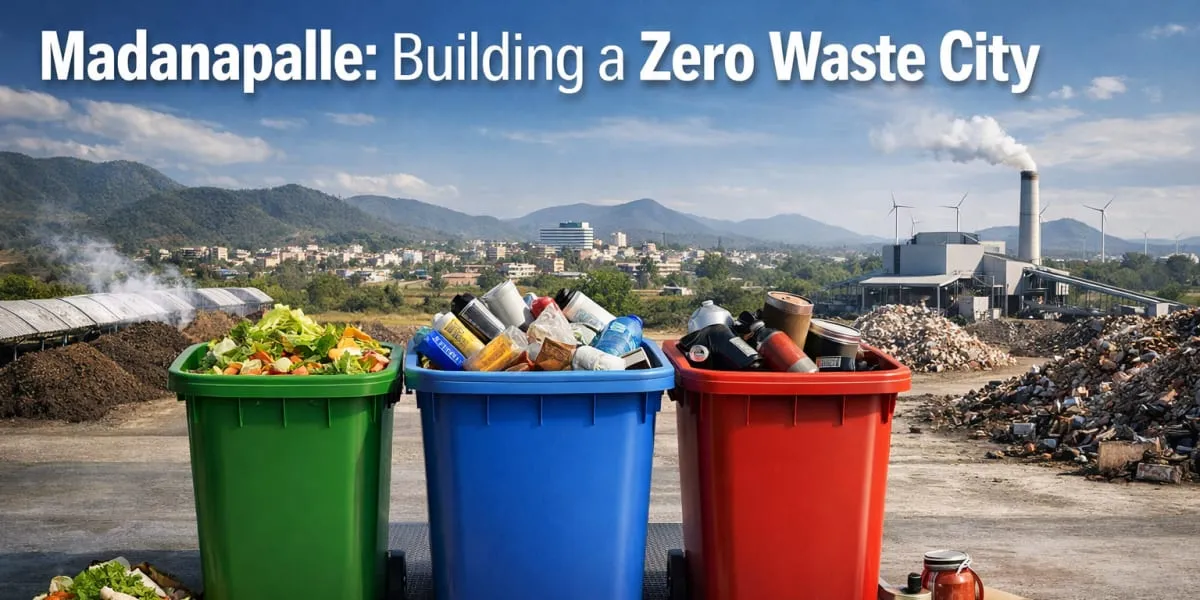
Madanapalle Municipality in Andhra Pradesh is reshaping urban sanitation under the Swachh Bharat Mission-Urban 2.0 by adopting an integrated approach to waste segregation, scientific processing and resource recovery. For reporting clarity the municipality defines the tonne (t) and states the town generates 62 t per day of municipal solid waste, including 25.5 t per day of dry waste, 36 t per day of wet waste and zero point five t per day of domestic hazardous waste. Source segregation categorises waste into biodegradable, non-biodegradable and upcycling streams to enable scientific processing.

A major focus is scientific management of biodegradable waste through decentralised on-site composting by bulk generators and home composting by households. Nearly 15.5 t of wet waste is processed daily through windrow composting at the municipal yard, producing about four point six five t of compost for parks and plantations. Around three t is processed daily through vermi composting, yielding one point two t of nutrient rich compost and reducing landfill burdens.

Dry waste is segregated at source; recyclables are sent to the Material Recovery Facility (MRF) for processing and onward supply to authorised recycling units. Non recyclable waste is sent to cement factories for co processing, improving utilisation and generating revenue for the municipality. The Reduce, Reuse and Recycle centre collects e waste, clothes, toys, books and footwear which are repaired, reused or redistributed to vulnerable communities.

The municipality remediated 36,512 t of legacy waste through bio mining and bio remediation, reclaiming approximately nine point four acres and developing nearly five acres with plantations to create green urban spaces. Recovered materials including Refuse Derived Fuel (RDF) are co processed at cement plants while soil and inert materials are reused to fill low lying areas. Wall paintings, waste to art installations and a Waste to Art Park at NVR Layout promote awareness and illustrate how integrated municipal action can advance the town towards zero dumping and zero littering.

Madanapalle Municipality in Andhra Pradesh is reshaping urban sanitation under the Swachh Bharat Mission-Urban 2.0 by adopting an integrated approach to waste segregation, scientific processing and resource recovery. For reporting clarity the municipality defines the tonne (t) and states the town generates 62 t per day of municipal solid waste, including 25.5 t per day of dry waste, 36 t per day of wet waste and zero point five t per day of domestic hazardous waste. Source segregation categorises waste into biodegradable, non-biodegradable and upcycling streams to enable scientific processing. A major focus is scientific management of biodegradable waste through decentralised on-site composting by bulk generators and home composting by households. Nearly 15.5 t of wet waste is processed daily through windrow composting at the municipal yard, producing about four point six five t of compost for parks and plantations. Around three t is processed daily through vermi composting, yielding one point two t of nutrient rich compost and reducing landfill burdens. Dry waste is segregated at source; recyclables are sent to the Material Recovery Facility (MRF) for processing and onward supply to authorised recycling units. Non recyclable waste is sent to cement factories for co processing, improving utilisation and generating revenue for the municipality. The Reduce, Reuse and Recycle centre collects e waste, clothes, toys, books and footwear which are repaired, reused or redistributed to vulnerable communities. The municipality remediated 36,512 t of legacy waste through bio mining and bio remediation, reclaiming approximately nine point four acres and developing nearly five acres with plantations to create green urban spaces. Recovered materials including Refuse Derived Fuel (RDF) are co processed at cement plants while soil and inert materials are reused to fill low lying areas. Wall paintings, waste to art installations and a Waste to Art Park at NVR Layout promote awareness and illustrate how integrated municipal action can advance the town towards zero dumping and zero littering.

Next Story
Infrastructure Urban

SCLR Extension Nears Completion Linking BKC With Signal-Free Route

The Santacruz-Chembur Link Road (SCLR) extension towards Bandra-Kurla Complex (BKC) via the Mumbai University campus has entered its final stage, bringing motorists closer to a direct, signal-free connection between the Western Express Highway and the city’s commercial district. The elevated connector is being built as an arm from the SCLR alignment and will link the western suburbs with BKC without surface signals. The link is designed to reduce journey times for commuters travelling from the western suburbs to BKC and to improve access to eastern Mumbai. By carrying through traffic above s..

Next Story
Infrastructure Transport

Raiganj MP Seeks Bengal Only Highway Link To Siliguri

Raiganj Member of Parliament Kartik Chandra Paul met Union Minister for Road Transport and Highways Nitin Gadkari in New Delhi to press for a new stretch of national highway in North Dinajpur district. He urged approval for a Bengal-to-Bengal link that would connect National Highways 12 and 27 to allow vehicles bound for Siliguri to avoid the current route through Kishanganj in neighbouring Bihar. He also submitted a proposed alignment of the new road to the ministry for consideration. At present vehicles from Raiganj travel along NH-12 and join NH-27 at Purnia More in Dalkhola, a route that p..

Next Story
Infrastructure Transport

Airport Kilambakkam Metro Line To Be Extended To Chengalpattu

Chennai Metro Rail (CMRL) has invited tenders for two detailed project reports that would extend its rail network to Chengalpattu in the south and extend Corridor-5 to Wimco Nagar in the north as part of a second wave of expansion beyond the operator's corridors under construction. The move signals an acceleration of planning for suburban links and interchange nodes. The larger of the two studies covers a roughly 27km extension from the planned Kilambakkam metro station to Chengalpattu under Corridor-1, Phase I. CMRL floated the tender at an estimated cost of Rs 21.6 mn. The proposed line woul..

Advertisement

Subscribe to Our Newsletter

Get daily newsletters around different themes from Construction world.

STAY CONNECTED

Advertisement

Advertisement

Advertisement














