Mahindra Research Valley Expansion To Cost Rs 1,960 Mn
ECONOMY & POLICY

Mahindra Research Valley Expansion To Cost Rs 1,960 Mn

Mahindra & Mahindra Ltd is to invest Rs 1,960 million (Rs 1,960 mn) to expand its Advanced Research and Development Centre and to add testing facilities at Mahindra Research Valley in Chennai. The investment is intended to strengthen the research and development centre and testing infrastructure to support advanced vehicle design, product engineering and future technology development. The company indicated that the expanded facility will support next-generation vehicle platforms across multiple segments.

The expansion is described as a deliberate step to enhance innovation and engineering capacity, including augmented test capabilities and design resources. The upgraded infrastructure is expected to provide integrated development and validation environments that accelerate product development cycles and assist in meeting evolving regulatory and market requirements. The project forms part of the firm’s broader commitment to invest in technological capabilities and to retain engineering expertise within the Chennai campus.

The site at Mahindra Research Valley will accommodate extended testing rigs, prototype workshops and simulation facilities to enable end-to-end vehicle validation and refinement. The enhanced capabilities are anticipated to support collaborations with internal engineering teams and external partners in areas such as electrification, software integration and advanced materials. The company noted that such facilities typically reduce time to market and improve product robustness.

The expanded centre is expected to become operational within this calendar year, subject to customary commissioning and certification processes. The investment decision follows ongoing industry trends that prioritise in-house development of complex vehicle systems and comprehensive testing regimes. Officials indicated that the upgrade will position the facility to address future mobility challenges and to sustain competitive development programmes.

The company expects the expansion will create additional engineering and technical roles and will deepen skill development initiatives within the campus, thereby supporting the talent pipeline. It is intended to foster knowledge transfer and to enable cross-functional teams to accelerate systems integration and validation. Taken together, these features are intended to improve responsiveness to customer and regulatory requirements while sustaining long-term product development programmes.

Mahindra & Mahindra Ltd is to invest Rs 1,960 million (Rs 1,960 mn) to expand its Advanced Research and Development Centre and to add testing facilities at Mahindra Research Valley in Chennai. The investment is intended to strengthen the research and development centre and testing infrastructure to support advanced vehicle design, product engineering and future technology development. The company indicated that the expanded facility will support next-generation vehicle platforms across multiple segments. The expansion is described as a deliberate step to enhance innovation and engineering capacity, including augmented test capabilities and design resources. The upgraded infrastructure is expected to provide integrated development and validation environments that accelerate product development cycles and assist in meeting evolving regulatory and market requirements. The project forms part of the firm’s broader commitment to invest in technological capabilities and to retain engineering expertise within the Chennai campus. The site at Mahindra Research Valley will accommodate extended testing rigs, prototype workshops and simulation facilities to enable end-to-end vehicle validation and refinement. The enhanced capabilities are anticipated to support collaborations with internal engineering teams and external partners in areas such as electrification, software integration and advanced materials. The company noted that such facilities typically reduce time to market and improve product robustness. The expanded centre is expected to become operational within this calendar year, subject to customary commissioning and certification processes. The investment decision follows ongoing industry trends that prioritise in-house development of complex vehicle systems and comprehensive testing regimes. Officials indicated that the upgrade will position the facility to address future mobility challenges and to sustain competitive development programmes. The company expects the expansion will create additional engineering and technical roles and will deepen skill development initiatives within the campus, thereby supporting the talent pipeline. It is intended to foster knowledge transfer and to enable cross-functional teams to accelerate systems integration and validation. Taken together, these features are intended to improve responsiveness to customer and regulatory requirements while sustaining long-term product development programmes.

Related Stories

Gold Stories

Next Story
Infrastructure Urban

KONE Opens India's First Digital Experience Centre in Pune

KONE, a global elevator and escalator manufacturer, has inaugurated its first Digital Experience Centre (DEC) in India, located in Pune. The facility aims to showcase how artificial intelligence (AI), connectivity and data-driven technologies can enhance customer experiences and improve building operations.The centre was inaugurated by Jussi Herlin, Executive Vice Chair, KONE Corporation; Philippe Delorme, President and CEO, KONE; and Nandan Nilekani, Co-founder and Chairman of the Board, Infosys.Designed as an interactive customer environment, the facility demonstrates digital solutions cover..

Next Story
Infrastructure Urban

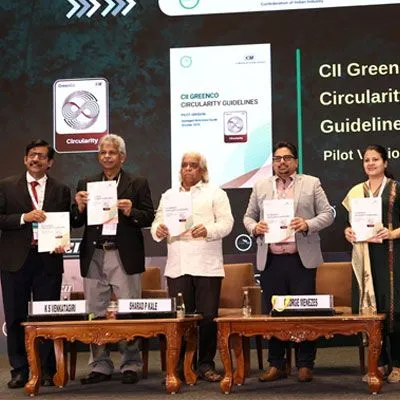
CII GreenCo Launches Circularity Guidelines for Indian Industry

The Confederation of Indian Industry (CII) GreenCo Council has launched the CII GreenCo Circularity Guidelines – Pilot Version at the 17th CII GreenCo Waste & Resource Management Summit 2026 in Chennai. The initiative aims to strengthen resource efficiency, waste reduction and circular economy practices across Indian manufacturing and process industries.The guidelines introduce a structured framework with circularity indices covering raw materials, consumables, packaging and other resource inputs. These indicators will help industries assess existing practices, identify opportunities to ..

Next Story
Infrastructure Energy

Global Electronics Association Launches IPC-1783-CO2E Standard

The Global Electronics Association has introduced IPC-1783-CO2E, a new international standard aimed at improving consistency, transparency and comparability in product carbon footprint reporting across the electronics manufacturing industry.The standard, titled International Standard for Data Collection and Reporting of CO2 Equivalent (CO2e) Emissions for the Electronics Manufacturing Supply Chain, provides industry-specific guidance for collecting, estimating and reporting carbon emissions data.With increasing regulatory requirements and customer expectations, electronics manufacturers face c..

Advertisement

Subscribe to Our Newsletter

Get daily newsletters around different themes from Construction world.

STAY CONNECTED

Advertisement

SPECIAL OFFER
QR Code