+
Meghalaya Launches Rs 1.75 Billion Mission for Lakadong Turmeric
ECONOMY & POLICY

Meghalaya Launches Rs 1.75 Billion Mission for Lakadong Turmeric

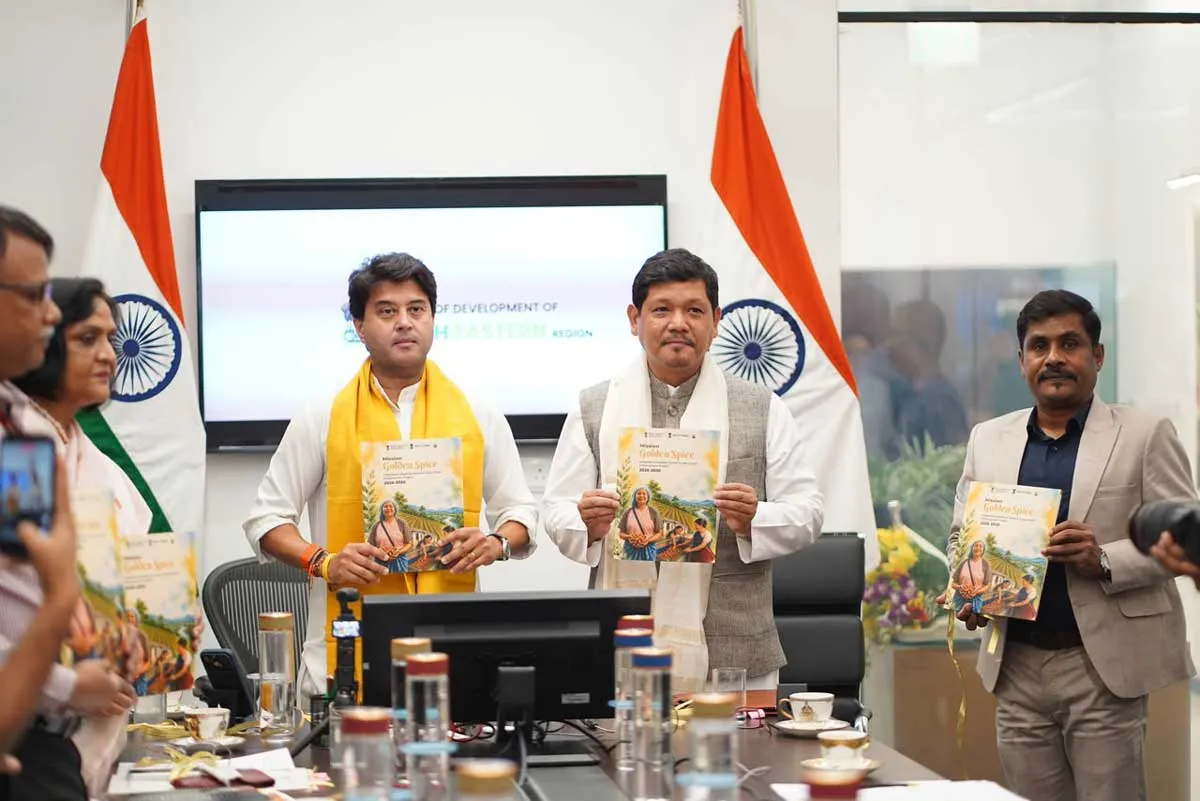
Meghalaya has launched Mission Golden Spice: Integrated Lakadong Turmeric Value Chain Enhancement Project, marking a major step towards establishing the state as a global centre for premium, organic and GI-tagged Lakadong turmeric.

Launched at Sanchar Bhavan in New Delhi, the initiative aims to transform Meghalaya’s agricultural sector by moving farmers from traditional commodity production towards a value-driven, entrepreneurship-led ecosystem. Through a Community-Public-Private Partnership (CPPP) model, the project focuses on strengthening processing capabilities, improving market access and enabling farmers, particularly women, to participate across the value chain.

Addressing the gathering, Jyotiraditya M. Scindia, Union Minister, Ministry of Development of North Eastern Region (MDONER), highlighted the project as a significant milestone in Meghalaya’s agricultural transformation. The initiative involves a collaborative investment of Rs 1.75 billion aimed at doubling farmer remuneration and expanding Lakadong turmeric cultivation by 2030.

The mission is expected to support more than 17,500 growers, with 99 per cent participation from women farmers. Highlighting Lakadong turmeric’s high curcumin content of 7 to 12 per cent, Scindia said the crop has the potential to establish Meghalaya as a global destination for premium turmeric production.

Conrad K. Sangma, Chief Minister of Meghalaya, said the state is adopting an end-to-end ecosystem approach for Lakadong turmeric through a mission-mode programme. He highlighted the importance of technology, financial support and value addition in improving farmer livelihoods and strengthening agricultural enterprises.

The five-year mission from 2026-2030 involves a total project cost of Rs 1.7545 billion and aims to benefit over 17,500 farming households across West and East Jaintia Hills. The project will expand Lakadong turmeric cultivation by an additional 7,000 hectares, increasing the total cultivation area to 9,581 hectares and raising production to nearly 60,000 MT by 2030.

The initiative is designed to increase farmer earnings from approximately Rs 40/kg to Rs 83.70/kg through improved processing, branding and market linkages. A Rs 416.9 million integrated organic turmeric processing and curcumin extraction facility will also be established in West Jaintia Hills. The facility will have the capacity to process 7,000 MT of fresh turmeric annually and produce curcumin extracts, oleoresins and premium turmeric powder.

The project will also support the development of 28 integrated FPO packhouses and 28 cluster warehouses, along with Rs 350 million assistance for planting material.

The initiative represents a Centre-State collaboration involving MDONER, the North Eastern Council (NEC), the Ministry of Agriculture & Farmers Welfare and the Government of Meghalaya. MDONER and NEC will contribute Rs 876.2 million towards physical infrastructure development, with MDONER already sanctioning Rs 432.4 million for Phase 1.

The Ministry of Agriculture & Farmers Welfare will provide Rs 581 million for production enhancement and organic certification, while the Government of Meghalaya will contribute Rs 297.3 million towards branding, FPO working capital and blockchain-based traceability systems for GI protection and export development.

Timothy D. Shira, Minister of Agriculture and Farmers’ Welfare, Meghalaya, said the mission aims to transform GI-tagged Lakadong turmeric into a globally competitive, export-oriented and women-led enterprise. The initiative is expected to expand cultivation, benefit farmers and generate additional livelihood opportunities.

Dr Vijay Kumar D, IAS, Commissioner and Secretary, Government of Meghalaya, highlighted the importance of the integrated value chain approach and acknowledged the role of women farmers in strengthening the state’s agricultural ecosystem.

The launch event also featured the screening of a short film on Mission Lakadong Turmeric and an interaction with farmers from Meghalaya. Padma Shri awardee Trinity Saioo and farmer entrepreneur Jhanika Siangshai shared their experiences on how value-added agricultural initiatives are creating opportunities for rural communities.

With Mission Golden Spice, Meghalaya aims to strengthen its position in global spice markets while promoting community-led growth, women entrepreneurship and sustainable agricultural development.

Meghalaya has launched Mission Golden Spice: Integrated Lakadong Turmeric Value Chain Enhancement Project, marking a major step towards establishing the state as a global centre for premium, organic and GI-tagged Lakadong turmeric.Launched at Sanchar Bhavan in New Delhi, the initiative aims to transform Meghalaya’s agricultural sector by moving farmers from traditional commodity production towards a value-driven, entrepreneurship-led ecosystem. Through a Community-Public-Private Partnership (CPPP) model, the project focuses on strengthening processing capabilities, improving market access and enabling farmers, particularly women, to participate across the value chain.Addressing the gathering, Jyotiraditya M. Scindia, Union Minister, Ministry of Development of North Eastern Region (MDONER), highlighted the project as a significant milestone in Meghalaya’s agricultural transformation. The initiative involves a collaborative investment of Rs 1.75 billion aimed at doubling farmer remuneration and expanding Lakadong turmeric cultivation by 2030.The mission is expected to support more than 17,500 growers, with 99 per cent participation from women farmers. Highlighting Lakadong turmeric’s high curcumin content of 7 to 12 per cent, Scindia said the crop has the potential to establish Meghalaya as a global destination for premium turmeric production.Conrad K. Sangma, Chief Minister of Meghalaya, said the state is adopting an end-to-end ecosystem approach for Lakadong turmeric through a mission-mode programme. He highlighted the importance of technology, financial support and value addition in improving farmer livelihoods and strengthening agricultural enterprises.The five-year mission from 2026-2030 involves a total project cost of Rs 1.7545 billion and aims to benefit over 17,500 farming households across West and East Jaintia Hills. The project will expand Lakadong turmeric cultivation by an additional 7,000 hectares, increasing the total cultivation area to 9,581 hectares and raising production to nearly 60,000 MT by 2030.The initiative is designed to increase farmer earnings from approximately Rs 40/kg to Rs 83.70/kg through improved processing, branding and market linkages. A Rs 416.9 million integrated organic turmeric processing and curcumin extraction facility will also be established in West Jaintia Hills. The facility will have the capacity to process 7,000 MT of fresh turmeric annually and produce curcumin extracts, oleoresins and premium turmeric powder.The project will also support the development of 28 integrated FPO packhouses and 28 cluster warehouses, along with Rs 350 million assistance for planting material.The initiative represents a Centre-State collaboration involving MDONER, the North Eastern Council (NEC), the Ministry of Agriculture & Farmers Welfare and the Government of Meghalaya. MDONER and NEC will contribute Rs 876.2 million towards physical infrastructure development, with MDONER already sanctioning Rs 432.4 million for Phase 1.The Ministry of Agriculture & Farmers Welfare will provide Rs 581 million for production enhancement and organic certification, while the Government of Meghalaya will contribute Rs 297.3 million towards branding, FPO working capital and blockchain-based traceability systems for GI protection and export development.Timothy D. Shira, Minister of Agriculture and Farmers’ Welfare, Meghalaya, said the mission aims to transform GI-tagged Lakadong turmeric into a globally competitive, export-oriented and women-led enterprise. The initiative is expected to expand cultivation, benefit farmers and generate additional livelihood opportunities.Dr Vijay Kumar D, IAS, Commissioner and Secretary, Government of Meghalaya, highlighted the importance of the integrated value chain approach and acknowledged the role of women farmers in strengthening the state’s agricultural ecosystem.The launch event also featured the screening of a short film on Mission Lakadong Turmeric and an interaction with farmers from Meghalaya. Padma Shri awardee Trinity Saioo and farmer entrepreneur Jhanika Siangshai shared their experiences on how value-added agricultural initiatives are creating opportunities for rural communities.With Mission Golden Spice, Meghalaya aims to strengthen its position in global spice markets while promoting community-led growth, women entrepreneurship and sustainable agricultural development.

Related Stories

Gold Stories

Next Story
Infrastructure Transport

MMRDA Targets Completion of Projects by December 2028

The Mumbai Metropolitan Region Development Authority (MMRDA) is targeting the completion of all its ongoing infrastructure projects by December 2028, a year ahead of its December 2029 deadline, Metropolitan Commissioner Dr Sanjay Mukherjee has said.Speaking at the sixth edition of the Real Estate & Infrastructure Investors' Summit (REIIS) 2026 in Mumbai, Mukherjee said the authority was developing an integrated network of roads, tunnels, sea links and Metro corridors under its broader vision of “Mumbai in 59 Minutes”.The objective is to improve east-west and north-south connectivity an..

Next Story
Building Material

High-Performance Façades Gain Ground in Indian Buildings

High-performance façades are gaining greater importance in Indian architecture as developers and architects increasingly focus on energy efficiency, thermal comfort and building performance, according to Shankar Fenestrations & Glasses.The company said modern façade systems are increasingly being considered as part of a building's overall performance strategy rather than being used primarily as aesthetic elements.High-performance glass, curtain wall systems and structural glazing can contribute to thermal regulation, solar control, daylight management and indoor comfort. Their growing ad..

Next Story
Technology

SPML Infra's 104.4 kWh BESS Battery Pack Clears Global Tests

SPML Infra has announced that its proprietary 104.4 kWh Battery Energy Storage System (BESS) battery pack has completed key international safety, performance and transportation testing and certification requirements, marking a step towards its commercial deployment.Developed under the company's own intellectual property, the battery pack has completed requirements under UL9540A, IEC 62619, IEC 63056, IEC 60730, IEC 61000-6-2, IEC 61000-6-4 and UN38.3 standards.The testing covers areas including thermal runaway safety, battery performance, system functional safety, electromagnetic compatibility..

Advertisement

Subscribe to Our Newsletter

Get daily newsletters around different themes from Construction world.

STAY CONNECTED

Advertisement

SPECIAL OFFER
QR Code