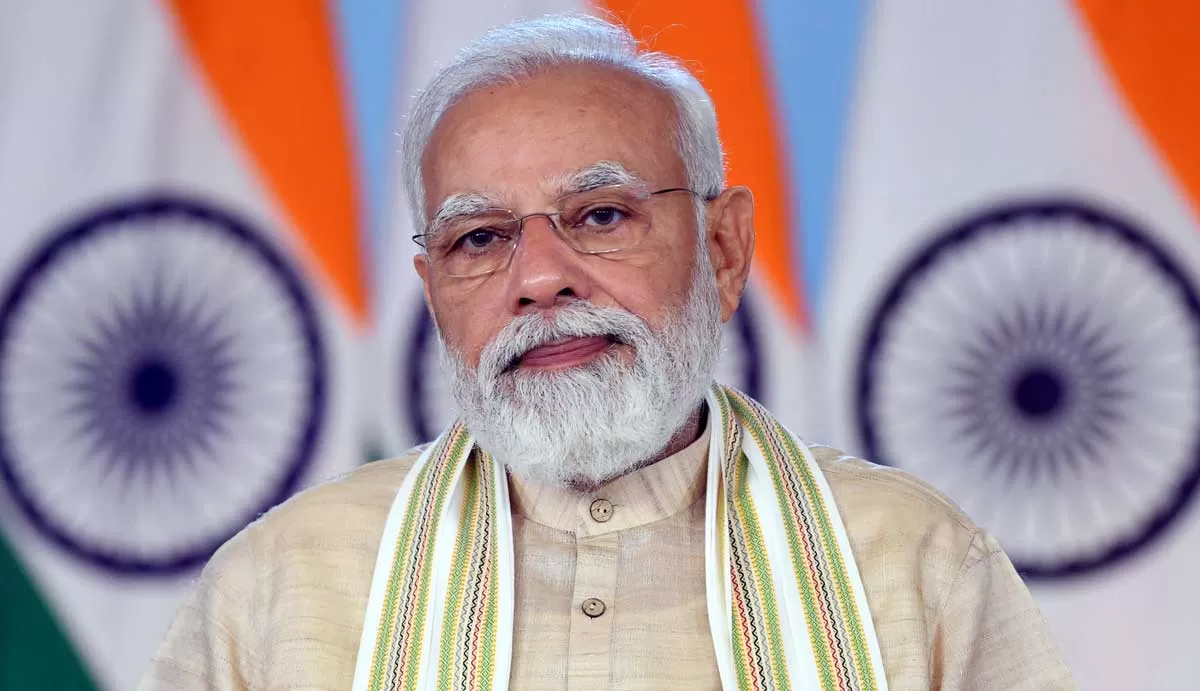
Modi inaugurated development projects worth Rs 320 billion in Jammu
ECONOMY & POLICY

Modi inaugurated development projects worth Rs 320 billion in Jammu

Prime Minister Narendra Modi inaugurated and laid the foundation stone for various development projects in the education, railway, aviation, and road sectors, amounting to over Rs 320 billion in Jammu.

The first electric train in the valley and the train service between Sangaldan station and Baramulla station were also flagged off by PM Modi.

In the course of the program, the PM distributed appointment orders to approximately 1500 new government recruits of Jammu and Kashmir. Additionally, as part of the 'Viksit Bharat Viksit Jammu' program, he interacted with beneficiaries of various government schemes.

The Prime Minister, who had arrived in the winter capital Jammu to launch these multiple development projects, was received at the Jammu technical airport by Lt Governor Manoj Sinha and Union minister Jitendra Singh, along with prominent BJP leaders, including J-K unit president Ravinder Raina. The Maulana Azad Stadium witnessed a large turnout of people from across Jammu and Kashmir for the event.

This marks the second visit of PM Modi to Jammu and Kashmir since the abrogation of Article 370 in 2019 and is significant in the lead-up to the upcoming Lok Sabha polls.

Prime Minister Narendra Modi inaugurated and laid the foundation stone for various development projects in the education, railway, aviation, and road sectors, amounting to over Rs 320 billion in Jammu. The first electric train in the valley and the train service between Sangaldan station and Baramulla station were also flagged off by PM Modi. In the course of the program, the PM distributed appointment orders to approximately 1500 new government recruits of Jammu and Kashmir. Additionally, as part of the 'Viksit Bharat Viksit Jammu' program, he interacted with beneficiaries of various government schemes. The Prime Minister, who had arrived in the winter capital Jammu to launch these multiple development projects, was received at the Jammu technical airport by Lt Governor Manoj Sinha and Union minister Jitendra Singh, along with prominent BJP leaders, including J-K unit president Ravinder Raina. The Maulana Azad Stadium witnessed a large turnout of people from across Jammu and Kashmir for the event. This marks the second visit of PM Modi to Jammu and Kashmir since the abrogation of Article 370 in 2019 and is significant in the lead-up to the upcoming Lok Sabha polls.

Next Story
Infrastructure Urban

Implementation Status of Jal Jeevan Mission

Since August 2019 the Government has implemented Jal Jeevan Mission to provide assured potable water through household tap connections in rural India. At the start of the mission only 32.3 million (mn) rural households, representing 16.7 per cent, were reported to have tap water connections. States and union territories have reported that 125.8 mn additional rural households have since been provided with tap connections. As a result, of about 193.6 mn rural households roughly 158.2 mn, or 81.71 per cent, are reported to have tap water supply at home.\n\nThe State, district and village level st..

Next Story
Infrastructure Urban

Jal Jeevan Mission Reaches Eighty One Per Cent Rural Coverage

The Government reported substantial progress under the Jal Jeevan Mission, launched in August 2019 to provide tap water to every rural household. At launch only 32.3 million (mn) rural households had tap connections and states and Union territories reported provision of 125.8 mn additional households by March 2026. Consequently, out of about 193.6 mn rural households around 158.2 mn, or 81.71 per cent, are reported to have tap water at home. The Finance Minister announced extension of the mission until 2028 in the 2025-26 budget speech. The Swachh Bharat Mission Grameen, launched in October 20..

Next Story
Infrastructure Urban

Empowering Local Governance for Sustainable Rural Water Supply

The Ministry of Jal Shakti has aligned the Jal Jeevan Mission (JJM) with the 73rd Amendment to strengthen village level planning and community ownership of water supply. Gram Panchayats, village water and sanitation committees and Pani Samitis are to plan, implement, manage and maintain piped water systems, with gram sabha processes formalising handover and oversight. Implementation support agencies including non government organisations, community based organisations and self help groups have been empanelled to train local committees and promote women participation. Under JJM, the department ..

Advertisement

Subscribe to Our Newsletter

Get daily newsletters around different themes from Construction world.

STAY CONNECTED

Advertisement

Advertisement

Advertisement