Modi Initiates Rs 80 bn infrastructure development in Ahmedabad
ECONOMY & POLICY

Modi Initiates Rs 80 bn infrastructure development in Ahmedabad

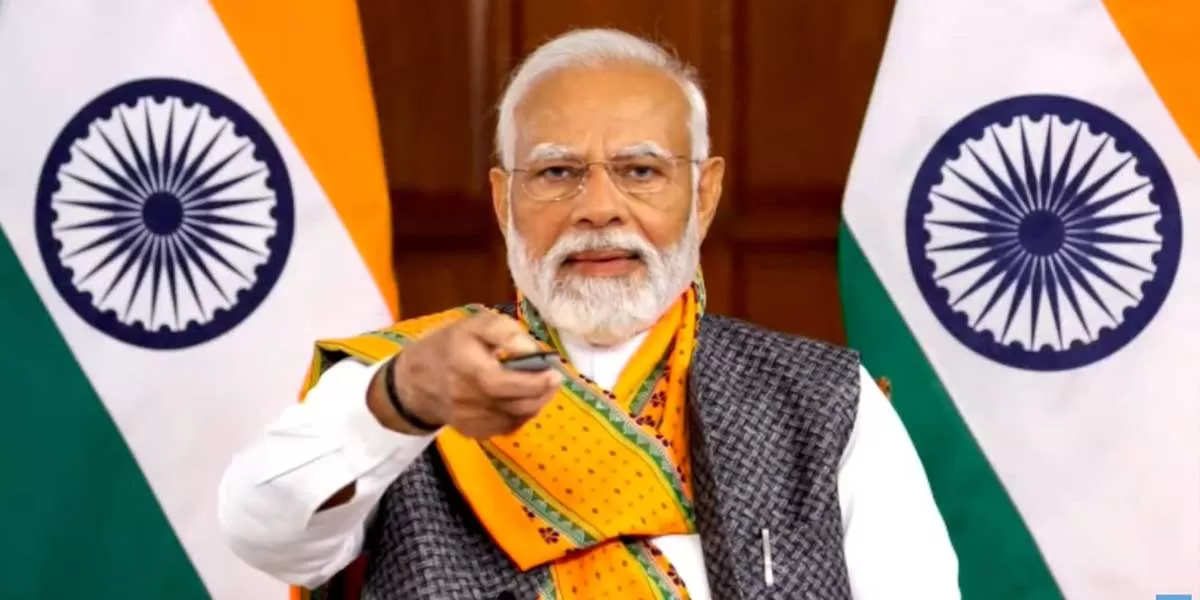
Prime Minister Modi has launched and laid the foundation for multiple developmental projects in Ahmedabad, Gujarat, collectively valued at over Rs 8,000 crore. These projects span various sectors, including railways, roads, power, housing, and finance.

Among the key highlights, Modi inaugurated India’s first Namo Bharat Rapid Rail service from Ahmedabad to Bhuj and introduced several new Vande Bharat train routes. These include services from Nagpur to Secunderabad, Kolhapur to Pune, Agra Cantt to Banaras, Durg to Visakhapatnam, and Pune to Hubballi. He also flagged off a 20-coach Vande Bharat train from Varanasi to Delhi. Additionally, the Prime Minister launched the Single Window IT System (SWITS) for the International Financial Services Centres Authority to streamline operational processes.

The infrastructure initiatives include the quadrupling of the Samakhiali-Gandhidham and Gandhidham-Adipur railway lines, which are expected to enhance transportation connectivity significantly. Plans are also underway for the development of iconic roads within the Ahmedabad Municipal Corporation (AMC) to improve city connectivity and transit ease. The inauguration marked the commencement of construction for flyover bridges at Bakrol, Hathijan, Ramol, and Panjarpol Junction, aimed at alleviating traffic congestion and improving travel times.

Moreover, PM Modi inaugurated a 30 MW solar system and a 35 MW Battery Energy Storage System (BESS) Solar PV Project at the Kutch Lignite Thermal Power Station. He also established 220 kV substations in Morbi and Rajkot. Additionally, over 30,000 houses have been sanctioned under the Pradhan Mantri Awas Yojana - Gramin initiative, with the initial installment released for these homes. These actions represent significant strides toward enhancing the country’s infrastructure and promoting sustainable energy practices.

Prime Minister Modi has launched and laid the foundation for multiple developmental projects in Ahmedabad, Gujarat, collectively valued at over Rs 8,000 crore. These projects span various sectors, including railways, roads, power, housing, and finance. Among the key highlights, Modi inaugurated India’s first Namo Bharat Rapid Rail service from Ahmedabad to Bhuj and introduced several new Vande Bharat train routes. These include services from Nagpur to Secunderabad, Kolhapur to Pune, Agra Cantt to Banaras, Durg to Visakhapatnam, and Pune to Hubballi. He also flagged off a 20-coach Vande Bharat train from Varanasi to Delhi. Additionally, the Prime Minister launched the Single Window IT System (SWITS) for the International Financial Services Centres Authority to streamline operational processes. The infrastructure initiatives include the quadrupling of the Samakhiali-Gandhidham and Gandhidham-Adipur railway lines, which are expected to enhance transportation connectivity significantly. Plans are also underway for the development of iconic roads within the Ahmedabad Municipal Corporation (AMC) to improve city connectivity and transit ease. The inauguration marked the commencement of construction for flyover bridges at Bakrol, Hathijan, Ramol, and Panjarpol Junction, aimed at alleviating traffic congestion and improving travel times. Moreover, PM Modi inaugurated a 30 MW solar system and a 35 MW Battery Energy Storage System (BESS) Solar PV Project at the Kutch Lignite Thermal Power Station. He also established 220 kV substations in Morbi and Rajkot. Additionally, over 30,000 houses have been sanctioned under the Pradhan Mantri Awas Yojana - Gramin initiative, with the initial installment released for these homes. These actions represent significant strides toward enhancing the country’s infrastructure and promoting sustainable energy practices.

Next Story
Infrastructure Transport

MMRDA advances 250 m on Orange Gate–Marine Drive tunnel

The Mumbai Metropolitan Region Development Authority (MMRDA) has completed 250 m of underground tunnelling for the Orange Gate–Marine Drive Urban Road Tunnel using India’s largest slurry shield tunnel boring machine (TBM) deployed for an urban road project.The project involves twin tunnels extending over 7 km beneath critical transport corridors, including Central Railway, Western Railway and Metro Line 3. The work requires high-precision engineering to navigate densely developed urban infrastructure.Once completed, the tunnel is expected to reduce travel time between Orange Gate and Marin..

Next Story
Infrastructure Urban

Hindustan Zinc Pays Rs 188.46 Billion in FY26

Hindustan Zinc contributed Rs 188.46 billion to the public exchequer in FY 2025-26, according to its 9th Tax Transparency Report. The contribution, equivalent to 46 per cent of the company’s revenue, included direct and indirect taxes, government royalties, dividends to the Government of India, withholding taxes and other statutory levies.The company’s five-year cumulative contribution to the exchequer stood at Rs 915.72 billion. In FY26, Hindustan Zinc reported revenue of Rs 408.44 billion, EBITDA of Rs 221.62 billion and profit after tax of Rs 138.32 billion. It also achieved its highest..

Next Story
Infrastructure Urban

World of Concrete India 2026 Opens in Mumbai

Informa Markets in India will host the 12th edition of World of Concrete India 2026 from 3–5 June 2026 at the Bombay Exhibition Centre, Mumbai. The specialised B2B exhibition will bring together manufacturers, suppliers, contractors, developers, architects, consultants, infrastructure companies, project leaders and government stakeholders.The event is expected to feature over 350 brands and more than 18,000 trade professionals. It will cover concrete and cement, dry mortar, precast technologies, formwork, construction chemicals, industrial and commercial flooring, scaffolding, safety solutio..

Advertisement

Subscribe to Our Newsletter

Get daily newsletters around different themes from Construction world.

STAY CONNECTED

Advertisement

Advertisement

Advertisement

-->