MSRTC To Install 7,035 CCTV Cameras Across Maharashtra
ECONOMY & POLICY

MSRTC To Install 7,035 CCTV Cameras Across Maharashtra

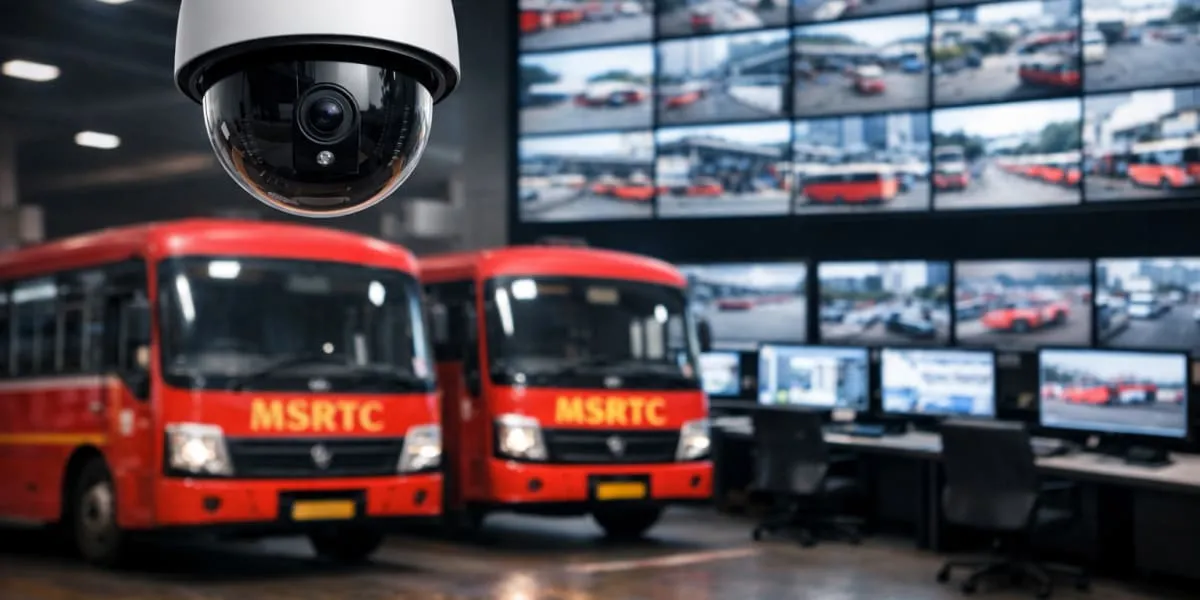
The Maharashtra State Road Transport Corporation (MSRTC) is to deploy 7,035 closed circuit television cameras across 633 locations after the state government launched a Rs 1.11 bn surveillance project to strengthen passenger safety. The grid will cover bus stations, depots, divisional offices, workshops and training institutes and will be monitored centrally from a command centre in Mumbai. Authorities said the initiative is intended to deter crime, counter potential terror related threats and improve emergency response across the transport network.

The work has been awarded through an e tendering process to Telecommunications Consultants India Limited which is expected to implement the system within one year and complete installation across all listed sites. User acceptance testing at the newly established central command centre in Mumbai has been completed and early results from a pilot phase were reported as encouraging. During the pilot surveillance systems were installed at 64 sensitive locations in the Mumbai, Thane, Raigad and Palghar divisions and officials decided to expand coverage to the remaining 27 divisions.

Officials indicated that continuous real time monitoring will help manage crowd movement, speed up operational decision making and enable immediate response to incidents reported from transport hubs. The centrally aggregated platform will allow authorised personnel to view feeds from all cameras across the state and to coordinate with local enforcement and emergency services when required. The move is also expected to make the iconic red Maharashtra State Road Transport Corporation buses, popularly known as Lalpari, safer for daily commuters.

MSRTC currently carries about 5.5 mn passengers each day across an operational fleet of approximately 14,000 buses and officials suggested that improved surveillance would enhance reliability and commuter confidence. The project budget and rollout plan reflect a wider push by the state to modernise transport infrastructure and leverage digital systems for public safety and operational efficiency. Implementation timelines foresee full commissioning within the contract year and ongoing monitoring and maintenance arrangements will be finalised by the contractor.

The Maharashtra State Road Transport Corporation (MSRTC) is to deploy 7,035 closed circuit television cameras across 633 locations after the state government launched a Rs 1.11 bn surveillance project to strengthen passenger safety. The grid will cover bus stations, depots, divisional offices, workshops and training institutes and will be monitored centrally from a command centre in Mumbai. Authorities said the initiative is intended to deter crime, counter potential terror related threats and improve emergency response across the transport network. The work has been awarded through an e tendering process to Telecommunications Consultants India Limited which is expected to implement the system within one year and complete installation across all listed sites. User acceptance testing at the newly established central command centre in Mumbai has been completed and early results from a pilot phase were reported as encouraging. During the pilot surveillance systems were installed at 64 sensitive locations in the Mumbai, Thane, Raigad and Palghar divisions and officials decided to expand coverage to the remaining 27 divisions. Officials indicated that continuous real time monitoring will help manage crowd movement, speed up operational decision making and enable immediate response to incidents reported from transport hubs. The centrally aggregated platform will allow authorised personnel to view feeds from all cameras across the state and to coordinate with local enforcement and emergency services when required. The move is also expected to make the iconic red Maharashtra State Road Transport Corporation buses, popularly known as Lalpari, safer for daily commuters. MSRTC currently carries about 5.5 mn passengers each day across an operational fleet of approximately 14,000 buses and officials suggested that improved surveillance would enhance reliability and commuter confidence. The project budget and rollout plan reflect a wider push by the state to modernise transport infrastructure and leverage digital systems for public safety and operational efficiency. Implementation timelines foresee full commissioning within the contract year and ongoing monitoring and maintenance arrangements will be finalised by the contractor.

Related Stories

Gold Stories

Next Story
Infrastructure Urban

KONE Opens India's First Digital Experience Centre in Pune

KONE, a global elevator and escalator manufacturer, has inaugurated its first Digital Experience Centre (DEC) in India, located in Pune. The facility aims to showcase how artificial intelligence (AI), connectivity and data-driven technologies can enhance customer experiences and improve building operations.The centre was inaugurated by Jussi Herlin, Executive Vice Chair, KONE Corporation; Philippe Delorme, President and CEO, KONE; and Nandan Nilekani, Co-founder and Chairman of the Board, Infosys.Designed as an interactive customer environment, the facility demonstrates digital solutions cover..

Next Story
Infrastructure Urban

CII GreenCo Launches Circularity Guidelines for Indian Industry

The Confederation of Indian Industry (CII) GreenCo Council has launched the CII GreenCo Circularity Guidelines – Pilot Version at the 17th CII GreenCo Waste & Resource Management Summit 2026 in Chennai. The initiative aims to strengthen resource efficiency, waste reduction and circular economy practices across Indian manufacturing and process industries.The guidelines introduce a structured framework with circularity indices covering raw materials, consumables, packaging and other resource inputs. These indicators will help industries assess existing practices, identify opportunities to ..

Next Story
Infrastructure Energy

Global Electronics Association Launches IPC-1783-CO2E Standard

The Global Electronics Association has introduced IPC-1783-CO2E, a new international standard aimed at improving consistency, transparency and comparability in product carbon footprint reporting across the electronics manufacturing industry.The standard, titled International Standard for Data Collection and Reporting of CO2 Equivalent (CO2e) Emissions for the Electronics Manufacturing Supply Chain, provides industry-specific guidance for collecting, estimating and reporting carbon emissions data.With increasing regulatory requirements and customer expectations, electronics manufacturers face c..

Advertisement

Subscribe to Our Newsletter

Get daily newsletters around different themes from Construction world.

STAY CONNECTED

Advertisement

SPECIAL OFFER
QR Code