


NGT Clears Rs 800 Billion Great Nicobar Project
ECONOMY & POLICY

NGT Clears Rs 800 Billion Great Nicobar Project

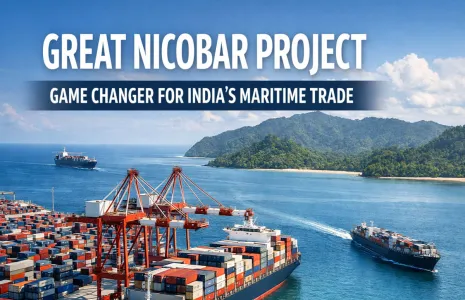
A National Green Tribunal special bench cleared the Rs 800 billion (Rs 800 bn) Great Nicobar infrastructure project after finding no good ground to interfere in the environmental clearance and recording that adequate safeguards had been incorporated. The six-member bench was headed by chairperson Justice Prakash Shrivastava and treated the project as having strategic importance that required a balanced approach. The tribunal disposed of petitions that had challenged aspects of the approval and directed authorities to ensure compliance with conditions.

The project spans 166 sq km, entails diversion of 130 sq km of forest and the felling of almost one million (one mn) trees, and envisages a transshipment port, an integrated township, a civil and military airport and a 450-MVA gas and solar power based plant. The approval followed a review by a high-powered committee formed after an earlier tribunal order. The Centre has advanced the plan amid objections about ecological harm and local dispossession concerns.

Petitions alleged violations of the Island Coastal Regulation Zone notification of 2019 and non-compliance with the tribunal’s 2023 directions, claiming parts of the scheme fell in prohibited areas. The tribunal examined the high-powered committee’s findings and recorded that no part fell in the prohibited zone, noting that the Environment Ministry did not make the committee report public and that the tribunal had relied on findings produced in an affidavit by the Centre. Submissions from the Zoological Survey of India on coral presence were considered.

The tribunal set conditions for protection of the leatherback sea turtle, the Nicobar megapode, saltwater crocodiles, the robber crab, the Nicobar macaque and other endemic birds and required the ministry to implement these measures. It directed steps to prevent shoreline erosion, safeguard sandy beaches as nesting sites and ensure protection and scientific regeneration of coral along the coastal stretch, including translocation where necessary. The order is likely to serve as a reference point for future strategic projects in ecologically sensitive areas.

A National Green Tribunal special bench cleared the Rs 800 billion (Rs 800 bn) Great Nicobar infrastructure project after finding no good ground to interfere in the environmental clearance and recording that adequate safeguards had been incorporated. The six-member bench was headed by chairperson Justice Prakash Shrivastava and treated the project as having strategic importance that required a balanced approach. The tribunal disposed of petitions that had challenged aspects of the approval and directed authorities to ensure compliance with conditions. The project spans 166 sq km, entails diversion of 130 sq km of forest and the felling of almost one million (one mn) trees, and envisages a transshipment port, an integrated township, a civil and military airport and a 450-MVA gas and solar power based plant. The approval followed a review by a high-powered committee formed after an earlier tribunal order. The Centre has advanced the plan amid objections about ecological harm and local dispossession concerns. Petitions alleged violations of the Island Coastal Regulation Zone notification of 2019 and non-compliance with the tribunal’s 2023 directions, claiming parts of the scheme fell in prohibited areas. The tribunal examined the high-powered committee’s findings and recorded that no part fell in the prohibited zone, noting that the Environment Ministry did not make the committee report public and that the tribunal had relied on findings produced in an affidavit by the Centre. Submissions from the Zoological Survey of India on coral presence were considered. The tribunal set conditions for protection of the leatherback sea turtle, the Nicobar megapode, saltwater crocodiles, the robber crab, the Nicobar macaque and other endemic birds and required the ministry to implement these measures. It directed steps to prevent shoreline erosion, safeguard sandy beaches as nesting sites and ensure protection and scientific regeneration of coral along the coastal stretch, including translocation where necessary. The order is likely to serve as a reference point for future strategic projects in ecologically sensitive areas.

Related Stories

Gold Stories

Next Story
Infrastructure Urban

KONE Opens India's First Digital Experience Centre in Pune

KONE, a global elevator and escalator manufacturer, has inaugurated its first Digital Experience Centre (DEC) in India, located in Pune. The facility aims to showcase how artificial intelligence (AI), connectivity and data-driven technologies can enhance customer experiences and improve building operations.The centre was inaugurated by Jussi Herlin, Executive Vice Chair, KONE Corporation; Philippe Delorme, President and CEO, KONE; and Nandan Nilekani, Co-founder and Chairman of the Board, Infosys.Designed as an interactive customer environment, the facility demonstrates digital solutions cover..

Next Story
Infrastructure Urban

CII GreenCo Launches Circularity Guidelines for Indian Industry

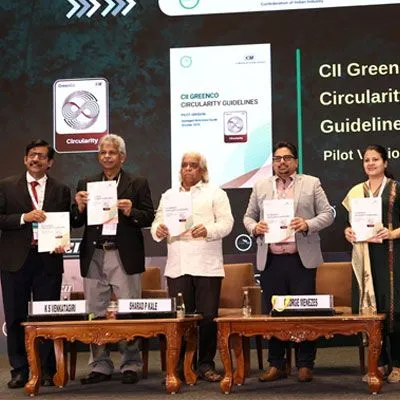
The Confederation of Indian Industry (CII) GreenCo Council has launched the CII GreenCo Circularity Guidelines – Pilot Version at the 17th CII GreenCo Waste & Resource Management Summit 2026 in Chennai. The initiative aims to strengthen resource efficiency, waste reduction and circular economy practices across Indian manufacturing and process industries.The guidelines introduce a structured framework with circularity indices covering raw materials, consumables, packaging and other resource inputs. These indicators will help industries assess existing practices, identify opportunities to ..

Next Story
Infrastructure Energy

Global Electronics Association Launches IPC-1783-CO2E Standard

The Global Electronics Association has introduced IPC-1783-CO2E, a new international standard aimed at improving consistency, transparency and comparability in product carbon footprint reporting across the electronics manufacturing industry.The standard, titled International Standard for Data Collection and Reporting of CO2 Equivalent (CO2e) Emissions for the Electronics Manufacturing Supply Chain, provides industry-specific guidance for collecting, estimating and reporting carbon emissions data.With increasing regulatory requirements and customer expectations, electronics manufacturers face c..

Advertisement

Subscribe to Our Newsletter

Get daily newsletters around different themes from Construction world.

STAY CONNECTED

Advertisement

SPECIAL OFFER
QR Code