Oswal Pumps Reports Record FY26 Income and Profitability
ECONOMY & POLICY

Oswal Pumps Reports Record FY26 Income and Profitability

Oswal Pumps Limited reported record FY26 results as total income rose to Rs20,859 million (mn), up 45.6 per cent year on year, and profit after tax reached Rs3,763 mn with a PAT margin of 18.0 per cent. Fourth quarter total income was Rs5,167 mn, up 41.3 per cent, while full year EBITDA grew 26.7 per cent to Rs5,354 mn and diluted EPS was Rs34.73.

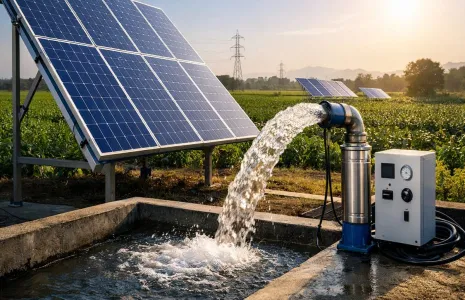
The company said growth was driven by execution under PM KUSUM and state schemes that reinforced its leadership in solar powered irrigation. Q4 EBITDA was Rs1,250 mn with a margin of 24.2 per cent and the sequential moderation in Q4 margins reflected competitive tender pricing and input cost pressures. Management is addressing these through value engineering and cost optimisation.

Operating cash flow improved from negative Rs1,421 mn in FY25 to negative Rs771 mn in FY26, and collections exceeding Rs1,164 mn received on two April 2026 shifted the full year operating cash flow to a positive Rs393 mn. Operating cash flow for Q4 FY26 was Rs1,706 mn, underlining improved working capital discipline and collections efficiency.

Order book stood at over 19,912 pumps and the near term pipeline exceeded 25,000 pumps. The company is tracking the anticipated rollout of PM KUSUM 2.0 and expects meaningful scaling in FY27. It has begun diversifying into rooftop, utility and commercial and industrial solar EPC and has a pipeline of 300 megawatt (MW).

With capacity expansions and a diversifying revenue mix, the company said it is positioned for further growth supported by ISO certifications and listing on the ministry approved list of models and manufacturers. A pan India distribution network and growing international footprint support its expansion across agricultural, residential and industrial markets.

Oswal Pumps Limited reported record FY26 results as total income rose to Rs20,859 million (mn), up 45.6 per cent year on year, and profit after tax reached Rs3,763 mn with a PAT margin of 18.0 per cent. Fourth quarter total income was Rs5,167 mn, up 41.3 per cent, while full year EBITDA grew 26.7 per cent to Rs5,354 mn and diluted EPS was Rs34.73. The company said growth was driven by execution under PM KUSUM and state schemes that reinforced its leadership in solar powered irrigation. Q4 EBITDA was Rs1,250 mn with a margin of 24.2 per cent and the sequential moderation in Q4 margins reflected competitive tender pricing and input cost pressures. Management is addressing these through value engineering and cost optimisation. Operating cash flow improved from negative Rs1,421 mn in FY25 to negative Rs771 mn in FY26, and collections exceeding Rs1,164 mn received on two April 2026 shifted the full year operating cash flow to a positive Rs393 mn. Operating cash flow for Q4 FY26 was Rs1,706 mn, underlining improved working capital discipline and collections efficiency. Order book stood at over 19,912 pumps and the near term pipeline exceeded 25,000 pumps. The company is tracking the anticipated rollout of PM KUSUM 2.0 and expects meaningful scaling in FY27. It has begun diversifying into rooftop, utility and commercial and industrial solar EPC and has a pipeline of 300 megawatt (MW). With capacity expansions and a diversifying revenue mix, the company said it is positioned for further growth supported by ISO certifications and listing on the ministry approved list of models and manufacturers. A pan India distribution network and growing international footprint support its expansion across agricultural, residential and industrial markets.

Next Story
Infrastructure Urban

Centre Clears Power Distribution Upgrade for Uttar Pradesh

The Central Government has approved power distribution projects worth Rs 407.39 billion for Uttar Pradesh under the Revamped Distribution Sector Scheme (RDSS). The investment will be used to modernise the state's electricity distribution infrastructure and strengthen network capacity across urban and rural areas. The package targets one of the country's largest distribution networks as the state experiences rapid urbanisation and rising electricity consumption. Planned interventions include the strengthening of distribution lines, modernisation of substations, replacement of ageing electrical ..

Next Story
Infrastructure Energy

India Data Centres To Consume 191 TWh By 2040 Driving Renewables

A Wood Mackenzie report says India's operational data centre capacity is projected to increase more than fivefold to 12 gigawatt (GW) by 2030 from 2.2 GW in 2025 as artificial intelligence (AI) and cloud computing drive demand. It projects electricity consumption to rise from 10 terawatt-hour (TWh) in 2025 to 191 TWh by 2040. The study forecasts a compound annual growth rate of around 40 per cent and notes AI-dedicated capacity will surge nearly 24-fold from 275 megawatt (MW) in 2025 to 6,546 MW by 2030. The report places India's digital economy at Rs 32 trillion (tn) in 2025 and says it contr..

Next Story
Infrastructure Transport

Hydrogen Train Completes 1,200 Kilometres Of Trials

India's first hydrogen train was flagged off between Jind and Sonipat on July 17 and has travelled over 1,200 kilometres in trials, saving diesel consumption of more than 3,200 litres, a Railway Ministry press release said. The deployment marks the introduction of a zero-emission fuel cell train into route testing and represents a milestone in domestic rail innovation. The train generates electricity onboard through a chemical reaction between hydrogen and oxygen, producing electricity to propel the vehicle while emitting only water vapour as a by-product. There is no smoke and no tailpipe car..

Advertisement

Subscribe to Our Newsletter

Get daily newsletters around different themes from Construction world.

STAY CONNECTED

Advertisement

Advertisement

Advertisement