Metro Expressways and Airports Drive Delhi-NCR Property Values
ECONOMY & POLICY

Metro Expressways and Airports Drive Delhi-NCR Property Values

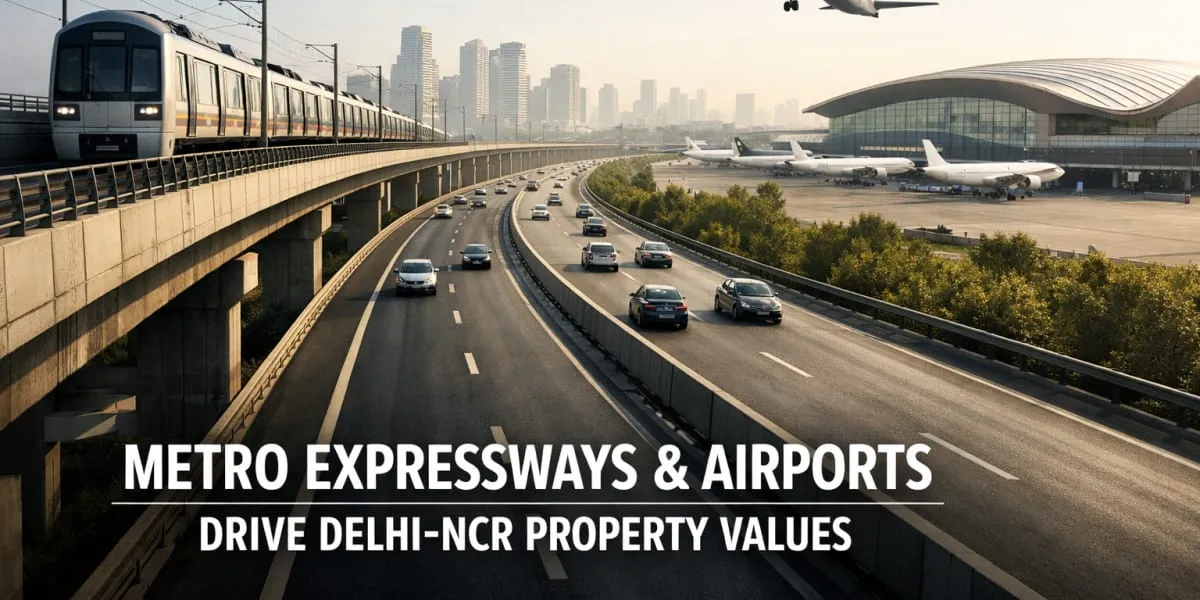
Connectivity is now the primary determinant of real estate value across the Delhi-NCR region, with buyers prioritising time, predictability and ease of movement over pure location. This structural reset has flipped the traditional sequence in which infrastructure followed demand, so that connectivity now arrives first and triggers pricing momentum and faster project absorption. Transit-oriented development is therefore shaping micro-markets around mobility rather than legacy identity.

Metro and regional rail networks, notably the Delhi Metro and the Delhi–Meerut RRTS, are compressing travel time and supporting rising end-user demand and investor confidence. As a result, property prices in Ghaziabad have risen by 131 per cent in the last four years. The ease of commuting is transforming perceptions of distance and catalysing demand across previously peripheral corridors.

Expressway-led growth corridors such as the Dwarka Expressway, the Noida Expressway and the NH-24 Delhi–Meerut Expressway are further redefining value. Ultra-luxury homes priced above Rs 100 million (million (mn)) along the Dwarka Expressway recorded total sales of Rs 3,830 mn in 2024 and Rs 83.47 bn (billion (bn)) in 2025, a 2,079 per cent increase in one year, according to industry data. These shifts have attracted both end users and long-term investors.

Airports, including the upcoming Noida International Airport and the Indira Gandhi International Airport, act as long-term value multipliers by stimulating hospitality, logistics and premium residential investment. Knight Frank data show Ghaziabad contributed around 10 per cent of new project launches in NCR and nearly 16 per cent of total sales, with the NH-24 corridor playing a pivotal role. Market participants report that improved connectivity is changing buyer preferences towards wellness-oriented and community driven locations.

Connectivity is now the primary determinant of real estate value across the Delhi-NCR region, with buyers prioritising time, predictability and ease of movement over pure location. This structural reset has flipped the traditional sequence in which infrastructure followed demand, so that connectivity now arrives first and triggers pricing momentum and faster project absorption. Transit-oriented development is therefore shaping micro-markets around mobility rather than legacy identity. Metro and regional rail networks, notably the Delhi Metro and the Delhi–Meerut RRTS, are compressing travel time and supporting rising end-user demand and investor confidence. As a result, property prices in Ghaziabad have risen by 131 per cent in the last four years. The ease of commuting is transforming perceptions of distance and catalysing demand across previously peripheral corridors. Expressway-led growth corridors such as the Dwarka Expressway, the Noida Expressway and the NH-24 Delhi–Meerut Expressway are further redefining value. Ultra-luxury homes priced above Rs 100 million (million (mn)) along the Dwarka Expressway recorded total sales of Rs 3,830 mn in 2024 and Rs 83.47 bn (billion (bn)) in 2025, a 2,079 per cent increase in one year, according to industry data. These shifts have attracted both end users and long-term investors. Airports, including the upcoming Noida International Airport and the Indira Gandhi International Airport, act as long-term value multipliers by stimulating hospitality, logistics and premium residential investment. Knight Frank data show Ghaziabad contributed around 10 per cent of new project launches in NCR and nearly 16 per cent of total sales, with the NH-24 corridor playing a pivotal role. Market participants report that improved connectivity is changing buyer preferences towards wellness-oriented and community driven locations.

Related Stories

Gold Stories

Next Story
Products

Koemmerling opens Navi Mumbai experience centre

Koemmerling, a brand of the profine Group, has expanded its presence in the Mumbai metropolitan region with the opening of a new experience centre in Navi Mumbai and launched its Allure S46 minimal sliding door system for the Indian market.Located in CBD Belapur, the facility was inaugurated by Peter Mrosik, Owner and CEO, profine Group, along with Farid Khan, Chairman and Managing Director, profine India, and Kamal Bajaj, CEO, profine India.The company said the new centre will showcase its portfolio of uPVC and aluminium window and door systems to architects, developers and homeowners.The ina..

Next Story
Products

India's waterproofing market nears Rs 150 bn milestone

India's waterproofing industry is approaching a market size of Rs 150 billion and is expected to surpass the $2 billion milestone, according to speakers at the 2nd India International Waterproofers Conference & Expo 2026 organised by the Waterproofers Association of India (WAI) in New Delhi.The two-day event brought together more than 20 speakers, 55 international delegates and 53 exhibition booths, with discussions focusing on climate-resilient construction, advanced waterproofing technologies and international collaboration.Inaugurating the event, Durga Shanker Mishra, former Secretary, ..

Next Story
Real Estate

Dilip Buildcon Q1 FY27 Revenue at Rs 23.78 billion

Dilip Buildcon Limited reported consolidated revenue from operations of Rs 2,378 crore in Q1 FY27, along with EBITDA of Rs 429 crore and profit after tax of Rs 128 crore.Consolidated EBITDA margin stood at 18.1%, improving from 17.1% in Q4 FY26. On a standalone basis, revenue from operations was Rs 1,930 crore, EBITDA stood at Rs 199 crore and PAT was Rs 39 crore, with an EBITDA margin of 10.3%.The company’s order book stood at Rs 27,691 crore as of 30 June 2026, compared with Rs 28,830 crore as of 31 March 2026. Roads and highways accounted for 17.1% of the order book, irrigation and water ..

Advertisement

Subscribe to Our Newsletter

Get daily newsletters around different themes from Construction world.

STAY CONNECTED

Advertisement