Parliament Raises Concerns Over Mangrove Restoration Efforts
ECONOMY & POLICY

Parliament Raises Concerns Over Mangrove Restoration Efforts

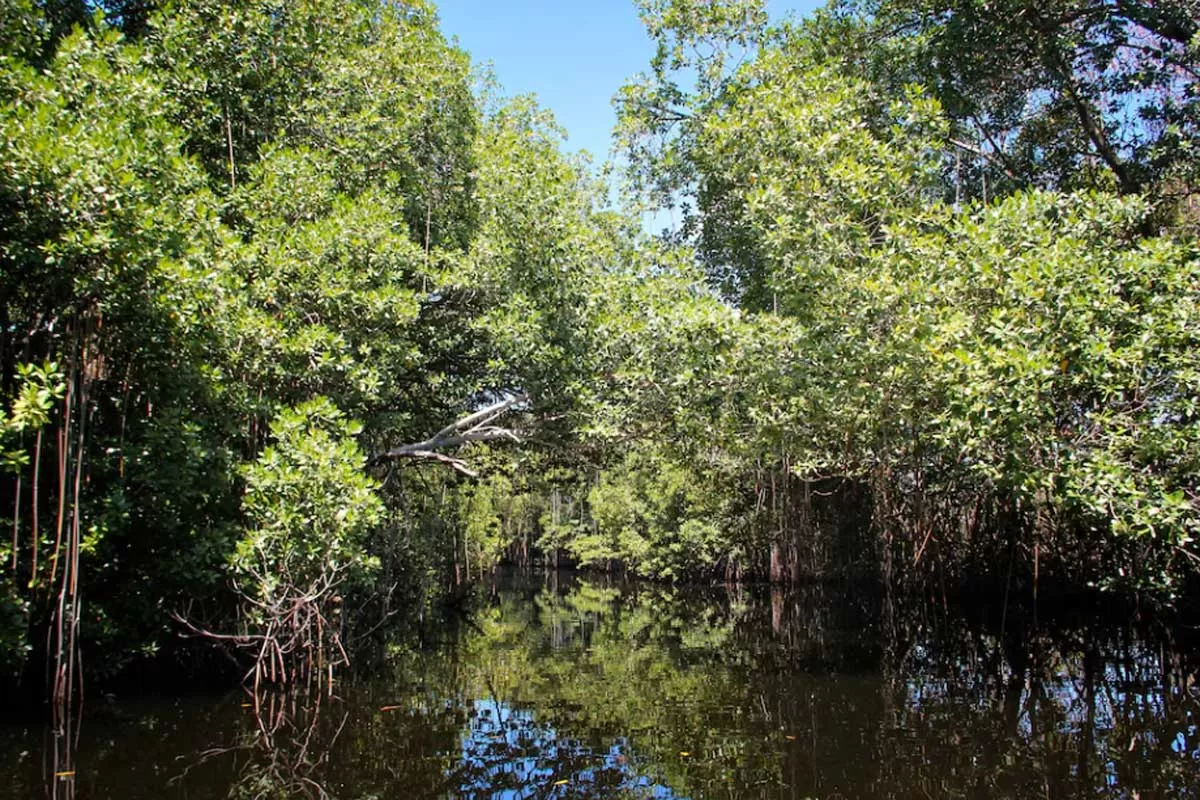
Mangrove forests in India are found along the coastline of 9 States and 4 Union Territories. Forest Survey of India (FSI), an organization mandated with forest survey under Ministry of Environment Forest and Climate Change (MoEFCC) publishes “India State of Forest Report” (ISFR) biennially.

As per recent ISFR 2023, India has a total Mangrove cover of 4,991.68 sq km; which is 0.15 per cent of the country’s total geographical areas. There has been net increase of 363.68 Sq km (7.86 per cent) in Mangrove cover area of the country in 2023 as compared to 2013 and net increase of 509.68 Sq.km (11.4 per cent) between 2001 and 2023.

The Government of India has implemented several regulatory and promotional measures to protect and enhance mangrove forests across coastal States and Union Territories.

Coastal Zone Regulation Notification of 2019 (CRZ) under The Environment (protection) Act, 1986 classifies Mangroves as Ecologically Sensitive Areas (ESAs) Very limited activities are allowed in these areas. Additionally, provision of a 50-meter buffer zone along mangroves is also specified as CRZ-IA in case the Mangrove cover is greater than 1,000 square meters. Activities permitted in Mangrove buffer is limited to laying of pipelines, transmission lines, conveyance systems or mechanisms and construction of road on stilts, etc. that are required for public utilities. In such instances, if any mangroves are likely to be affected during the developmental process, three times the number of mangroves lost must be replanted as per the provision of CRZ regulation.

The promotional measure includes ‘Mangrove Initiative for Shoreline Habitats & Tangible Incomes (MISHTI) programme, launched by Government of India with aim to comprehensively explore the possible area for development of Mangroves covering approximately 540 sq km spread across the coastline of India. The objective is to conserve and restore the Mangroves and organise awareness campaigns to educate coastal communities about the importance of Mangroves and their role in protecting the environment. Implementation of MISHTI is carried out by coastal State/UT governments, with financial support through convergence and gap funding from the National Compensatory Afforestation Fund Management and Planning Authority (CAMPA). For the financial year 2024-25, Rs 170.96 million has been allocated from CAMPA to Andhra Pradesh, Gujarat, Kerala, Odisha, West Bengal, and the Union Territory of Puducherry for treatment of 3836 ha of degraded Mangroves and restoration efforts.

‘Conservation and Management of Mangroves and Coral Reefs’ under National Coastal Mission scheme of the Ministry of Environment, Forest & Climate Change provides financial assistance to coastal States and Union Territories (UTs) for the conservation and management of 38 identified mangrove sites and four coral reef sites across nine coastal states and four UTs. Under this scheme, State governments submit proposals to seek financial support, which is provided in a 60:40 cost-sharing ratio between the Central Government and State Governments. An amount of Rs 80.58 million has been released as Central assistance to 7 Coastal States during period 2021 -23 under the scheme for conservation and management of Mangroves.

In addition, MoEFCC with support of three Coastal State (Andhra Pradesh, Maharashtra and Odisha) is implementing Green Climate Fund assisted Enhancing Coastal Resilience of Indian Coastal Community (GCF-ECRICC) project since 2019. The project has a target for restoration and conservation of 10,575 ha of Mangroves in the State of Andhra Pradesh, Maharashtra and Odisha and approximately 3114.29 ha has been achieved during 2019-2024

This information was provided by Union Minister Of State For Environment, Forest And Climate Change, Kirti Vardhan Singh, in a written reply to a question in Rajya Sabha today.

News source: PIB

Mangrove forests in India are found along the coastline of 9 States and 4 Union Territories. Forest Survey of India (FSI), an organization mandated with forest survey under Ministry of Environment Forest and Climate Change (MoEFCC) publishes “India State of Forest Report” (ISFR) biennially. As per recent ISFR 2023, India has a total Mangrove cover of 4,991.68 sq km; which is 0.15 per cent of the country’s total geographical areas. There has been net increase of 363.68 Sq km (7.86 per cent) in Mangrove cover area of the country in 2023 as compared to 2013 and net increase of 509.68 Sq.km (11.4 per cent) between 2001 and 2023. The Government of India has implemented several regulatory and promotional measures to protect and enhance mangrove forests across coastal States and Union Territories. Coastal Zone Regulation Notification of 2019 (CRZ) under The Environment (protection) Act, 1986 classifies Mangroves as Ecologically Sensitive Areas (ESAs) Very limited activities are allowed in these areas. Additionally, provision of a 50-meter buffer zone along mangroves is also specified as CRZ-IA in case the Mangrove cover is greater than 1,000 square meters. Activities permitted in Mangrove buffer is limited to laying of pipelines, transmission lines, conveyance systems or mechanisms and construction of road on stilts, etc. that are required for public utilities. In such instances, if any mangroves are likely to be affected during the developmental process, three times the number of mangroves lost must be replanted as per the provision of CRZ regulation. The promotional measure includes ‘Mangrove Initiative for Shoreline Habitats & Tangible Incomes (MISHTI) programme, launched by Government of India with aim to comprehensively explore the possible area for development of Mangroves covering approximately 540 sq km spread across the coastline of India. The objective is to conserve and restore the Mangroves and organise awareness campaigns to educate coastal communities about the importance of Mangroves and their role in protecting the environment. Implementation of MISHTI is carried out by coastal State/UT governments, with financial support through convergence and gap funding from the National Compensatory Afforestation Fund Management and Planning Authority (CAMPA). For the financial year 2024-25, Rs 170.96 million has been allocated from CAMPA to Andhra Pradesh, Gujarat, Kerala, Odisha, West Bengal, and the Union Territory of Puducherry for treatment of 3836 ha of degraded Mangroves and restoration efforts. ‘Conservation and Management of Mangroves and Coral Reefs’ under National Coastal Mission scheme of the Ministry of Environment, Forest & Climate Change provides financial assistance to coastal States and Union Territories (UTs) for the conservation and management of 38 identified mangrove sites and four coral reef sites across nine coastal states and four UTs. Under this scheme, State governments submit proposals to seek financial support, which is provided in a 60:40 cost-sharing ratio between the Central Government and State Governments. An amount of Rs 80.58 million has been released as Central assistance to 7 Coastal States during period 2021 -23 under the scheme for conservation and management of Mangroves. In addition, MoEFCC with support of three Coastal State (Andhra Pradesh, Maharashtra and Odisha) is implementing Green Climate Fund assisted Enhancing Coastal Resilience of Indian Coastal Community (GCF-ECRICC) project since 2019. The project has a target for restoration and conservation of 10,575 ha of Mangroves in the State of Andhra Pradesh, Maharashtra and Odisha and approximately 3114.29 ha has been achieved during 2019-2024 This information was provided by Union Minister Of State For Environment, Forest And Climate Change, Kirti Vardhan Singh, in a written reply to a question in Rajya Sabha today. News source: PIB

Next Story
Infrastructure Urban

Centre Clears Power Distribution Upgrade for Uttar Pradesh

The Central Government has approved power distribution projects worth Rs 407.39 billion for Uttar Pradesh under the Revamped Distribution Sector Scheme (RDSS). The investment will be used to modernise the state's electricity distribution infrastructure and strengthen network capacity across urban and rural areas. The package targets one of the country's largest distribution networks as the state experiences rapid urbanisation and rising electricity consumption. Planned interventions include the strengthening of distribution lines, modernisation of substations, replacement of ageing electrical ..

Next Story
Infrastructure Energy

India Data Centres To Consume 191 TWh By 2040 Driving Renewables

A Wood Mackenzie report says India's operational data centre capacity is projected to increase more than fivefold to 12 gigawatt (GW) by 2030 from 2.2 GW in 2025 as artificial intelligence (AI) and cloud computing drive demand. It projects electricity consumption to rise from 10 terawatt-hour (TWh) in 2025 to 191 TWh by 2040. The study forecasts a compound annual growth rate of around 40 per cent and notes AI-dedicated capacity will surge nearly 24-fold from 275 megawatt (MW) in 2025 to 6,546 MW by 2030. The report places India's digital economy at Rs 32 trillion (tn) in 2025 and says it contr..

Next Story
Infrastructure Transport

Hydrogen Train Completes 1,200 Kilometres Of Trials

India's first hydrogen train was flagged off between Jind and Sonipat on July 17 and has travelled over 1,200 kilometres in trials, saving diesel consumption of more than 3,200 litres, a Railway Ministry press release said. The deployment marks the introduction of a zero-emission fuel cell train into route testing and represents a milestone in domestic rail innovation. The train generates electricity onboard through a chemical reaction between hydrogen and oxygen, producing electricity to propel the vehicle while emitting only water vapour as a by-product. There is no smoke and no tailpipe car..

Advertisement

Subscribe to Our Newsletter

Get daily newsletters around different themes from Construction world.

STAY CONNECTED

Advertisement

Advertisement

Advertisement