PDUNASS Holds Workshop On Corporate Insolvency Resolution
ECONOMY & POLICY

PDUNASS Holds Workshop On Corporate Insolvency Resolution

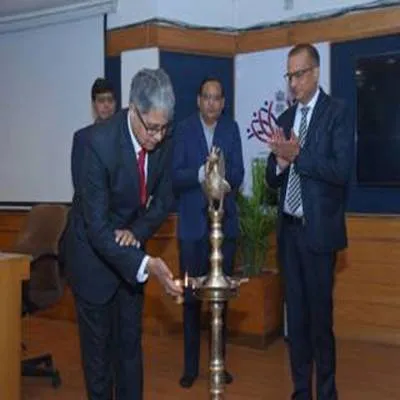
The Pandit Deendayal Upadhyaya National Academy of Social Security (PDUNASS) held a half-day workshop on the Corporate Insolvency Resolution Process under the Insolvency and Bankruptcy Code, 2016 for members of the Central Board of Trustees (CBT), the Investment Committee of the CBT and officers of the Employees' Provident Fund Organisation (EPFO). The workshop aimed to enhance institutional understanding of insolvency resolution and the legal and administrative issues relevant to EPFO. The event formed part of ongoing capacity building for statutory organisations.

The Central Provident Fund Commissioner (CPFC) Ramesh Krishnamurthi and the Financial Adviser and Chief Accounts Officer Roli Shukla Malge participated virtually, while Kumar Rohit, Director of PDUNASS, and M. M. Ashraf, Additional Central Provident Fund Commissioner, attended in person. Members of the CBT, Investment Committee members, officers from the EPFO head office and PDUNASS staff also took part. The participation reflected an emphasis on engaging senior decision makers.

The CPFC highlighted the importance of a clear and informed grasp of the insolvency resolution framework for statutory organisations and noted that timely and well informed decisions are essential to safeguard subscriber interests and ensure compliance with evolving law. The PDUNASS Director set out the usefulness of workshops in building clarity, confidence and contextual understanding among EPFO leadership. Presentations were followed by deliberations to assess practical implications for trustees and administrators.

Focused sessions covered insolvency mechanisms, legal finality under the code, post resolution recovery, exceptions and administrative closure and enabled substantive knowledge exchange on complex insolvency related matters. The initiative reinforced PDUNASS's commitment to capacity building and to strengthening EPFO institutional preparedness in addressing legal and financial challenges under the Insolvency and Bankruptcy Code, 2016. PDUNASS, established in 1990, carries out training, research and consultancy in social security.

The Pandit Deendayal Upadhyaya National Academy of Social Security (PDUNASS) held a half-day workshop on the Corporate Insolvency Resolution Process under the Insolvency and Bankruptcy Code, 2016 for members of the Central Board of Trustees (CBT), the Investment Committee of the CBT and officers of the Employees' Provident Fund Organisation (EPFO). The workshop aimed to enhance institutional understanding of insolvency resolution and the legal and administrative issues relevant to EPFO. The event formed part of ongoing capacity building for statutory organisations. The Central Provident Fund Commissioner (CPFC) Ramesh Krishnamurthi and the Financial Adviser and Chief Accounts Officer Roli Shukla Malge participated virtually, while Kumar Rohit, Director of PDUNASS, and M. M. Ashraf, Additional Central Provident Fund Commissioner, attended in person. Members of the CBT, Investment Committee members, officers from the EPFO head office and PDUNASS staff also took part. The participation reflected an emphasis on engaging senior decision makers. The CPFC highlighted the importance of a clear and informed grasp of the insolvency resolution framework for statutory organisations and noted that timely and well informed decisions are essential to safeguard subscriber interests and ensure compliance with evolving law. The PDUNASS Director set out the usefulness of workshops in building clarity, confidence and contextual understanding among EPFO leadership. Presentations were followed by deliberations to assess practical implications for trustees and administrators. Focused sessions covered insolvency mechanisms, legal finality under the code, post resolution recovery, exceptions and administrative closure and enabled substantive knowledge exchange on complex insolvency related matters. The initiative reinforced PDUNASS's commitment to capacity building and to strengthening EPFO institutional preparedness in addressing legal and financial challenges under the Insolvency and Bankruptcy Code, 2016. PDUNASS, established in 1990, carries out training, research and consultancy in social security.

Next Story
Technology

Twin Tracks

Digital-twin adoption in India’s rail sector is gradually making its presence felt across asset management, infrastructure planning, predictive maintenance, construction monitoring and operator training.While large-scale deployments of digital twins are still evolving, Nipun Dumpala, a Senior Technical Lead specialising in digital twins, synthetic data, simulation and mixed reality technologies, points out that several organisations are exploring BIM-integrated digital twins, IoT-enabled monitoring, AI-based analytics and simulation platforms to improve operational efficiency and reduce life..

Next Story
Infrastructure Urban

Centre Clears Power Distribution Upgrade for Uttar Pradesh

The Central Government has approved power distribution projects worth Rs 407.39 billion for Uttar Pradesh under the Revamped Distribution Sector Scheme (RDSS). The investment will be used to modernise the state's electricity distribution infrastructure and strengthen network capacity across urban and rural areas. The package targets one of the country's largest distribution networks as the state experiences rapid urbanisation and rising electricity consumption. Planned interventions include the strengthening of distribution lines, modernisation of substations, replacement of ageing electrical ..

Next Story
Infrastructure Energy

India Data Centres To Consume 191 TWh By 2040 Driving Renewables

A Wood Mackenzie report says India's operational data centre capacity is projected to increase more than fivefold to 12 gigawatt (GW) by 2030 from 2.2 GW in 2025 as artificial intelligence (AI) and cloud computing drive demand. It projects electricity consumption to rise from 10 terawatt-hour (TWh) in 2025 to 191 TWh by 2040. The study forecasts a compound annual growth rate of around 40 per cent and notes AI-dedicated capacity will surge nearly 24-fold from 275 megawatt (MW) in 2025 to 6,546 MW by 2030. The report places India's digital economy at Rs 32 trillion (tn) in 2025 and says it contr..

Advertisement

Subscribe to Our Newsletter

Get daily newsletters around different themes from Construction world.

STAY CONNECTED

Advertisement

Advertisement

Advertisement