+
PM Modi Launches Rs 1.22 Trillion Development Projects in Banswara
ECONOMY & POLICY

PM Modi Launches Rs 1.22 Trillion Development Projects in Banswara

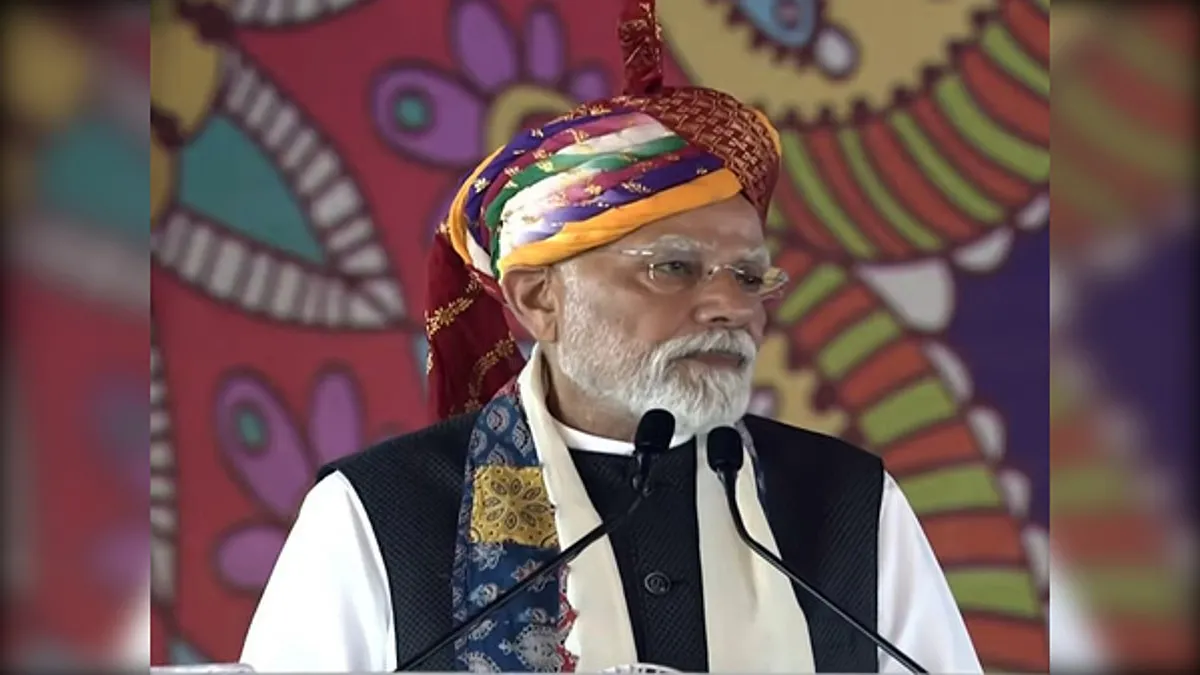
Prime Minister Shri Narendra Modi inaugurated and laid the foundation stone for development works worth over Rs 1.22 trillion in Banswara, Rajasthan, on the fourth day of Navratri. During his visit to the sacred land of Maa Tripura Sundari and Maa Mahi, the Prime Minister paid homage to the region’s spiritual heritage and highlighted the resilience of India’s tribal communities, inspired by the legacy of Mahayogi Govind Guru Ji.
Shri Modi emphasised energy generation as a national priority, announcing power projects exceeding Rs 900 billion across Rajasthan, Madhya Pradesh, Andhra Pradesh, Karnataka, and Maharashtra. In Rajasthan, he inaugurated solar energy initiatives, transmission lines, and the Rajasthan Atomic Power Project, underlining India’s focus on scaling clean energy from solar to nuclear power.
Highlighting past challenges, the Prime Minister noted that in 2014, 25 million households lacked electricity and 18,000 villages had no electric poles. His government ensured free electricity connections to these households, improved rural electrification, and facilitated industrial growth, transforming energy access nationwide.
Under the PM Surya Ghar Muft Bijli Yojana, solar panels are being installed on rooftops in urban and rural areas, providing free electricity for households. The PM-KUSUM scheme supports farmers with solar pumps, ensuring free electricity for agricultural operations, benefiting millions of farmers across India.
Shri Modi also announced additional projects worth Rs 300 billion in Rajasthan, focusing on water, electricity, and healthcare, alongside the flagging off of three new trains, including a Vande Bharat service. As part of employment initiatives, 15,000 youth in Rajasthan received government job appointments on the same day.
Emphasising tribal welfare, the Prime Minister highlighted projects like the PM Janman Yojana, Dharti Aaba Janjatiya Gram Utkarsh Abhiyan, Eklavya Model Residential Schools, and the Van Dhan Yojana, benefiting over 50 million tribal citizens. These initiatives ensure tribal communities gain economic empowerment, forest rights, and market access for forest produce.
Shri Modi also outlined the benefits of GST reforms, citing reductions in taxes on daily essentials, footwear, motorcycles, and construction materials, delivering direct savings to citizens and households. He encouraged citizens to embrace the Swadeshi spirit, purchasing domestically made goods to support local artisans, workers, and traders, thereby contributing to national development.
The event was attended by the Governor of Rajasthan Shri Haribhau Kisanrao Bagade, Chief Minister Shri Bhajanlal Sharma, Union Minister Shri Pralhad Joshi, and other dignitaries.

Prime Minister Shri Narendra Modi inaugurated and laid the foundation stone for development works worth over Rs 1.22 trillion in Banswara, Rajasthan, on the fourth day of Navratri. During his visit to the sacred land of Maa Tripura Sundari and Maa Mahi, the Prime Minister paid homage to the region’s spiritual heritage and highlighted the resilience of India’s tribal communities, inspired by the legacy of Mahayogi Govind Guru Ji.Shri Modi emphasised energy generation as a national priority, announcing power projects exceeding Rs 900 billion across Rajasthan, Madhya Pradesh, Andhra Pradesh, Karnataka, and Maharashtra. In Rajasthan, he inaugurated solar energy initiatives, transmission lines, and the Rajasthan Atomic Power Project, underlining India’s focus on scaling clean energy from solar to nuclear power.Highlighting past challenges, the Prime Minister noted that in 2014, 25 million households lacked electricity and 18,000 villages had no electric poles. His government ensured free electricity connections to these households, improved rural electrification, and facilitated industrial growth, transforming energy access nationwide.Under the PM Surya Ghar Muft Bijli Yojana, solar panels are being installed on rooftops in urban and rural areas, providing free electricity for households. The PM-KUSUM scheme supports farmers with solar pumps, ensuring free electricity for agricultural operations, benefiting millions of farmers across India.Shri Modi also announced additional projects worth Rs 300 billion in Rajasthan, focusing on water, electricity, and healthcare, alongside the flagging off of three new trains, including a Vande Bharat service. As part of employment initiatives, 15,000 youth in Rajasthan received government job appointments on the same day.Emphasising tribal welfare, the Prime Minister highlighted projects like the PM Janman Yojana, Dharti Aaba Janjatiya Gram Utkarsh Abhiyan, Eklavya Model Residential Schools, and the Van Dhan Yojana, benefiting over 50 million tribal citizens. These initiatives ensure tribal communities gain economic empowerment, forest rights, and market access for forest produce.Shri Modi also outlined the benefits of GST reforms, citing reductions in taxes on daily essentials, footwear, motorcycles, and construction materials, delivering direct savings to citizens and households. He encouraged citizens to embrace the Swadeshi spirit, purchasing domestically made goods to support local artisans, workers, and traders, thereby contributing to national development.The event was attended by the Governor of Rajasthan Shri Haribhau Kisanrao Bagade, Chief Minister Shri Bhajanlal Sharma, Union Minister Shri Pralhad Joshi, and other dignitaries.

Next Story
Infrastructure Transport

Lucknow Metro East-West Corridor Consultancy Contract Awarded

The Uttar Pradesh Metro Rail Corporation has awarded the first construction-related consultancy contract for the Lucknow Metro East West Corridor to a joint venture of AYESA Ingenieria Arquitectura SAU and AYESA India Pvt Ltd. The firm was declared the lowest bidder for the Detailed Design Consultant contract for Lucknow Metro Line-2 under Phase 1B and the contract was recommended following the financial bid. The contract is valued at Rs 159.0 million (mn), covering design services for the corridor. Lucknow Metro Line-2 envisages the construction of an 11.165 kilometre corridor connecting Cha..

Next Story
Infrastructure Urban

Div Com Kashmir Urges Fast Tracking Of Jhelum Water Transport Project

The Divisional Commissioner of Kashmir has called for the fast-tracking of the Jhelum water transport project, urging district administrations and relevant agencies to accelerate planning and clearances. In a meeting convened at the divisional headquarters, the commissioner instructed officials from irrigation, public health engineering and municipal departments to prioritise the project and coordinate survey and design work. The directive emphasised removal of administrative bottlenecks and close monitoring to ensure timely mobilisation of resources and contractors. Officials were told to in..

Next Story
Infrastructure Urban

Interarch Reports Strong Q3 And Nine Month Results

Interarch Building Solutions Limited reported unaudited results for the third quarter and nine months ended 31 December 2025, recording strong revenue growth driven by execution and a robust order book. Net revenue for the third quarter rose by 43.7 per cent to Rs 5.225 billion (bn), compared with Rs 3.636 bn a year earlier, reflecting heightened demand in pre-engineered building projects. The company’s total order book as at 31 January 2026 stood at Rs 16.85 bn, supporting near-term visibility. EBITDA excluding other income for the quarter increased by 43.2 per cent to Rs 503 million (mn),..

Advertisement

Subscribe to Our Newsletter

Get daily newsletters around different themes from Construction world.

STAY CONNECTED

Advertisement

Advertisement

Advertisement

Open In App