


Rajnath Singh Calls For Self-Reliance In Defence Technology
DEFENSE

Rajnath Singh Calls For Self-Reliance In Defence Technology

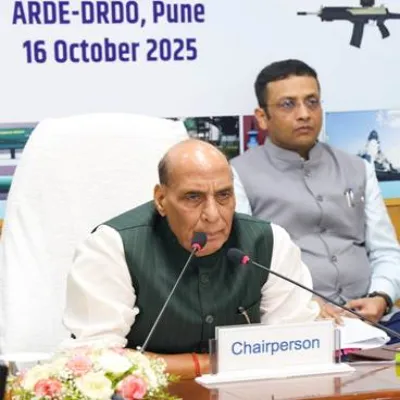
The Consultative Committee for the Ministry of Defence, chaired by Raksha Mantri Rajnath Singh, visited the Armament Research & Development Establishment (ARDE) in Pune on 16 October 2025. ARDE, a premier Defence Research and Development Organisation (DRDO) laboratory under the Armament & Combat Engineering Systems (ACE) cluster, showcased several cutting-edge indigenous technologies and weapons systems.

During the visit, the committee reviewed advanced defence products developed by various DRDO laboratories, including the Advanced Towed Artillery Gun System, PINAKA Rocket System, Light Tank ‘Zorawar’, Wheeled Armoured Platform, and the AKASH–New Generation Missile. They were also briefed on emerging technologies in Robotics, Rail Gun systems, Electromagnetic Aircraft Launch Systems, and High-Energy Propulsion Materials.

A detailed future roadmap for the ACE cluster was presented, outlining strategic plans for technological development and self-reliance.

Addressing the meeting on ‘Emerging Technologies and DRDO’, Rajnath Singh emphasised the urgent need to adapt to the transforming nature of warfare and integrate cutting-edge technologies into India’s defence strategy. “Today is an era of technological dominance. The nation that prioritises science and innovation will lead the future,” he stated, reaffirming the government’s vision to make India a global hub for defence innovation.

He underlined that Aatmanirbharta (self-reliance) in defence is not merely a policy objective but a strategic necessity. “We must not only use technology but also create it. Self-reliance in defence is the strongest shield for national security,” he asserted.

The Defence Minister noted that under Prime Minister Narendra Modi’s leadership, India has made significant progress towards reducing dependence on imported technologies. “Some nations withhold or restrict disruptive technologies for strategic reasons. India has challenged these barriers by proving that with clear intent and policies, we can achieve self-reliance in any sector,” he said.

Rajnath Singh commended DRDO for its breakthroughs in indigenously developing technologies that were earlier imported, and for pioneering advancements in futuristic domains. He highlighted that a collaborative ecosystem involving industry, academia, start-ups, and public sector enterprises is now driving national R&D efforts.

“Together, DRDO, start-ups, and private industry are setting new benchmarks in defence innovation. Our youth are making rapid progress in artificial intelligence, cyber security, robotics, quantum communication, and space technology. These emerging technologies not only modernise our armed forces but also open new economic opportunities,” he remarked.

Members of the Consultative Committee lauded the achievements of the ACE cluster and offered policy suggestions to accelerate technological progress. Rajnath Singh assured them that their recommendations would receive due consideration.

The meeting was attended by Raksha Rajya Mantri Sanjay Seth, Chief of Defence Staff General Anil Chauhan, Defence Secretary Rajesh Kumar Singh, Secretary (Defence Production) Sanjeev Kumar, DRDO Chairman Dr Samir V. Kamat, and other senior officials and scientists from the Ministry of Defence.

The Consultative Committee for the Ministry of Defence, chaired by Raksha Mantri Rajnath Singh, visited the Armament Research & Development Establishment (ARDE) in Pune on 16 October 2025. ARDE, a premier Defence Research and Development Organisation (DRDO) laboratory under the Armament & Combat Engineering Systems (ACE) cluster, showcased several cutting-edge indigenous technologies and weapons systems. During the visit, the committee reviewed advanced defence products developed by various DRDO laboratories, including the Advanced Towed Artillery Gun System, PINAKA Rocket System, Light Tank ‘Zorawar’, Wheeled Armoured Platform, and the AKASH–New Generation Missile. They were also briefed on emerging technologies in Robotics, Rail Gun systems, Electromagnetic Aircraft Launch Systems, and High-Energy Propulsion Materials. A detailed future roadmap for the ACE cluster was presented, outlining strategic plans for technological development and self-reliance. Addressing the meeting on ‘Emerging Technologies and DRDO’, Rajnath Singh emphasised the urgent need to adapt to the transforming nature of warfare and integrate cutting-edge technologies into India’s defence strategy. “Today is an era of technological dominance. The nation that prioritises science and innovation will lead the future,” he stated, reaffirming the government’s vision to make India a global hub for defence innovation. He underlined that Aatmanirbharta (self-reliance) in defence is not merely a policy objective but a strategic necessity. “We must not only use technology but also create it. Self-reliance in defence is the strongest shield for national security,” he asserted. The Defence Minister noted that under Prime Minister Narendra Modi’s leadership, India has made significant progress towards reducing dependence on imported technologies. “Some nations withhold or restrict disruptive technologies for strategic reasons. India has challenged these barriers by proving that with clear intent and policies, we can achieve self-reliance in any sector,” he said. Rajnath Singh commended DRDO for its breakthroughs in indigenously developing technologies that were earlier imported, and for pioneering advancements in futuristic domains. He highlighted that a collaborative ecosystem involving industry, academia, start-ups, and public sector enterprises is now driving national R&D efforts. “Together, DRDO, start-ups, and private industry are setting new benchmarks in defence innovation. Our youth are making rapid progress in artificial intelligence, cyber security, robotics, quantum communication, and space technology. These emerging technologies not only modernise our armed forces but also open new economic opportunities,” he remarked. Members of the Consultative Committee lauded the achievements of the ACE cluster and offered policy suggestions to accelerate technological progress. Rajnath Singh assured them that their recommendations would receive due consideration. The meeting was attended by Raksha Rajya Mantri Sanjay Seth, Chief of Defence Staff General Anil Chauhan, Defence Secretary Rajesh Kumar Singh, Secretary (Defence Production) Sanjeev Kumar, DRDO Chairman Dr Samir V. Kamat, and other senior officials and scientists from the Ministry of Defence.

Next Story
Infrastructure Energy

Vedanta Aluminium Uses 1.57 bn Units of Green Energy in FY25

Vedanta Aluminium, India’s largest aluminium producer, recently reported consumption of 1.57 billion units of renewable energy in FY25, marking a significant milestone in its 2030 decarbonisation roadmap. The company also achieved an 8.96 per cent reduction in greenhouse gas (GHG) emissions intensity compared to FY21, reinforcing its leadership in India’s low-carbon manufacturing transition. During FY25, Vedanta Aluminium expanded its renewable energy portfolio through long-term power purchase agreements, strengthening its strategy to source nearly 1,500 MW of renewable power over the lon..

Next Story
Real Estate

Oberoi Group to Develop Luxury Resort at Makaibari Tea Estate

EIH Limited, the flagship company of The Oberoi Group, has announced the signing of a management agreement to develop an Oberoi luxury resort at the iconic Makaibari Tea Estate in Darjeeling. The project marks a key milestone in the Group’s long-term strategy of creating distinctive hospitality experiences in rare and environmentally significant locations. Established in 1859, Makaibari is one of the world’s oldest tea estates and is globally recognised for its Himalayan landscape, primary forests and exceptional biodiversity. Spread across 1,236 acres, the estate houses one of the world..

Next Story
Real Estate

GHV Infra Secures Rs 1.09 Bn EPC Order in Jamshedpur

GHV Infra Projects Ltd, a fast-growing EPC company in India’s infrastructure and construction sector, has recently secured a Rs 1.09 billion work order in Jamshedpur, Jharkhand. Awarded by a reputed group entity, the contract covers end-to-end civil construction, mechanical, electrical and plumbing (MEP) systems, along with high-quality finishing works for a large building development. The project will be executed over a 30-month period, with defined benchmarks for quality, safety and timely delivery. The order strengthens GHV Infra’s footprint in Jamshedpur, a key industrial hub known fo..

Advertisement

Subscribe to Our Newsletter

Get daily newsletters around different themes from Construction world.

STAY CONNECTED

Advertisement

Advertisement

Advertisement

Advertisement

Open In App