+
PM Surya Ghar and PM-KUSUM Expand Decentralised Solar Reach
ECONOMY & POLICY

PM Surya Ghar and PM-KUSUM Expand Decentralised Solar Reach

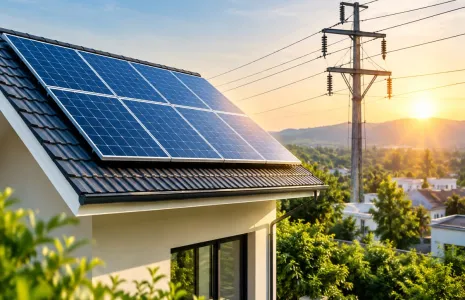
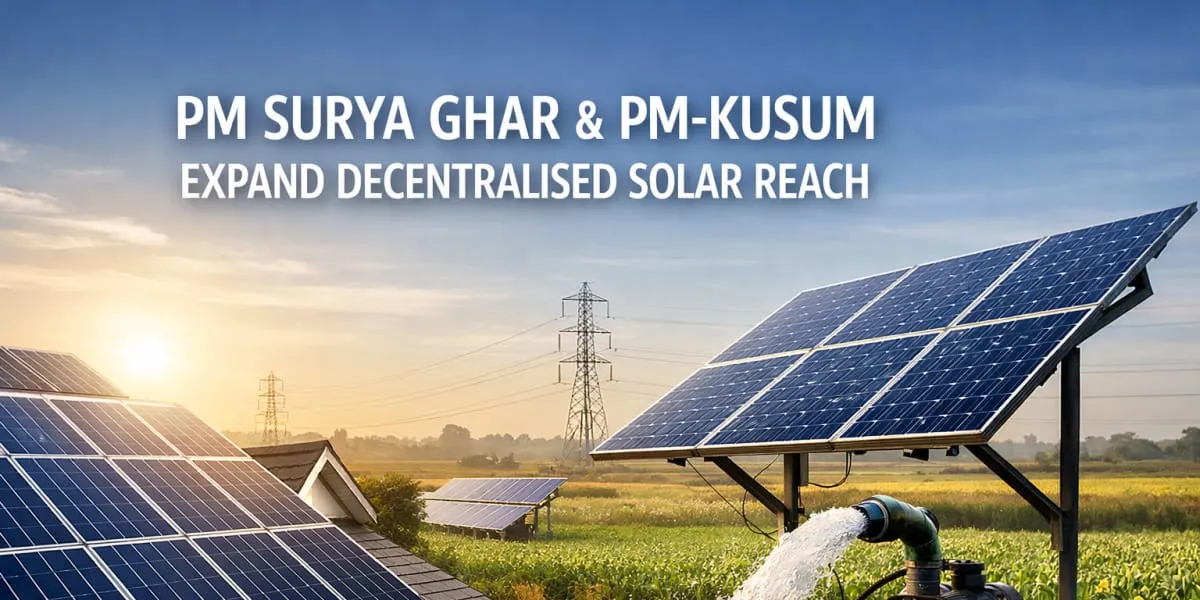
The government said more than five point one two seven million (mn) households have benefited under PM Surya Ghar: Muft Bijli Yojana and two point eight three nine million (mn) irrigation pumps have been solarised under PM-KUSUM, in a Lok Sabha reply. The Ministry of New and Renewable Energy said it is reviewing implementation with states, power distribution companies and banks and taking measures based on feedback to improve delivery. The schemes are demand driven, with PM Surya Ghar primarily benefiting individual households and PM-KUSUM primarily benefiting individual farmer families.

Since 2023-24 a total of 114,502 megawatt (MW) of renewable energy capacity has been added across the country up to July 31, 2026, including 68,765.72 MW of ground mounted solar, 21,864.62 MW of rooftop solar and 4,116.89 MW under off grid solar and PM-KUSUM. The ministry said these additions reflect both large scale and decentralised deployment and support the government objective of expanding renewable access. Higher central financial assistance has been provided for north eastern states, hilly states and Union Territories and island Union Territories, which have relatively low renewable potential.

State wise data showed Gujarat recorded the highest total renewable energy capacity addition at 31,184.32 MW, followed by Rajasthan at 27,524.79 MW and Maharashtra at 17,390.32 MW during the period. The Centre has released Rs 287.002 billion (bn) in financial assistance for PM Surya Ghar since 2023-24 up to August 10, 2026, with Maharashtra receiving Rs 51.7738 bn, Gujarat Rs 57.4387 bn and Uttar Pradesh Rs 48.9193 bn. Under PM-KUSUM Rs 108.508 bn was released during 2023-24 to July 31, 2026, with Maharashtra receiving Rs 59.2519 bn.

The ministry said it is promoting decentralised solar energy in regions with relatively low renewable energy potential, including Bihar and the Seemanchal region, so these areas can also benefit. Regular monitoring and regional review meetings will continue as part of efforts to improve implementation and expand the benefits of decentralised solar energy. Officials said the measures are intended to increase energy access and support farmer incomes while advancing national renewable targets.

The government said more than five point one two seven million (mn) households have benefited under PM Surya Ghar: Muft Bijli Yojana and two point eight three nine million (mn) irrigation pumps have been solarised under PM-KUSUM, in a Lok Sabha reply. The Ministry of New and Renewable Energy said it is reviewing implementation with states, power distribution companies and banks and taking measures based on feedback to improve delivery. The schemes are demand driven, with PM Surya Ghar primarily benefiting individual households and PM-KUSUM primarily benefiting individual farmer families. Since 2023-24 a total of 114,502 megawatt (MW) of renewable energy capacity has been added across the country up to July 31, 2026, including 68,765.72 MW of ground mounted solar, 21,864.62 MW of rooftop solar and 4,116.89 MW under off grid solar and PM-KUSUM. The ministry said these additions reflect both large scale and decentralised deployment and support the government objective of expanding renewable access. Higher central financial assistance has been provided for north eastern states, hilly states and Union Territories and island Union Territories, which have relatively low renewable potential. State wise data showed Gujarat recorded the highest total renewable energy capacity addition at 31,184.32 MW, followed by Rajasthan at 27,524.79 MW and Maharashtra at 17,390.32 MW during the period. The Centre has released Rs 287.002 billion (bn) in financial assistance for PM Surya Ghar since 2023-24 up to August 10, 2026, with Maharashtra receiving Rs 51.7738 bn, Gujarat Rs 57.4387 bn and Uttar Pradesh Rs 48.9193 bn. Under PM-KUSUM Rs 108.508 bn was released during 2023-24 to July 31, 2026, with Maharashtra receiving Rs 59.2519 bn. The ministry said it is promoting decentralised solar energy in regions with relatively low renewable energy potential, including Bihar and the Seemanchal region, so these areas can also benefit. Regular monitoring and regional review meetings will continue as part of efforts to improve implementation and expand the benefits of decentralised solar energy. Officials said the measures are intended to increase energy access and support farmer incomes while advancing national renewable targets.

Related Stories

Gold Stories

Next Story
Infrastructure Urban

TransIndia Launches World View Collection at Meridian

TransIndia Group has recently launched ‘The World View Collection’ at TransIndia Meridian, its residential development in Mumbai’s Sion-Matunga Corridor. The campaign introduces residences located on the 22nd floor and above, offering expansive views of the cityscape, Eastern Bay and the sea.The collection positions elevation as an integral part of the living experience, with the higher-floor homes designed around openness, changing skylines and wider city views. Rather than focusing only on floor height, the campaign highlights how elevated residences can offer a different perspective o..

Next Story
Real Estate

Villaro Design Studio Opens on MG Road in Delhi

Furniture designer Yuvraj Vohra has recently launched the new Villaro Design Studio on MG Road, Delhi, introducing a furniture brand built around an architectural approach to design, materiality and craftsmanship.Trained as an architect, Vohra approaches furniture as an integral part of the spatial experience rather than as standalone objects. Villaro's design philosophy focuses on proportion, material expression and the relationship between furniture and its surrounding architecture.The collection explores combinations of stone, marble, wood, metal and upholstery, with materials treated as st..

Next Story
Infrastructure Urban

India-Belgium Trade Shows Signs of Recovery in FY2026

India-Belgium economic relations are gaining renewed momentum following Belgian Prime Minister Bart De Wever’s three-day official visit to India from September 2–4, 2026. The visit, the first by a Belgian Prime Minister to India in two decades, focused on strengthening cooperation across trade, investment, defence, technology, connectivity and logistics.Belgium is an important European investment and trading partner for India, with cumulative foreign direct investment inflows of around $4.25 billion between April 2000 and March 2026. The country is a major European manufacturing, trade and..

Advertisement

Subscribe to Our Newsletter

Get daily newsletters around different themes from Construction world.

STAY CONNECTED

Advertisement

SPECIAL OFFER
QR Code