+
Policy Report and Toolkit Launched for Inclusive Voice Technology
ECONOMY & POLICY

Policy Report and Toolkit Launched for Inclusive Voice Technology

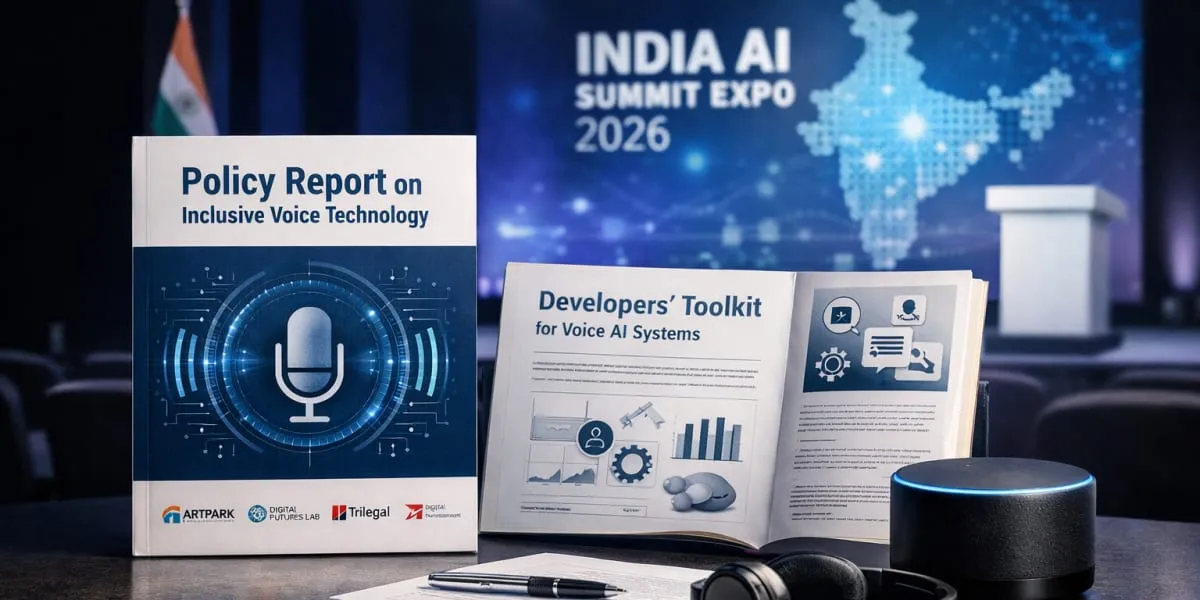
Government and partners launched a Policy Report and Developers' Toolkit on voice technologies at the India AI Summit Expo on 20 February 2026 to establish a framework for open, inclusive and responsible voice systems. The documents were jointly developed by ARTPARK at IISc, Digital Futures Lab and Trilegal with support from the Digital India BHASHINI Division and the FAIR Forward initiative implemented by GIZ and funded by the German Federal Ministry for Economic Cooperation and Development. The initiative brings together research, technical expertise and ecosystem collaboration to advance speech technologies that support digital inclusion.

The report frames voice technologies as a critical layer of digital public infrastructure in a linguistically diverse country, lowering barriers to public services, information and participation in the digital economy. It identifies barriers across data collection, model development, infrastructure and governance and proposes recommendations that include treating foundational speech datasets as digital public goods, improving openness and representativeness of models and investing in sustainable public infrastructure. The report also stresses embedding safeguards to prevent misuse while enabling innovation.

The Developers' Toolkit complements policy recommendations by setting out lifecycle approaches for developers working with Indian language datasets and voice applications, and it highlights structural gaps such as uneven data representation, weak quality assurance and fragmented evaluation practices. It outlines practical approaches adopted across the national ecosystem from product conceptualisation through deployment and recommends stronger evaluation frameworks, standards and technical toolkits to improve multilingual performance. The toolkit frames inclusion as a design principle to be operationalised throughout data collection, modelling and governance.

Partners described the resources as a roadmap to make voice a foundational layer of India's digital public infrastructure and to bridge language, literacy and digital divides at scale. The materials were curated through interactions with linguists, technical experts and AI ethicists and are intended to guide policymakers, developers and infrastructure providers in building interoperable, multilingual and responsible voice solutions. Continued collaborative efforts and sustained investment in skills, standards and public infrastructure are presented as necessary to realise a voice-first digital ecosystem.

Government and partners launched a Policy Report and Developers' Toolkit on voice technologies at the India AI Summit Expo on 20 February 2026 to establish a framework for open, inclusive and responsible voice systems. The documents were jointly developed by ARTPARK at IISc, Digital Futures Lab and Trilegal with support from the Digital India BHASHINI Division and the FAIR Forward initiative implemented by GIZ and funded by the German Federal Ministry for Economic Cooperation and Development. The initiative brings together research, technical expertise and ecosystem collaboration to advance speech technologies that support digital inclusion. The report frames voice technologies as a critical layer of digital public infrastructure in a linguistically diverse country, lowering barriers to public services, information and participation in the digital economy. It identifies barriers across data collection, model development, infrastructure and governance and proposes recommendations that include treating foundational speech datasets as digital public goods, improving openness and representativeness of models and investing in sustainable public infrastructure. The report also stresses embedding safeguards to prevent misuse while enabling innovation. The Developers' Toolkit complements policy recommendations by setting out lifecycle approaches for developers working with Indian language datasets and voice applications, and it highlights structural gaps such as uneven data representation, weak quality assurance and fragmented evaluation practices. It outlines practical approaches adopted across the national ecosystem from product conceptualisation through deployment and recommends stronger evaluation frameworks, standards and technical toolkits to improve multilingual performance. The toolkit frames inclusion as a design principle to be operationalised throughout data collection, modelling and governance. Partners described the resources as a roadmap to make voice a foundational layer of India's digital public infrastructure and to bridge language, literacy and digital divides at scale. The materials were curated through interactions with linguists, technical experts and AI ethicists and are intended to guide policymakers, developers and infrastructure providers in building interoperable, multilingual and responsible voice solutions. Continued collaborative efforts and sustained investment in skills, standards and public infrastructure are presented as necessary to realise a voice-first digital ecosystem.

Next Story
Equipment

Kabelschlepp India Installs Robotic VMC in Bengaluru

Kabelschlepp India, part of the Tsubaki Group, has installed a state-of-the-art Vertical Machining Center (VMC) integrated with robotic automation at its Bengaluru facility. The inauguration was held in the presence of Henning Preis, President & CEO, Kabelschlepp Group, Jörg Schulz, Vice President – Production, and Srinivas P. Kamisetty, Managing Director, Kabelschlepp India.The high-precision CNC VMC is designed for advanced milling, drilling, tapping and multi-axis machining. Equipped with a vertical spindle orientation, automatic tool changer and intelligent CNC control system, it en..

Next Story
Infrastructure Transport

Highway Delivery Reset!

Project delays and inefficiencies continue to bedevil the progress of India’s National Highways network. A multi-pronged reform agenda is needed to inject greater transparency and accountability at every stage – from planning and procurement to execution, maintenance and oversight. This article offers key recommendations and reform strategies that government stakeholders – from the Ministry of Road Transport & Highways (MoRTH) and the National Highways Authority of India (NHAI) to state agencies and oversight bodies – should pursue to put highway development on a better track.Decen..

Next Story
Infrastructure Transport

MSIDC Executes ₹37,000 Crore Road Programme

With Rs 37,000 crore worth of road projects under execution across Maharashtra, Maharashtra State Infrastructure Development Corporation (MSIDC) is driving one of the state’s largest infrastructure programmes. Dr Brijesh Dixit, Managing Director, discusses the institutional reforms, execution frameworks, financing strategies and technology adoption enabling timely, high-quality delivery, in conversation with PRATAP PADODE, Editor-in-Chief, CW.With over Rs 37,000 crore worth of road projects underway across districts – many under tight timelines – what institutional and executio..

Advertisement

Subscribe to Our Newsletter

Get daily newsletters around different themes from Construction world.

STAY CONNECTED

Advertisement

Advertisement

Advertisement

Open In App