Railways and Bengaluru Bodies Review Waste Management on Railway Land
ECONOMY & POLICY

Railways and Bengaluru Bodies Review Waste Management on Railway Land

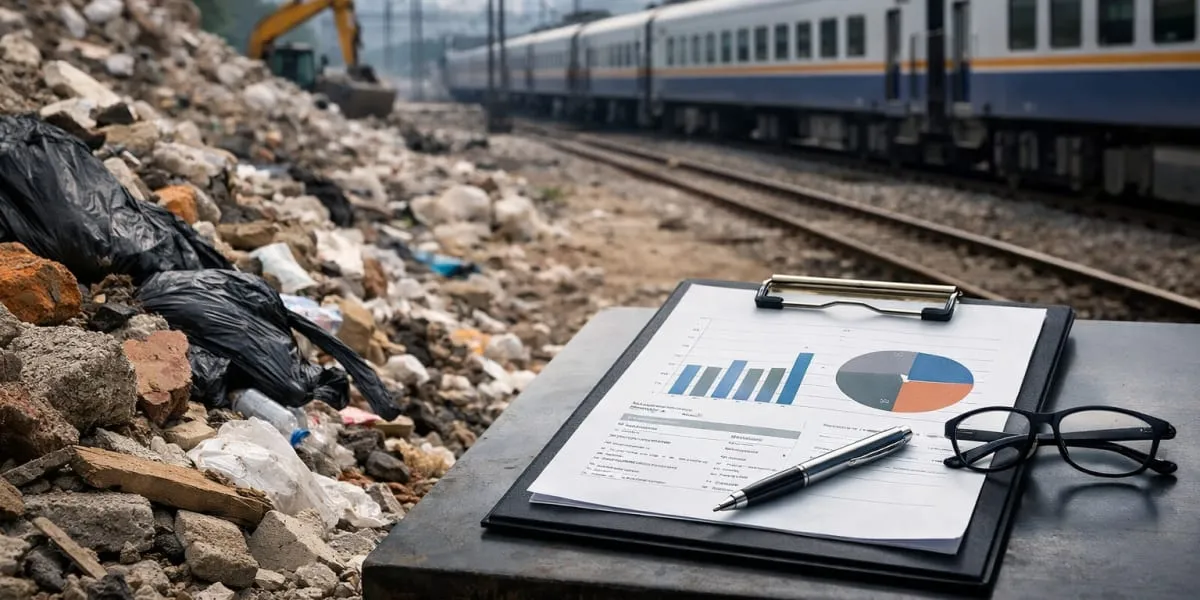
Union Minister of State for Railways V. Somanna and Bengaluru Development Minister Krishna Byre Gowda held a review meeting in Bengaluru on 25 July 2026 to examine solid waste management on railway land. The officials examined issues related to garbage disposal, the dumping of construction debris and the unauthorised disposal of waste on railway premises. The meeting brought together representatives of the Railways, the city municipal corporation and utilities to devise coordinated responses.

Mr Somanna directed railway officials to carry out systematic surveys to identify sites of unauthorised dumping and to prepare a comprehensive action plan for their rapid clearance with timelines and designated leads. He urged all concerned agencies, including the Bengaluru Water Supply and Sewerage Board (BWSSB), the Bengaluru Electricity Supply Company (BESCOM) and the city municipal corporation, to cooperate under a common coordination mechanism. The ministers emphasised the need for strict action and the imposition of penalties against those found dumping waste.

Operational measures discussed included mapping vulnerable stretches of railway land, scheduling debris removal operations and instituting regular inspections to deter repeat offences. Participants recommended clear signage, physical barriers where appropriate and the establishment of rapid response teams to clear fresh deposits and ensure safe disposal. The meeting also identified public awareness campaigns and engagement with local ward offices as necessary to prevent illegal dumping and to sustain cleanliness in urban corridors adjacent to tracks.

A timetable for joint action and periodic review was proposed so that progress can be monitored and responsibilities clearly assigned. The Railways agreed to lead the preparation of a detailed clean up plan and to coordinate with civic agencies for implementation and enforcement. Officials said that stronger interagency cooperation and visible enforcement would help protect railway property, improve urban sanitation and reduce hazards to passengers and staff and minimise environmental risks.

Union Minister of State for Railways V. Somanna and Bengaluru Development Minister Krishna Byre Gowda held a review meeting in Bengaluru on 25 July 2026 to examine solid waste management on railway land. The officials examined issues related to garbage disposal, the dumping of construction debris and the unauthorised disposal of waste on railway premises. The meeting brought together representatives of the Railways, the city municipal corporation and utilities to devise coordinated responses. Mr Somanna directed railway officials to carry out systematic surveys to identify sites of unauthorised dumping and to prepare a comprehensive action plan for their rapid clearance with timelines and designated leads. He urged all concerned agencies, including the Bengaluru Water Supply and Sewerage Board (BWSSB), the Bengaluru Electricity Supply Company (BESCOM) and the city municipal corporation, to cooperate under a common coordination mechanism. The ministers emphasised the need for strict action and the imposition of penalties against those found dumping waste. Operational measures discussed included mapping vulnerable stretches of railway land, scheduling debris removal operations and instituting regular inspections to deter repeat offences. Participants recommended clear signage, physical barriers where appropriate and the establishment of rapid response teams to clear fresh deposits and ensure safe disposal. The meeting also identified public awareness campaigns and engagement with local ward offices as necessary to prevent illegal dumping and to sustain cleanliness in urban corridors adjacent to tracks. A timetable for joint action and periodic review was proposed so that progress can be monitored and responsibilities clearly assigned. The Railways agreed to lead the preparation of a detailed clean up plan and to coordinate with civic agencies for implementation and enforcement. Officials said that stronger interagency cooperation and visible enforcement would help protect railway property, improve urban sanitation and reduce hazards to passengers and staff and minimise environmental risks.

Related Stories

Gold Stories

Next Story
Infrastructure Urban

KONE Opens India's First Digital Experience Centre in Pune

KONE, a global elevator and escalator manufacturer, has inaugurated its first Digital Experience Centre (DEC) in India, located in Pune. The facility aims to showcase how artificial intelligence (AI), connectivity and data-driven technologies can enhance customer experiences and improve building operations.The centre was inaugurated by Jussi Herlin, Executive Vice Chair, KONE Corporation; Philippe Delorme, President and CEO, KONE; and Nandan Nilekani, Co-founder and Chairman of the Board, Infosys.Designed as an interactive customer environment, the facility demonstrates digital solutions cover..

Next Story
Infrastructure Urban

CII GreenCo Launches Circularity Guidelines for Indian Industry

The Confederation of Indian Industry (CII) GreenCo Council has launched the CII GreenCo Circularity Guidelines – Pilot Version at the 17th CII GreenCo Waste & Resource Management Summit 2026 in Chennai. The initiative aims to strengthen resource efficiency, waste reduction and circular economy practices across Indian manufacturing and process industries.The guidelines introduce a structured framework with circularity indices covering raw materials, consumables, packaging and other resource inputs. These indicators will help industries assess existing practices, identify opportunities to ..

Next Story
Infrastructure Energy

Global Electronics Association Launches IPC-1783-CO2E Standard

The Global Electronics Association has introduced IPC-1783-CO2E, a new international standard aimed at improving consistency, transparency and comparability in product carbon footprint reporting across the electronics manufacturing industry.The standard, titled International Standard for Data Collection and Reporting of CO2 Equivalent (CO2e) Emissions for the Electronics Manufacturing Supply Chain, provides industry-specific guidance for collecting, estimating and reporting carbon emissions data.With increasing regulatory requirements and customer expectations, electronics manufacturers face c..

Advertisement

Subscribe to Our Newsletter

Get daily newsletters around different themes from Construction world.

STAY CONNECTED

Advertisement

SPECIAL OFFER
QR Code