Raksha Mantri Inaugurates Exercise MILAN in Visakhapatnam
ECONOMY & POLICY

Raksha Mantri Inaugurates Exercise MILAN in Visakhapatnam

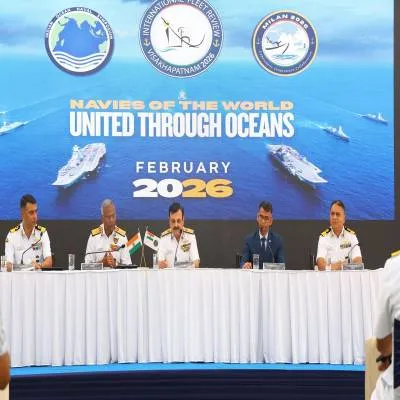
Raksha Mantri Rajnath Singh inaugurated Exercise MILAN in Visakhapatnam and urged the international community to address evolving maritime challenges through mutual respect and cooperation. He spoke to navy chiefs and heads of delegation from 74 countries at the opening ceremony on 19 February 2026, noting growth in international trade and contests over straits and channels alongside rising interest in underwater resources. He said threats such as piracy, maritime terrorism, illegal fishing, trafficking, cyber vulnerabilities and disruptions to critical supply chains coexist with traditional security concerns.

He said the United Nations Convention on the Law of the Sea (UNCLOS) provides a robust legal framework and that it could be strengthened by a comprehensive global naval architecture to facilitate information sharing, protect communications links and curb criminality at sea. He noted that climate change is intensifying natural disasters and increasing demand for humanitarian and disaster relief. He stressed that no single navy can tackle these interconnected challenges alone and called for enhanced cooperation.

He described MILAN 2026, with participation from 74 nations, as evidence of global confidence in India as a responsible maritime partner and said the exercise seeks to enhance interoperability, professional competence and mutual trust. He noted that India’s approach has evolved from Security and Growth for All in the Region (SAGAR) to Mutual and Holistic Advancement for Security And Growth Across Regions (MAHASAGAR), indicating deeper engagement with partners. He said India will continue to act as a trusted Vishwa-Mitra and contribute to joint surveillance, hydrographic assistance and multilateral patrols.

The Chief of the Naval Staff, Admiral Dinesh K Tripathi, described the event as a Maritime Mahakumbh and urged participating navies to deepen collective competence and resilience through manoeuvres, drills, exchanges and discussions. Organisers said the harbour phase will focus on professional interaction, seminars, subject matter expert exchanges, cultural activities and pre-sail planning, while the sea phase will feature coordinated maritime security operations, tactical manoeuvres and communication drills. MILAN 2026 was presented as reinforcing India’s role as a dependable partner and security provider in the Indian Ocean region and beyond.

Raksha Mantri Rajnath Singh inaugurated Exercise MILAN in Visakhapatnam and urged the international community to address evolving maritime challenges through mutual respect and cooperation. He spoke to navy chiefs and heads of delegation from 74 countries at the opening ceremony on 19 February 2026, noting growth in international trade and contests over straits and channels alongside rising interest in underwater resources. He said threats such as piracy, maritime terrorism, illegal fishing, trafficking, cyber vulnerabilities and disruptions to critical supply chains coexist with traditional security concerns. He said the United Nations Convention on the Law of the Sea (UNCLOS) provides a robust legal framework and that it could be strengthened by a comprehensive global naval architecture to facilitate information sharing, protect communications links and curb criminality at sea. He noted that climate change is intensifying natural disasters and increasing demand for humanitarian and disaster relief. He stressed that no single navy can tackle these interconnected challenges alone and called for enhanced cooperation. He described MILAN 2026, with participation from 74 nations, as evidence of global confidence in India as a responsible maritime partner and said the exercise seeks to enhance interoperability, professional competence and mutual trust. He noted that India’s approach has evolved from Security and Growth for All in the Region (SAGAR) to Mutual and Holistic Advancement for Security And Growth Across Regions (MAHASAGAR), indicating deeper engagement with partners. He said India will continue to act as a trusted Vishwa-Mitra and contribute to joint surveillance, hydrographic assistance and multilateral patrols. The Chief of the Naval Staff, Admiral Dinesh K Tripathi, described the event as a Maritime Mahakumbh and urged participating navies to deepen collective competence and resilience through manoeuvres, drills, exchanges and discussions. Organisers said the harbour phase will focus on professional interaction, seminars, subject matter expert exchanges, cultural activities and pre-sail planning, while the sea phase will feature coordinated maritime security operations, tactical manoeuvres and communication drills. MILAN 2026 was presented as reinforcing India’s role as a dependable partner and security provider in the Indian Ocean region and beyond.

Related Stories

Gold Stories

Next Story
Infrastructure Urban

KONE Opens India's First Digital Experience Centre in Pune

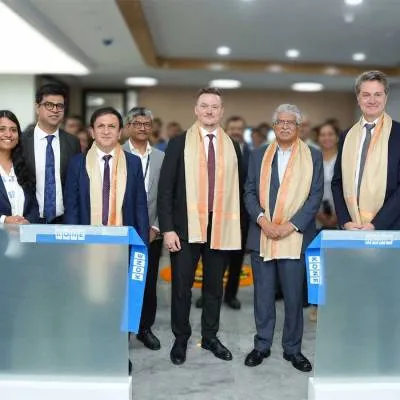
KONE, a global elevator and escalator manufacturer, has inaugurated its first Digital Experience Centre (DEC) in India, located in Pune. The facility aims to showcase how artificial intelligence (AI), connectivity and data-driven technologies can enhance customer experiences and improve building operations.The centre was inaugurated by Jussi Herlin, Executive Vice Chair, KONE Corporation; Philippe Delorme, President and CEO, KONE; and Nandan Nilekani, Co-founder and Chairman of the Board, Infosys.Designed as an interactive customer environment, the facility demonstrates digital solutions cover..

Next Story
Infrastructure Urban

CII GreenCo Launches Circularity Guidelines for Indian Industry

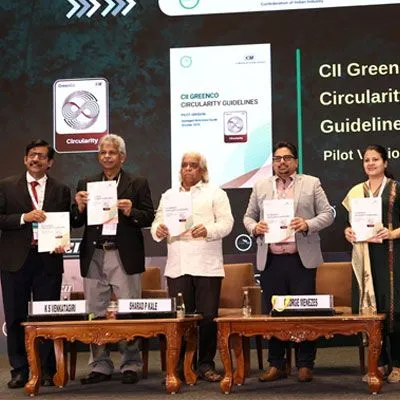
The Confederation of Indian Industry (CII) GreenCo Council has launched the CII GreenCo Circularity Guidelines – Pilot Version at the 17th CII GreenCo Waste & Resource Management Summit 2026 in Chennai. The initiative aims to strengthen resource efficiency, waste reduction and circular economy practices across Indian manufacturing and process industries.The guidelines introduce a structured framework with circularity indices covering raw materials, consumables, packaging and other resource inputs. These indicators will help industries assess existing practices, identify opportunities to ..

Next Story
Infrastructure Energy

Global Electronics Association Launches IPC-1783-CO2E Standard

The Global Electronics Association has introduced IPC-1783-CO2E, a new international standard aimed at improving consistency, transparency and comparability in product carbon footprint reporting across the electronics manufacturing industry.The standard, titled International Standard for Data Collection and Reporting of CO2 Equivalent (CO2e) Emissions for the Electronics Manufacturing Supply Chain, provides industry-specific guidance for collecting, estimating and reporting carbon emissions data.With increasing regulatory requirements and customer expectations, electronics manufacturers face c..

Advertisement

Subscribe to Our Newsletter

Get daily newsletters around different themes from Construction world.

STAY CONNECTED

Advertisement

SPECIAL OFFER
QR Code